Revue Starlight
a review by planetJane
a review by planetJane
This review extensively spoils the reviewed material. Familiarity is advised before reading further.

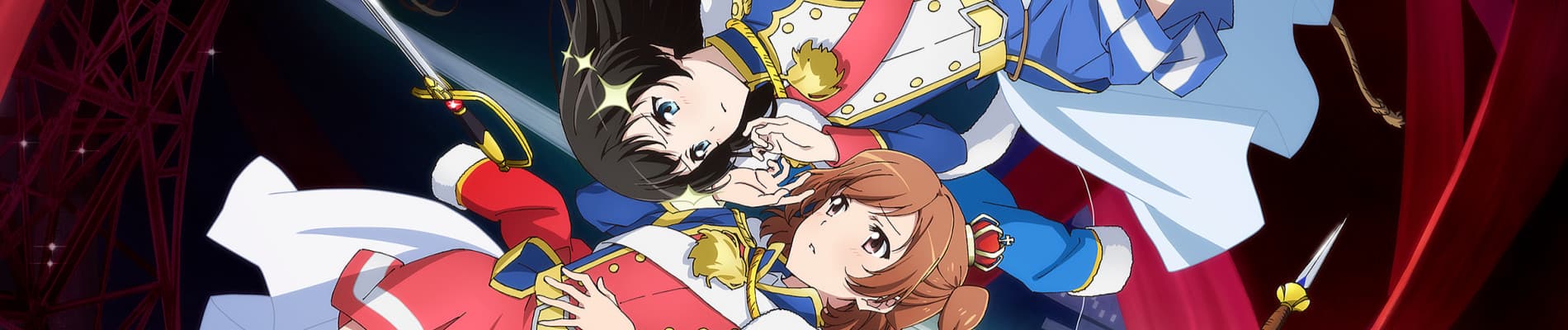
It’s breathtaking. You do not get that kind of knock-you-on-your-ass punch very often, not from anime and not from anything. It’s a pretty bold display of directoral prowess, and what is perhaps most amazing is that it’s director Tomohiro Furukawa’s first series at the helm. What is less surprising is that Furukawa has an impressive non-directorial resume, spanning everything from the whacked-out Mawaru Penguindrum to standard shonen fare like Bleach and Yu-Gi-Oh! ZeXal. Even as its impacted is ever so slightly lessened by its repetition in later episodes (is it really a magical girl transformation sequence if it’s not later used to save time?), it remains a striking image.
You could be forgiving for assuming that something like this simply must have sprung fully-formed from nowhere as a work of auteurship, that kind of narrative is still common, but the truth is that Revue Starlight the anime is only one facet of a surprisingly large franchise with roots in, in something likely quite foreign to western anime audiences, the country’s thriving live-action musical theatre scene. It’s sort of impossible then, to talk about Revue Starlight the anime without at least mentioning Revue Starlight the stage show, which it is an adaption of. To understand Revue, and developments over the rest of the series, you have to understand that first. It’s an intimidating proposition, Japanese theatre (specifically the Takarazuka Revue, whose academy the setting of Starlight is based on, and an alumnus of which is responsible for the Starlight stage play) has its own entirely separate fan culture and the scene itself dates back over a century, it’s a cultural wellspring that Utena director Kunihiko Ikuhara has drawn from, and given the aforementioned pedigree of this series’ director--Tomohiro Furukawa--it shouldn’t come as a surprise that it’s a heavy influence here too. Revue Starlight the anime revolves in part, itself, around the annual school production of an in-series play called simply Starlight. There’s a lot of theatre in here, for many viewers it is going to be their first window into this world.
Take this as an admission then that you’re not going to get the full story here--you simply can’t. It's perhaps unusual to "break" a review in this manner, but, to get the full breadth of the Takarazuka-inspired thematics behind Revue Starlight, I strongly recommend Swedish youtuber Andrea Ritsu's youtube videos on the subject. Do be aware, some of the episodes delve into rather heavy subject matter.

-Aijo Karen; the aforementioned protagonist. Plucky, childhood friends with Hikari who she made a promise to become a stage star with. Karen falls loosely within the storied “idiot hero” archetype, though she’s not nearly as dumb as you’d at first think. Utterly obsessed with the in-universe Starlight play.

-Kagura Hikari; Karen’s childhood friend. Transfer student, very mysterious, and for the first half of the series the character elaborated upon the least.

-Tsuyuzaki Mahiru; Karen’s roommate. A rural girl with a warm personality and an absolutely massive crush on Karen.

-Daiba “Banana” Nana; A motherly sort of girl who oversees the production of the Starlight play. She has an interesting secret, too.

-the class president, a studious sort who envies her more naturally-gifted classmates.

-Hanayagi Kaoruko; A haughty rich girl who has trouble doing much for herself. Dating Futaba.

-Isurugi Futaba; A rather butch motorcyclist who Kaoruko relies on heavily. Dating Kaoruko, also.

-Saijou Claudine; Half-Japanese Half-French ojou type, perpetually frustrated at always playing second fiddle to Maya.

-Tendo Maya; The ace of the 99th class. The Top Star-to-be by all reasonable metrics.

-Finally, there is The Giraffe; the mysterious arbiter of the underground revues, about whom rather little is known.
The first half of the show explores these characters in detail, as mentioned. Then, at the series’ halfway point, Episode 7 is very different, and it is here that the show begins to take a different turn.
After the first part of the episode--which finds the class performing their version of Starlight much to her delight, and graduating from their first year at the academy--Banana ends up at the underground stage, where she is confronted by the Giraffe and talked into auditioning.
 It’s also worth noting that this is easily the most heartless and sinister the underground revue looks up until this point.
She wins--easily, in fact--even trouncing Maya, who until now has been framed as untouchably above everyone else in the auditions. As the top star of the auditions, we learn that she is (effectively, though the series doesn’t put it in these words) entitled to a wish, and it is the wish she makes that effectively turns the series on its head. It’s the kind of shock moment that lent infamy to Madoka’s head chomp. Banana’s only wish is for her class to perform the play at the end of last year again. Her wish is granted, and she is sent back in time.
It’s almost too classic, but the execution is too good to not give it the credit it deserves. Banana has spent the entire series being built up as a rather passive, supporting character, to learn that that was deliberate on her part is a wrench to the gut. Moreover, we find out that the loop we’ve been watching is not the first, and the final moments of the episode allude to the idea of Hikari as some kind of disrupting agent, a girl Banana doesn’t actually recognize from how many dozens of times she’s locked herself in this circuit. It’s really hard to pull off this kind of complete 180 reframing of a character, to take Banana from being one of the show’s most likable characters to the closest thing among the class to an actual villain (no matter that this doesn’t last, that’s honestly just not the point) isn’t just gutsy, it’s risky, the kind of twist that poorly pulled-off could completely tank the show. Here, that it works so well is a testament to the strength of Revue’s writing.

But above all that, it ties the show’s thematics together nicely. The central struggle--for all of the girls at the academy--is to be the top star, but Revue seems to push us toward this idea being inherently flawed. The Giraffe speaks of an ultimate, blindingly brilliant stage that defies all expectation, and transcends into sublimeness. This is a struggle that ultimately pours out of Revue itself and indeed the entire medium altogether.
All of that, though, is just part of Revue’s general critique of the Takarazuka system and competition in art in general. Something we’ve not mentioned thus far is that Revue treats stage glow--”radiance” or “glimmer” as its variously rendered in subtitles, star power as it’s probably more commonly known--as a literal, supernatural force.
So a central question is raised then, if the Top Star system isn’t valid, what is? This struggle defines both Nana’s character arc, and, later, Hikari’s. The ninth episode gives us something of an answer, for Banana’s character arc is resolved there. If there’s no point in freezing a perfect “peak” in time forever, then, Revue postulates, maybe there is one in the simple act of change. This isn’t a new idea in anime--”the power of friendship” is kind of a cliche, in fact--but the specific execution here and the heavy ties to the theme of the rest of the series make it stand out nonetheless.
Things aren’t as they seem of course. The 11th episode sees Hikari finally breaking the system by refusing the Giraffe’s offer of a stage of destiny. Unfortunately, what this seems to do is imprison her in the underground revue, as we learn at the episode’s end. As a side note, after the credits, we’re treated to the surreal image of Hikari, naked and trembling in a pink desert, with the Tokyo Tower toppled behind her.

The final episode is hard to even talk about with objectively-minded, critical language. It is a poem, it is a play, it is a song, it a story. Cursed Hikari constructs candy stars of pink sand, stacking them to the sky, they are toppled by the two blood-red prop stars that hang from the Underground Revue’s ceiling. She repeats, chanting lines from Starlight itself, over and over, to see a character so strong rendered so weak by this Sisyphean task is heart-rending. Then, again, like she did in the first episode, Karen leaps in to save her. First failing, then again, and then….
The Tokyo Tower itself rendered in miniature crashes through the stage, an endless cycle broken, the tragedy of Starlight straightened out, fixed, snapped by the sheer will and love of the redheaded stage girl. The Greek Chorus Giraffe screams in awe, maybe you scream in awe. I told you it was hard to talk about.
If Revue Starlight is not, maybe, the best anime of 2018, it is the one with the best finale. The ending drives a stake through the heart of cheap melodrama. No stage girl, no girl, no girl who loves another girl, dies at the end of Revue Starlight. The Giraffe is shocked, as minutes before this he actually breaks the fourth wall (perhaps we can call this a stage whisper?) to point out that we, like him, are the audience, and all this reverie and tragedy is for our benefit. Leaving the show on that note would’ve been a very easy thing to do. Lesser series have done it and been praised for doing so. Here, Karen destroys the very possibility, demolishing the stage Hikari is trapped on with the Tokyo Tower, and lying to bed the idea that a story built around something like this has to end in tragedy.
The very, very end promises a new beginning, directly from the characters’ mouths.
Sure enough, to bring us back to reality, there are many plans for Revue Starlight. It was conceived as a multimedia franchise after all, a mobile phone game is on the way, multiple manga are currently running, more iterations of the live action show are in the works.
Here is the secret, though.
Even if none of that was so. Revue Starlight forces you by the simple sheer brilliance it shines with, that this is the new story now forever. The game has changed, there is before Starlight, and there is after Starlight. Tragedy for the sake of tragedy is dead.
Is that actually true? Time will tell, but for a few moments at the end of the series, as the curtain literally drew closed on the 12-episode odyssey, I believed it. Those moments, in of themselves, are a testament to the fact that anime as a medium still has endless potential to awe, dazzle, and thrill.
Does the show have flaws? Certainly, nothing is perfect--there are some dips in animation quality in non-action scenes, some reused cuts, it’s been poured over many times by the time this review will go up that the French in the series is pretty terrible, and so on, but these are not major issues. Certainly, series that are not nearly this ambitious have been given a pass for much less. Let the stage bring you some joy, it’s good for you.
At the end of the day. We, just like the Giraffe, are the audience. The girls of Revue Starlight perform for us, and we should all be so lucky to have a front-row seat.
173 out of 179 users liked this review
