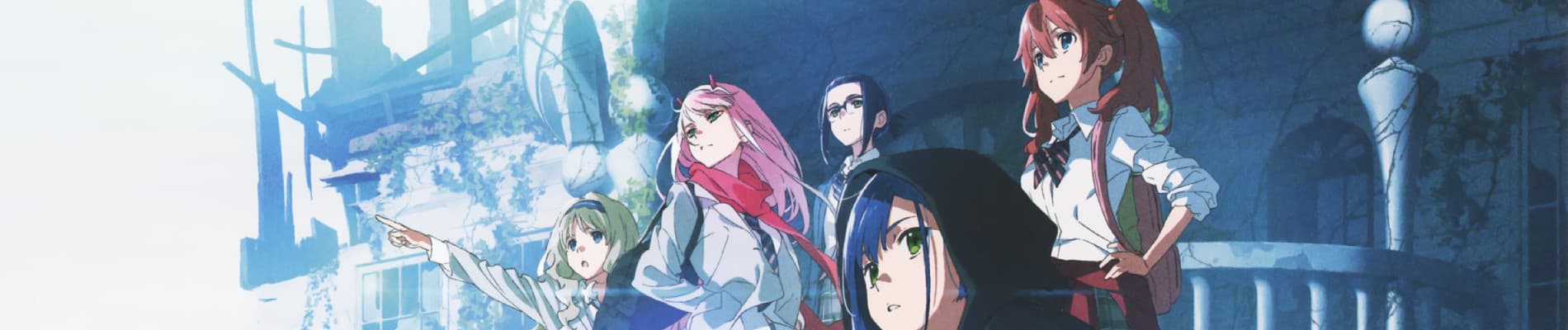


Let's imagine Darling in the Franxx as a rocky planet. On its surface, it has established a firm story of isolation in a world full of humanizing concepts but things are different once you get a bit too deep into its core. Simply put, it became a terraforming job too big to tackle successfully.
For the most part, the story works through the unknowns. The world with the Klaxosaurs and the mecha called Franxx, their origins are kept in the dark from both us and the characters themselves until a late backstory. It's a strange way to tell a story, even frustrating at times, but it has also presented this instinctually wild perspective away from the outside world. The rift between the children and knowledge opens up to an exploration of inherent human qualities that function within a compact community. Many thematic elements, from the innate curiosity to a sense of belonging or the human identity and even romantic love, piece together into a mirror that reflects humanity in its rawest form. While the reflection is sometimes distorted from the cluttered directions and contrived executions, all these fleshing outs give a better understanding of their relationships and attitudes. Especially with the poetic snippets of character backstories that add a lot more emotional connections, providing us the need to support them through their last battles and quite frankly, the mess at the end. It's actually pretty clear that the show has put some thought into its build-up to a grander scale. There are subtle plot details scattered throughout. But some huge elements it has decided to introduce late in the game, with no indicators or explanations whatsoever, overshadow the little details. They didn't completely engulf the story into oblivion but their intrusive presence have definitely left a mark of lower enjoyment. Being absurd can be entertaining. Sudden absurdity on the other hand? Not so much.
Now, when it comes to the art, it certainly is a more praiseworthy work compared to the story. What started off with fan services has quickly matured into a visual expression that not only packs a punch, but also complements the story well. Throughout the show, there's this faint discoloring of grayness that represents the disconnection between the children and their world outside. With many shots positioning them against a bigger futuristic setting, the underlying theme of the unknowns is always nearby. Fluid animation has augmented this show further through emotional appeals, whether that'd be the exciting or the more upsetting ones. It's expressive. Even the Franxx has a personality that mirrors its controllers. Great choreography and perspective animate a sense of scale into the battles brimming with cool mecha actions. On a more personal level, there's quite an amount of intimacy found between the characters as they express delicate feelings with one another. Many of this type of scene is sandwiched by the use of black bars, also known as letterboxing, to narrow the focus towards the main subjects, thus signifying them even more. With the good voice acting at its side, each character is given their own personality and together, forms this small community full of various identities. While some have a generic persona, their feelings have at least humanized them aplenty. Soundtracks in the range of calm to epic, and especially the insert songs, are appropriately used to emotionally move scenes with impact. Combined together, the audiovisual drives many of the show's message home, even though some are quite cheesy to digest.
Terraformation is supposed to be something that gives life to a planet but Darling in the Franxx got too ambitious at the end there. For the most run, it succeeded in exploring the attributions of humanity through its characters. It's only when the core story is finally focused on, do they start messing things up on a bigger scale.