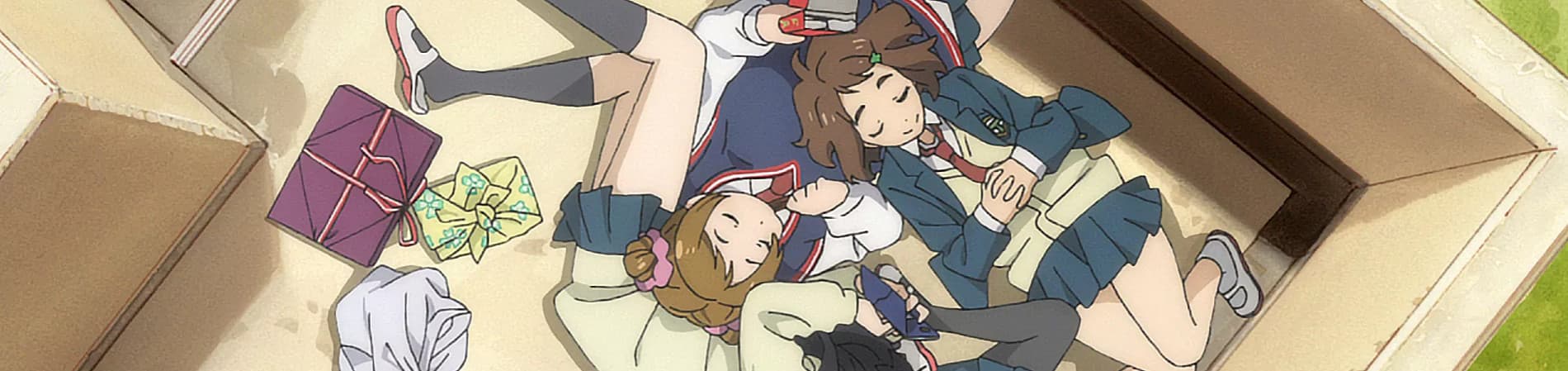

--Haruko Haruhara, Episode 6

And so ends one of the most profoundly odd trilogies in the entire medium. FLCL, FLCL Progressive, and FLCL Alternative. What’s maybe most striking about the three entries in what is now a franchise is how different they are from each other despite working off the same “core” premise. The original still exists, to some extent, upon a pedestal. It is a bizarre, ever-shifting thing, both literally (the series was originally conceived as a way to experiment with animation after all) and thematically, and any analysis of it that attempts to be brief and snappy is doomed to fail. Progressive is a darker, and, lord help me for using the word positively, grittier take on the idea. Recasting the villainous but charming Haruko as the much nastier Haruha, and replacing the self-important but lovable Naota with the deeply depressed violence fetishist Hidomi. Those two form a part in of themselves, as much of Progressive’s raison d’arte is to cast a skeptical, leering eye toward the original FLCL, sometimes seeming to question as to whether making the villain so charming is a good idea, and whether maybe the series is a bit too open to interpretation altogether.
Where does that leave Alternative? The final entry in the trilogy, and in some ways, a bit of a rebuttal to Progressive’s audience-antagonizing take on the series. More than that though, Alternative--at least initially--seems like it has much less to say about FLCL and much more to say about, well, stuff in general. In a strange sort of sense, this makes it rather “traditional”, to the extent that a franchise like FLCL has traditions to return to.

If Alternative has an overall theme, it is probably something like this; “People fuck up”. Specifically, our protagonist, 17 year old Kana, fucks up. A lot. In a broader sense, so does almost everyone else in the cast. Kana’s three friends--Hijiri, Mossan, and Pets--each get a focus episode (in a half-cour series, really) in which they make some kind of mistake. Hijiri is caught in a hookup with a college-aged boy, Mossan attempts to shoulder the burden of working up enough money to attend a fashion school on her own, and Pets….is rather complicated. Kana--and Haruko, here in a much more heroic role than her turn in Prog and indeed even the original--helps to solve these problems in her own way, which turns out in the grand scheme of things, to be something of a fuckup in of itself, in the last episode she admits her propensity to help others at the expense of her own wellbeing to be, basically, an act. Something done for her own sake.
The last episode, interestingly, brings back some of the metatext that made Prog as good as it was (or more properly, reveals what's been there from the start) and at the end, FLCL, one of the most strikingly original anime of all time, has its sequel duology go out like a shonen series. All stammered speeches about the power of love and 11th-hour super-powers to rewrite reality and scratch together a happy(-ish) ending at the last minute. Does that sound like a complaint? It isn’t, though it’d be foolish to expect answers from FLCL of all things, the final episode of Alternative is jam-packed with conversation with the show’s predecessors--not just Progressive (the “I don’t know what I want” segment of Kana’s speech echoing Hidomi’s “there’s nothing I want to be”) and the original FLCL (full-on flashbacks as Haruko appears to be flung sideways in time at the series’ conclusion)--but the rest of the Daicon lineage too, most saliently, Diebuster, whose ending this series’ finale somewhat mirrors. Nono’s black hole sacrifice recontextualized as an act of self-empowerment and seizing control of one’s life.

This is without even getting into the minor details; The fan bait that is the Steve Blum-voiced soba shop owner talking about making soba until the end of the world, a statement it’s hard to not read on a meta level as being about the perpetually half-dying anime localization industry. The scarily prescient idea of the richest and most powerful citizens of Earth fleeing to Mars in the face of a doomed planet.The knotted timeline which I can only imagine the most devoted fans will be trying to untangle for years. Alternative even, in parts of Kana's speech in the finale and an earlier conversation in the same episode, joins A Place Further Than The Universe as the second series this year to openly criticize the "endless everyday" concept that is foundational to the slice of life genre, and subsequently, much modern anime in general. There’s a lot to Alternative, which is both its greatest strength and greatest weakness.
If anything, I suspect Alternative will work for even fewer people than Progressive. Prog relied on having a working knowledge of the original series and hearts in your eyes for Haruko. Alt cranks that up to eleven and rips the dial off. Invoking the original, Prog, Diebuster, anime youth dramas, and so much more. It’s a lot to ask of the audience, and depending on how you view these sorts of things, you could argue that Alt doesn’t really stand on its own legs. After spending four of its six episodes seeming like it was unconcerned with the series’ legacy, Alt turns out to have the most relationship to the rest of FLCL out of almost any other work in the franchise--the manga adaptation of the original included. This structure can also make the first half of Alternative feel a little aimless, so it’s definitely not a strategy that works perfectly, but of the three six-episode series, Alt might--if only just barely--actually prove to be the most rewarding in the long run, both in how it interacts with the rest of the series and its commentary on the real world. It’s a hard thing to call, but if the original FLCL proved anything way back when it aired at the dawn of the new millennium, it’s that you can be weird, be difficult, be obtuse even, and still have people respect what you’re trying to do, and maybe even love it.
If there’s a note to close on, it should be this; In a world that feels doomed, works like Alternative are cathartic, even important. A hard-fought struggle for love on a planet that seems like it’s lost it, in 2018, by design or by simple applicability, is something worth praising.
