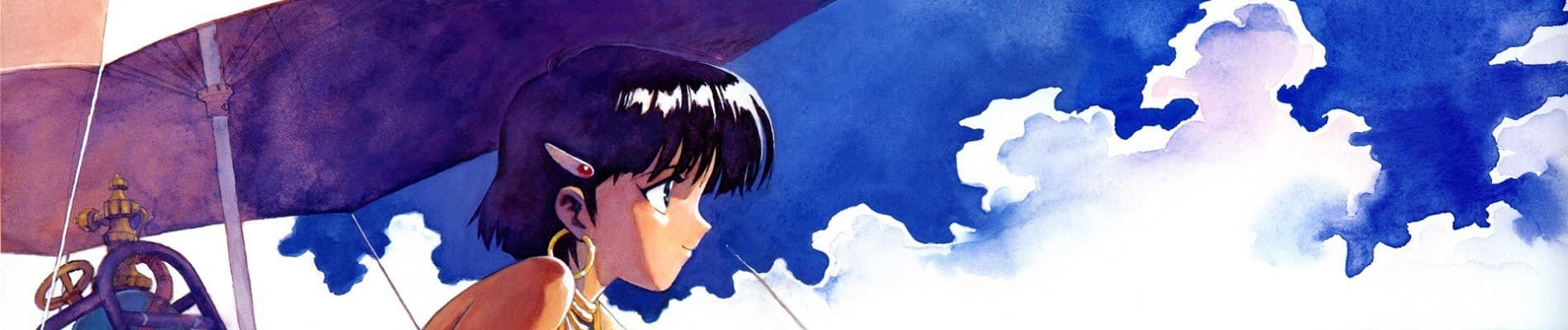
In the mid 1970's, prior to obtaining his well-deserved status as Japan's greatest animator ever, a young Hayao Miyazaki was hired by Japanese movie giant Toho to develop ideas for TV series. One of these concepts was "Around the World Under the Sea", based on Jules Verne's "20,000 Leagues Under the Sea," in which two orphan children pursued by villains team up with Captain Nemo and his mighty submarine, the Nautilus. Although it was never produced, Toho nonetheless kept the rights to the story outline. Miyazaki would reuse elements from his original concept in later projects of his, most notably the terrific action-adventure Castle in the Sky. Ten years later, in the mid-1980's, animation studio Gainax was commissioned to produce an original Anime series to be broadcast on television network NHK. Under the direction of a brilliant but angst-ridden artist known as Hideaki Anno, the studio selected Miyazaki's concept, and crafted an engaging story set in a steampunk 1889 France, with interesting characters, amazing animation (for its time), and a mixture of comedy, romance, mystery, and drama. The result was Nadia: The Secret of Blue Water, which has since become a worldwide fan favorite.
The story begins at a Paris World Exposition Fair where Jean, a nerdy but charming and instantly lovable inventor boy of fourteen, becomes smitten with a pretty, dark-skinned girl his own age. The girl, known as Nadia, is an unhappy circus acrobat with no clue about her past other than a jeweled necklace she wears. After rescuing her from a trio of comic bandits (the Grandis Gang) Jean earns Nadia's trust. The two set off on an even bigger adventure to find Nadia's birthplace, which supposedly lies in Africa. Along the way, they have run-ins with a supercharged submarine commanded by the mysterious Captain Nemo and his pretty but overprotective first officer Electra as well as a shadowy cult of Nazi-like masked soldiers known as Neo-Atlanteans led by the misanthropic, sinister Gargoyle, who wants Nadia's pendant at any cost. In the course of their around-the-world adventure, Jean and Nadia adopt an orphaned little girl, Marie, who senses that her new guardians will become more than just close friends. Although Nadia's explosive temper poses problems, Jean's patience and loyalty keeps their relationship afloat, and her growing love for the boy gradually transforms her as a person.
Nadia has all the makings of a classic series: a well-rounded cast of characters, unforgettable sequences, and a long, involving action adventure. There is a distinctive "Miyazaki-esque" style to the visual designs of the leads, yet only Jean seems to emerge as a Miyazaki creation. Which is arguably what makes him the most lovable character in the whole show. It's easy to see why Nadia finds herself gradualy falling for him--who wouldn't want to be with a boy as intelligent, genuinely compassionate, and impossibly generous as Jean? While he does display clumsiness in terms of social graces around the opposite sex, it only makes him all the more appealing as a character. Nadia herself, by contrast, is not always lovable. In addition to having serious anger management issues, she also has unbending and irrational principles about killing, eating meat, or trusting grown-ups. She does, however, display courage and, as mentioned, finds herself growing to care for Jean. Actually, Anno has said that he created Jean and Nadia based on his "light" and "dark" sides. Shiro Sagisu's music is sometimes bland, although some of the later tracks, notably the Neo-Atlantis themes, are memorable. The opening and ending theme songs as sung by Miho Morikawa are also enjoyable.
For all its assets, however, Nadia suffers from one fatal flaw that prevents it from being the classic it aims to be--it doesn't always stay afloat throughout its 39-episode count. The first twenty-two episodes are old-fashioned adventure at its best, with humor, young love, traumatic situations which involve death, and compelling, engrossing mysteries as we learn about Nadia, the Nautilus, and the Atlanteans. The production values in these episodes show their age at times, but frankly, they still exude detail and clarity for an early '90s series. Episodes 23-34, however, now remembered (unflatteringly) as the island/Africa arc, are another story. Following a powerfully charged climax from episode 22, the subsequent twelve half-hours turn a compelling sci-fi epic into a nonsensical, haphazardly directed and written, unimaginative, unengaging, unpleasant mess that feels more like a bad Looney Tunes cartoon on drugs than anything else. The characters become caricatures of themselves (Nadia herself, in particular, regresses into a completely unlikeable brat), the idiotic, slapstick-oriented stories are absolutely devoid of any adventure, substance, and, most damaging of all, ultimately sabotage the momentum of the first 22 episodes. With the exception of episodes 30 and 31 (which even director Hideaki Anno would have salvaged if he was given the choice of eliminating the filler), the rest in this aptly-dubbed filler arc have absolutely no reason to exist. None. But don't blame Gainax for them; the real problem was that backing distributor NHK requested them to be made -- the show was supposed to be a 27-30 episode series, but better-than-expected ratings prompted said filler arc. (The animation was also subcontracted to other studios in Japan and Korea, which explains the poor animation quality.) In the final five episodes Nadia does recover in terms of artistry and storytelling, delivering a satisfying finale, but it's hard to compensate for the damage that has been done. Simply put, the show would have been far better if it were eleven episodes shorter.
In spite of my misgivings with Nadia, though, I personally have no qualms with the English dub provided by Monster Island. The characters are all excellently cast and give splendid, lively performances. The voices of the children in particular are spot-on: Meg Bauman (13), Nathan Parsons (12), and Margaret Cassidy (11) as Nadia, Jean, and Marie, respectively, are what really drive the dub's heart, providing it with an intangible feeling of realism that really enhances the characters onscreen. For inexperienced youngsters, they do outstanding jobs, and the chemistry between all three is terrific (some may have trouble with Jean's shaky French accent, but I thought it was very appropriate and fitting for his character). These three are amply supported by a similarly entertaining cast of adults, particularly Sarah Richardson, Corey Gagne, Martin Blacker (as the Grandis Gang, who, like the children, are absolutely perfect for their roles and crackle genuine chemistry). I also liked Jennifer Stuart's turn as Electra -- the British accent she uses is fitting for the character and she especially gets to shine in the latter episodes of the show where she has to drop her controlled attitude and express her fiery emotions. Ev Lunning Jr. (Nemo) and David Jones (Gargoyle)'s were the only two performances that took a bit of getting used to for me. I had a vision on how Nemo should sound, and Ev's Indian-accented tone wasn't quite it. As the show went on, however, it grew on me, and learning that the idea was to connect Nemo's origin to the book "Mysterious Island", I finally accepted it. It helps that he gets increasingly better with his performance as the show goes on, the climactic episodes especially displaying a real fiery passion. The same is true with David Jones' distinctively stentorian-sounding Gargoyle. This dub has taken a lot of undeserved flak from critics who have made the mistake of writing it off on account of the sometimes uneven accents (As mentioned, Jean's admittingly shaky French dialect in particular takes some getting used to; although Parsons does improve on it as the show goes on). Despite that and the occasional trepidatious moment in the opening episodes, the end result is still a spirited, energetic, emotionally charged dub that really brings its characters to life. It is most certainly a very commendable effort that deserved better recognition than what it was accorded for back in 2001 and even today.
The ADV dub is not the only English track of Nadia to exist. In the 1990's Streamline Pictures attempted a release of the show. Interestingly, the head of Streamline, Carl Macek, did express interest in paring down the much maligned filler arc. As his version only got about as far as eight episodes, we probably never may know how it would have turned out. Having said that, though, I don't think the Streamline dub compares favorably to the ADV version. The recording quality is obviously inferior to the current one, especially the sound mix. But it's the performances that are a problem. Wendee Lee and Ardwright Chamberlain are both very credible actors, but both are miscast as Nadia and Jean and unfortunately underwhelm. Cheryl Chase is OK as Marie, but ultimately Margaret Cassidy does a much better job. Jeff Winkless is a bit less stiff than Ev as Nemo, but even then his turn isn't anything amazing. Steve Bulen's Gargoyle is also played too much like a stereotypical villain and isn't helped by an obviously artificially lowered voice. While I wasn't so sure with what Jones was trying to bring with Gargoyle at first, his approach gradually grew on me and he gets to do some evil cackling at the end, to the point where I can't imagine anyone else. Bulen's voice might have worked well for the character if he was portrayed as a supervillain, but as he isn't I don't think the approach would work. I did like Edie Mirman as Electra (she ties with Stuart) and the Grandis gang doesn't sound too bad, but on the whole I prefer the ADV dub. It strikes me as the better of the two by far. It isn't really surprising the Streamline dub isn't well remembered, either; compared with the company's other output it underwhelms.
Out of curiosity, I did sample a few episodes of the Japanese version. Although some voices are solid (Nemo, Gargoyle, and Sanson), I felt rather indifferent about the others. Marie's voice is the weakest of the bunch; no offense to the late Yuko Mizutani, but I feel Margaret Cassidy does a far better job of bringing out this little girl's innocence as opposed to Yuko's high-pitched shrieking. Likewise, despite Yoshino Takamori and Noriko Hidaka's solid turns as Jean and Nadia I found myself preferring Bauman and Parsons, if mainly because both characters are supposed to be children. It just feels more natural to hear them voiced by actors of the appropriate age. Despite insistence from some long-in-the-tooth fans that this show should only be appreciated in its native language track, I don't consider either version better or worse, only different. Whichever one you prefer is a matter of personal preference.
Is Nadia a complete waste of time? Not at all; its characters, as mentioned, are compelling, the core storyline is interesting and labyrinthine, and as long as it is focused on adventure and mystery it is indeed deserving of praise. It's just too bad that it suffers from an unfortunate filler arc; without it Nadia would have been a classic. To truly appreciate the show, it is recommended to watch it like this: episodes 1-22, 30, 31, and 35-39. Although the missing gaps may seem jarring, take it from me, it's better than sitting through episode after episode of discouraging nonsense that negatively impact one's enjoyment of the show. Even Gainax agrees that it plays better this way.
38 out of 40 users liked this review