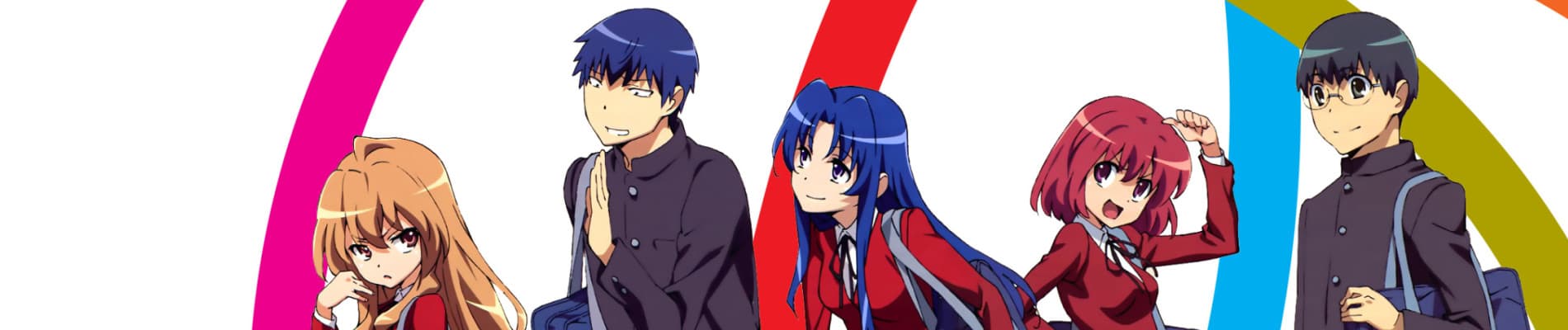
ToraDora! tells a story about the bizarre tangled intricacies of teenage love, complete with matchmaker plots, zany schemes, and an increasingly convoluted love quadrangle that’s played for both comedy and drama. It also tells a story about how everyone has issues, inner turmoil, and inner selves that they keep concealed, usually with the intention of preserving a certain image of themselves for the people around them.
It starts small by introducing the audience to protagonist Ryuji, who most of his classmates assume is a delinquent because he has “the eyes of a killer” but is in reality a studious, quiet, and compassionate boy. This makes him a neat foil to his classmate Taiga, who at first glance is small, cute, and unthreatening, but has an aggressive temper. These two outcasts prove that outward appearances can be deceptive, but as they become friends and agree to help set the other up with their respective love interest, this theme of outward persona versus inner personality deepens and becomes much more poignant.
Each member of ToraDora!’s core cast is deliberately introduced to create audience expectations, then gradually revealed to have hidden depths and a side they don’t show to the public. This notion of the “true self” and the importance of embracing it is the most heartfelt and important theme of the show, tied into the coming-of-age story and the life lesson that even if you love and idolize someone, feelings change over time. It also goes hand in hand with the way the show deconstructs, examines, and builds from the familiar high school anime tropes that the core cast embodies. This is especially true in the case of Taiga and the show’s two other female leads, Minorin and Ami.
Ryuji’s crush Minorin is portrayed as an ever-optimistic genki (cheerful) girl; her rival and foil Ami as a cute, peppy idol figure; and dual-protagonist Taiga as a quintessential aggressive-but-adorable tsundere. They’re not so entrenched in these stock archetypes that they’re obvious parodies or self-aware nods to them (as seen in deliberate and genre savvy series like Nozaki-Kun or Saekano), but it’s easy to assign familiar labels based on their dominant personality traits, behavior, and establishing character moments.
These familiar patterns and the assumptions they create are thrown into question as the series gradually peels the characters’ outer layers away to reveal the real humans beneath the romance tropes. This shift away from their initial archetype—even if it means the character is more flawed and less pretty—is ultimately portrayed as a positive thing, which is the greatest strength of ToraDora!’s character work.
The most immediate example of this is Kawashima Ami, who’s introduced as a peppy, ditzy teen model. Before her introductory episode is over, however, we learn that her sugar-coated persona is a mask she wears to get people to like her. As soon as she’s left alone with Taiga—whom Ami can’t impress—Ami reverts to her “true” self: a vindictive, highly intelligent, selfish bully.
Her development doesn’t end with “cute idol girl secretly has a nasty personality” as a one-note plot twist, however. The relentlessly conniving, haughty version of Ami turns out to be yet another mask, concealing her anger and vulnerabilities. Ami hides a bully behind her sweet idol persona and a frustrated, lonely, out-of-her-depth teenager behind her bully persona. This comes to a head at the climax of the first solid character arc of the series, when it’s revealed that Ami gave up her modelling career and changed schools to evade an obsessive fan who’d been stalking her. Letting her understandable anger and fear finally bubble to the surface, Ami stops hiding, calls the stalker out, and stomps on his camera.
In this pivotal scene, Ami is animated as almost predatory and manic—a far cry from the clean lines and dainty body language used when she’s trying to win over her new classmates. The power of the moment lies in its shock value; she is terrifying, messy, and unattractive for the first time, which horrifies her stalker as well as viewers.
This final blow shatters the presumptions created during her introduction and emphasizes the core theme of the series: contrary to appearances, Ami is not a pure and perfect angel; she is an emotional, complicated human being. This realization terrifies and confuses the stalker, but the series makes it clear he’s in the wrong for believing and behaving the way he does. Ami is in the right—and portrayed as developing positively—when she abandons her persona and expresses herself honestly for once.
Ami is more than her body and more than either her cutesy or nasty personae. The Ami at the end of the show is not the same Ami in episode five, who in turn isn’t the same as the image she presents to the world—all of which comes parceled with the message that no woman is perfect, even if their career branding makes it seem that way. Ami is a realistically flawed person with emotions and frustrations, including unattractive and unfriendly tendencies, and that’s okay.
Ami makes for a smart foil to Kushieda Minorin, the resident sports-loving, adorable optimist. She serves as Ryuji’s initial love interest and acts like she’s always fueled by at least two cans of Red Bull. Minorin’s relentless happy-go-lucky attitude make her appear, at first, as a flat character with no internal conflict. However, as with Ami, it’s gradually revealed that Minorin’s cheerful exterior hides emotions often considered less attractive to others, like frustration, jealousy, and cowardice. Eventually Ami (who’s already gone through her major character development) calls Minorin out and tells her to be true to herself even if she fears people won’t like her as much.
This all revolves around the big plot twist that drops towards the end of the series: while Taiga worked to set Ryuji and Minorin up, Minorin secretly had a crush on Ryuji the whole time but noticed that Taiga was developing feelings for him as well and put a lid on her affections so that her best friend could be happy. This selfless act fits with both the genki girl trope as well as Minorin’s own dedication to inspiring happiness in people and putting others before herself, but the effort to hide her mounting heartbreak starts to crack her sparkly exterior.
During a long emotional arc, Minorin struggles to bury both her feelings for Ryuji and hide how much it hurts her to watch Ryuji and Taiga fall for each other. The mystery of Minorin’s true feelings becomes part of the tangled emotional intrigue of the show, and in the end, it parallels and bolsters the message of Ami’s arc: it’s unhealthy to hide your true self, even if that side of you seems ugly or causes trouble.
The strength of Minorin’s character arc is that it would have been simple to have her harbor a traumatic past beneath a cheerful mask, selflessly trying not to burden anyone with her problems. This is a trope all-too-commonly used as a last-ditch attempt to make a love interest seem deep and sympathetic while keeping her peppy and attractive to the audience. The show doesn’t need to break Minorin or reveal some terrible, tragic plot twist. In the end, Minorin accepts that her negative emotions are just as much a part of her as her positive ones. She resolves to stride forward as energetically as always, while also allowing herself to express anger or cry over a broken heart.
The peppy façade isn’t a façade, but simply one part of her personality. When she lets that natural optimism co-exist with other negative and less “user-friendly” emotions, she becomes a more balanced person. Minorin’s bittersweet finale features her sobbing with Ami after Ryuji leaves forever, the two girls begrudgingly bonding over their shared revelations. It’s a moving personal arc for the character and embodies the themes of the show.
Meta-textually, it’s also great to see Minorin and Ami—who at first seem like perfect, darling romance tropes—have parallel arcs about how it’s okay to let yourself be human and flawed. ToraDora! takes these tropes apart and explores the human beings underneath them. It argues that trying so hard to maintain a false and sweet persona is ultimately unhealthy, and that the girls should let themselves be themselves. It’s better for their own wellbeing and positive growth and helps them form more meaningful relationships—a message that’s also present in the character arc of the female protagonist, Taiga.
Possibly the most prickly and problematic archetype the show examines is that of the tsundere, embodied by Aisaka Taiga, who shares the role of protagonist alongside Ryuji. The tsundere as a character type comes with a plot twist built into it: this outwardly angry, haughty girl is actually sweet and vulnerable on the inside. In the context of the romance genre, this archetype often comes with the message that she just needs The Right Guy to wear her down and reveal her warm, caramel center.
However, Ryuji (and by extension, the audience) soon find that Taiga’s quick temper masks a depressed, immature, and emotionally vulnerable person rather than simply a cuter and more approachable side. The show then investigates how a person would end up like Taiga, who outwardly expresses her anger to make people uncomfortable and push them away—essentially the opposite of the people-pleasing Ami and Minorin—and how it’s an equally unhealthy way to live.
As with Ami, the execution is flawed: Taiga’s temper is the result of an emotionally abusive background, but it’s still frequently used for slapstick comedy. This behavior, as with Taiga’s temper, is often played for laughs, meant to be funny in the typical romcom sort of way. However, these personality traits also get explored gradually over the course of the series, with ToraDora! moving beyond the “angry little girl” archetype not only by using Taiga’s backstory as a vessel to explain how she ended up emotionally stunted, but by actually calling her out on her behavior.
Take the pool arc, for instance, another rom-com staple. These episodes feature many of the usual, expected tropes, and of course find an excuse for long conversations about the varying sizes of the heroines’ breasts. But amidst all that comedic nonsense, the start of Taiga’s emotional growth peeks through.
In learning that Taiga started a fight with some classmates who made fun of her flat chest the year before, Ryuji (and, again, the audience through him) realizes that below such an aggressive exterior is a girl that faces problems that any other girl would have. The pool arc also has a much deeper significance than Ryuuji merely getting angry that Taiga was taking it out on him. It doesn’t make sense, since it doesn’t really bother him. What really ticked him off was the idea that Taiga didn't care about him as much as he cared about Taiga. In the end, Taiga concludes that she does care about Ryuuji and goes to fight for him in the swimming race, showing to the pair how their feelings are mutual. This is surprisingly mature, since the idea of how much someone is putting into a relationship is a problem that extends far beyond high school.
It’s an important first step in Taiga’s positive development: not only is the source of her anger explored, but both the characters and narrative recognize that this violent anger is unhealthy. Ryuji helps Taiga build confidence through positivity and support as well as mutual trust and communication, and Taiga finds herself, for the first time, in a safe environment where she doesn’t have to push anybody away.
Taiga might conform to a certain cute factor initially, but the series slowly strips this away as well, refusing to let her be a flawless romantic lead. Her neglectful parents instilled in her a self-enforced isolation and rely-on-nobody attitude, causing her to default to temper tantrums to either get her way or push people away, lest they see her vulnerable side and look down on her for it.
This behavior is used for comedy at first, but when the plot takes a heavier turn, the series shifts to depicting her actions as both the result of an emotionally abusive life as well as being immature and harmful to others. It’s not a cute quirk; it’s a problem, one that has real consequences as she gets suspended for two weeks after her fight with the Student President. However, it’s a problem that Taiga does eventually leave behind at the end of her character arc.
The narrative also avoids “breaking” Taiga or having Ryuji wear her down to induce this character development. Instead, Taiga learns to trust and communicate honestly with people. Though it’s more down-to-earth and thus less dramatic, this growth eventually takes precedence over her slapstick battles, and the series makes it clear this is the healthiest way for her to act. Ryuji falls in love with Taiga because he sees her as a rounded person with flaws and issues and someone he can be share his faults with, not because she’s a flat tsundere trope with a hot temper and a secret soft side. Their relationship is one of mutual trust and balanced friendship, and it helps them both grow and change for the better.
Taiga’s character arc comes to a full conclusion in the end. Taiga had been running away throughout the entire series, ignoring her family problems and such. Yet, by seeing how immature her mom was acting, she was able to look at herself more critically and decided to not run away from her problems anymore. Furthermore, she had been relying on Ryuuji so much this series that she became bothered by it, and how she wasn't doing anything by herself. She makes a point to explicitly do it without Ryuuji’s help to grow herself as well and become more independent. Ryuuji, for Taiga, isn't someone who will just love her who she is. Ryuuji is someone who she can place trust in to watch her, as she begins to move past her stagnation for the last few years. Ultimately, Taiga’s character arc is not characterized by Ryuuji saving Taiga, but rather Taiga recognizing that she’s flawed and choosing to save herself and fix those flaws independently because she can trust that Ryuuji will be there to watch over her.
Like Ami and Minorin, Taiga is introduced as a one-note trope. But, also like Ami and Minorin, over the course of the series she learns that hiding her true self away will ultimately leave her frozen in this toxic state. She shouldn’t be afraid to change the way she’s perceived just because it might reveal emotions and traits she doesn’t consider part of her image. By the end of the series, the gorgeous preppy mean girl can be vulnerable and angry, the adorable selfless optimist can cry and express her emotions for her own sake, and the ferocious tsundere can recognize her issues, mature, and develop beyond her “cute” slapstick traits.
ToraDora! systematically dismantles the images of perfection surrounding the girls, and though it leads to turmoil, in the end these changes are all expressed as positive growth. Most importantly, these changes are about them, rather than the people they love or what they want other people to think. ToraDora! is a beautiful and nuanced exploration of societal expectations, fictional assumptions, and the multidimensional girls struggling underneath. It works threefold, making for a satisfying coming-of-age story, a great meta-textual mess-up of the tropes we all know and love (or love to hate), and giving us three well-rounded and interesting female characters that stay with us long after the final credits roll.
59.5 out of 66 users liked this review
