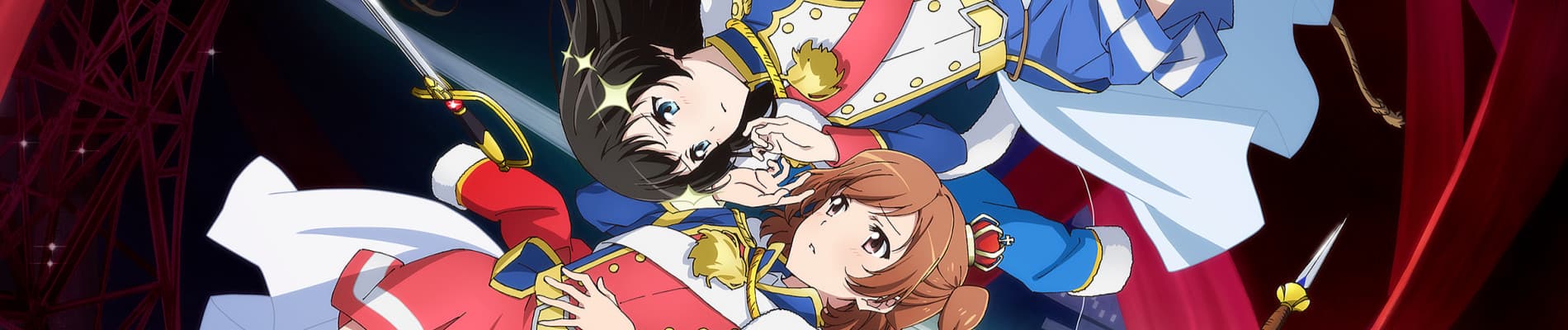
Revue Starlight
a review by byrne
a review by byrne
At first this show seems like an unholy mess staplered together into a cute-girls anime. Or is it a musical? There’s a transformation sequence? Wait, so they’re physically fighting? Huh, a giraffe? But beyond the original confusion, you’ll find an endearing story of growth which packs as much fun as it has emotional weight.

As someone who generally dislikes idolesque male-targeted all-female shows, I expected to be put off, but boy was this show a complete surprise. For me, its success boils down to how it manages to appeal to various audiences without compromising the show as a whole. To those who simply want an all-girls anime will find plenty of shippable relationships. Those who crave action will find its revue fight scenes dynamic. There is plenty of drama featuring characters better developed than the show would lead you to believe. The show works in each of those layers. But what sets it apart, is how all those layers builds up on each other to form a fascinating narrative.
We are introduced to the characters, their wishes, and see how their relationships are affected by pursuing their goals. We see them deal with problems of jealousy, the pressure of remaining ahead, the feeling of being left behind, the fear of moving forward. And the revue reflects all of that. The way each character fights shows their personality, each revue insert songs carries their character and struggles so well. It's something both set design and cinematography also conveys well.

The show invest needed time in showing how each individual characters progress, making each development believable while also sowing the seeds of future conflicts. When an arc reaches its climax, we understand why things go where they do. It doesn’t feel rushed. This respect for its characters is what makes the show stands out, and it does so without bogging down the narrative as a whole. So by the time the show nears its conclusion, we have a good understanding of why each character performs.
The show treads a fine line between goofy day to day life, moments of serious character development, and the dramatic tone if its revues. It’s a balancing act that holds out well all the way to its final episodes.
Here’s a pretty spoiler heavy look into one of many character arcs in revue starlight, and why it works
The first impression we’re left with of Nana is one of passivity, a support character if there ever was one. She doesn’t stand out among her peers, except to support others in time of need. To top it off she has decided to focus more in the production group, further removing herself from competition.
During episode 5 where Karen and Mahiru duels, we are shown the rest of the cast, each engaged in their own revue. What’s important is that Nana is not shown. We’re meant to believe that she is harmless, that her very participation in the revue is to be ignored.
But she is not harmless. In fact, compared to Karen’s measly ninth, she is third.

Hints of her involvement are shown during Karen and Maya’s duel, a hilt of a sword, inconspicious enough, but upon closer inspection something we’ve yet to seen in any previous revues.
 If you’ve seen the opening then you’ll realize that the only one wielding that particular weapon is harmless, supportive Nana.

This illusion of harmlessness is further put to question by the end of episode 6, where she engages in an ominous monologue regarding the course of the revue.
Then we learn more. The next episode starts with the 99th starlight, the same one Mahiru and Maya recalls before, but this time from Nana’s perspective. It is now clear how precious this particular production of Starlight is to her. Next Nana is shown taking pictures of her environment and her friends. Innocent enough, until we learn later on the root desire behind these actions. She wants to preserve these moments. When she’s brought into the revue, she given the chance to grant her wish. To this end, she fights with a ruthlessness which stuns even Maya, whom we’ve ascertained to be the strongest competitor. In return for winning, Nana is allowed to relive the previous year.
 Right about here, we realize how terrifying she really is
While the implication this has on the narrative is huge (we go from a surreal anime, to full-on magical show), what is also huge is the implication on Nana’s character. No longer the passive side character, she is someone who is willing to trap everyone in time in an attempt to preserve her starlight. With each repetitive victories, she shows what she is willing to do to keep her time on loop.
 In fact, she repeats time so much that this tree had the chance to grow AND wither
Hints of this obsession manifests even in the very first episode. From a nostalgic remark to her opposition to the change in the 100th starlight. Moments like these are present in every episode. Offhand dialogues or visual cue that seem innocent enough, but in hindsight hints at an important character development. And this applies to all the major characters.
In a show where everyone competes, Nana’s drive serves as the perfect antithesis of Hikari’s, and by extension Karen’s struggle to improve and advance. Let’s discuss episode 8, where her arc and Hikari’s merge. Here she is the antagonist, though by no means a villain. She opposes the protagonist, Hikari, but not due to malicious intent. In fact, through the preceeding episodes, we understand her frankly symphatethic reasoning. She’s unwilling to move on. She tells Hikari that what she’s doing is for their collective good, but we know there’s more to it. The 99th Starlight was the time of her life. Nothing in her life had shone as bright, and nothing, so she fears, will ever shine as bright. She fought to protect the certainty of her Starlight, and she will not let Hikari lead her into an uncertain future. This culminates in what is arguably the series’ best revue.
“I’ll protect those important to me, no matter how many times…” –Nana, Re:createAnd this isn’t even Nana’s episode, it is Hikari’s. The episode serves to set up Hikari as a character of her own, and it does so while integrating Nana, about whom we learned in the previous episode, as the perfect opposition, the one hurdle Hikari must overcome in order to rediscover her passion.
After her defeat, the revue slips further from Nana’s grasp. She becomes noticeably somber. Finally she snaps, openly voicing her fears, to the surprise of those who knew her only as the ever cheerful Banana.
 But this is much Karen’s episode as it is Nana’s. We are shown the story of Starlight, reaffirming Karen’s resolve to perform it with Hikari.
In Nana and Karen’s revue she grows more desperate as the time she sought to preserve drifts further away, which is reflected in the tone of the insert song.
“change brings about tragedy!” – Nana, Hoshiboshi no Kizuna
Then comes the final confrontation. Karen arguing for progress, as Nana begs for things to stay the way they were. The insert song chimes in, echoing their respective voices.
 “I want to deliver you this newborn star.” –Karen
“I just want to treasure and protect you.” –Nana, Hoshiboshi no Kizuna
“I want to deliver you this newborn star.” –Karen
“I just want to treasure and protect you.” –Nana, Hoshiboshi no KizunaFollowing her defeat, Nana’s arc wraps up nicely with a dialogue with Junna, where she reconciles with her actions and accepts her past experiences, now truly in the past, as a part of her. After a good cry, she is ready move forward. 1 point for character arc, 1 point for the Junna-Nana ship.
And mind you, all this for someone who is technically a side character.
So are they, like, allowed to kill each other?
Is the stage of fate a hidden part of the school, or does it materialize every time?
Is the academy secretly aware of the revues? Are the teachers the previous victors?
Are the revues actually battle duels, or only interpreted as such?
Do Karen not take fall damage?
Which schools gets to have a revue? Does the giraffe select the school based on students, curriculum or accreditation?
Are all giraffes sentient magical beings? Are all of them evil?
If the tree is able to grow, does it mean the stage of fate exists in a separate time plane?
How old is Banana?
In summary, Shoujo Kageki Revue Starlight is many things. A high school drama, an action musical, a cute-girls show, a story of growth. It does each of these things well. But most of all it manages to be ALL these things very well without seeming pretentious.
Is this show a fun watch? Yes. Is this show good? More than it should be. Do I recommend this show? Absolutely.
``
57 out of 60 users liked this review
