
What Does It Mean To Be Alive?
TL;DR: A great coming-of-age movie that is definitely worth a watch, though it does have its fair share of minor flaws that prevent it from being spectacular.
This is a longer review than what I normally see on AniList, so I'm providing a table of contents to make this a bit more readable (just CTRL/CMD+F and search for the headings)! Thanks to @leonhardt95 for reading through my draft of this review!
I try not to specifically spoil anything in this review that you wouldn't be able to gather from the synopsis, but I do mention some scenes that may seem like minor-to-moderate spoilers for those who want to go in completely blind. These spoilers are mainly limited to the Narrative section.
Table of Contents:
I. Aesthetics
a) Audio
b) Visuals
II. Narrative
III. Emotional Impact
IV. Conclusion

a) Audio
As far as the OST goes, I thought the music was average to decent at best. There wasn't a song as memorable as Zen Zen Zense from Kimi no na Wa or with the emotional poignancy of the title track of Liz to Aoi Tori, but to be fair, it is difficult to reach those kinds of heights, and nothing struck me as terrible either. The opening and ending by Sumika were well done and served to highlight some of the themes of the movie, and some of the background piano tracks complemented scenes really well. To me, the thing that struck me the most from an auditory standpoint was the absence of music in certain parts. To me, any type of media truly shines in this respect when it knows when and when not to employ music. To this end, this movie does an okay job, but there were certainly moments throughout where leaving out the background music would have certainly increased the impact on me as a viewer. I did enjoy the voice acting though - the VAs did a great job of conveying emotion without sounding too over-the-top or cheesy, with the exception of Sakura, though I blame that more on her portrayal as an incredibly bubbly character more than the VA herself.
b) Visuals
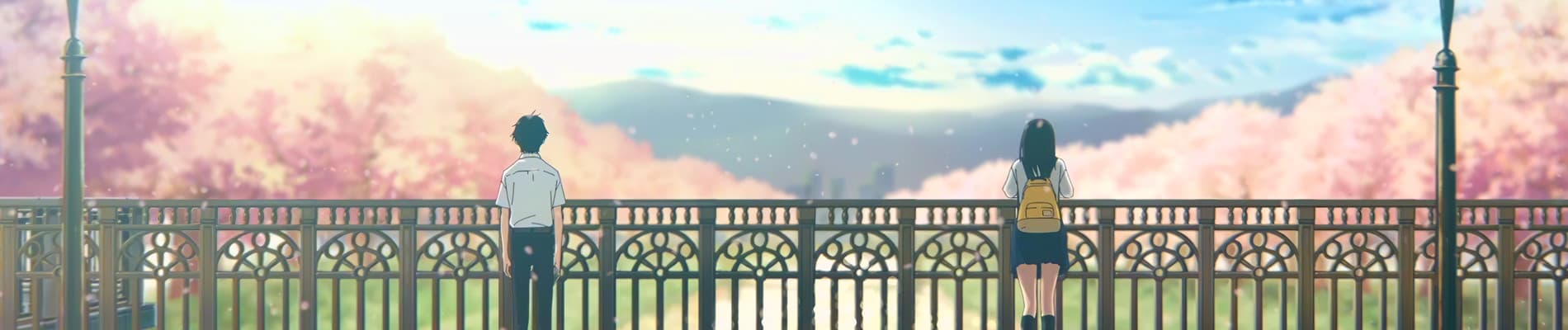
From a visual standpoint, this movie looked nice, but nothing struck me as spectacular. There are a few nicely framed shots, one of which is pictured below, and the fireworks scene in particular is definitely a gorgeous scene. However, there were multiple points where still images are shown over narration. In a seasonal anime, this can be expected, but in this context, it just seems a bit lazy. I suspect they did it because they wanted to show highlights of events as time passes, and there is one particular instance where it indeed makes sense to do so (you'll recognize it when you watch the movie). However, for the other instances, I feel the viewing experience would have been greatly enhanced if each still was instead replaced with even a 3-5 second clip of the characters in motion, which would greatly add to both the viewing experience and how the movie portrays the characters' emotions.

I walked into the movie theater only knowing that Sakura, the female MC, ends up dying, and not much else. The Fathom pre-event clips showed some interviews with members of both the Japanese and English casts, so I was "spoiled" somewhat regarding some characters' personalities and the inclusion of various scenes, but for the most part, I went in blind. From the beginning, they do make it clear that Sakura dies, and the majority of the movie involves Boku (whose true name I won't include for spoiler reasons, despite it appearing on the AniList page for the movie...) recalling his encounters and growing relationship with her.
I will say that calling this movie a romance is misleading - there are various moments where the two characters are intimate, and there are moments where it is clear that the two probably have crushes on each other. However, there's never really a point where their romantic interests are truly realized, and I believe that is for the better. I Want To Eat Your Pancreas is not a tragic story about how a boy and a girl meet and fall in love before the girl dies, nor does it try to portray itself in that way, which is made incredibly clear in Sakura's final monologue and Boku's thoughts in the scenes surrounding it. Rather, it is a story about how Boku and Sakura, through their time together, help each other grow as people. In this regard, I would consider this movie to be more of a coming-of-age story.
As such, this movie should be watched with the mindset of watching Sakura help Boku break out of his incredibly introverted shell, while Boku helps Sakura find herself as a unique individual who just wants to be treated normally despite her terminal illness. To this extent, I personally feel that the character development is done wonderfully. While reading through some of the other reviews of this movie on AniList as some light research, I came across the following quote from this review:
I could not get fully emotionally invested in the relationship between the two main characters as their attitudes and emotions seemed to have a convenient "light switch" wherever it was convenient for the plot to do so.
To an extent, I totally see where this reviewer is coming from. There are numerous moments in this movie where the characters will be doing something lighthearted and then one of them says something that completely flips the mood. However, as a viewer, you must keep in mind that their interactions are predicated, at least initially, on the fact that Sakura is going to die soon. Obviously, their relationship becomes much deeper than this, but it is made clear that this is something that weighs heavily on both of their minds. As such, I find it a bit misguided to simply relate the sudden mood changes to "flipping a switch", especially as the transitions aren't done in such a blunt way that it feels unnatural.
This reviewer then goes on to criticize the movie for placing some focus on how the majority of the side characters dismiss Boku and try to get Sakura to stop hanging out with him. On the contrary, I feel that the inclusion of this drama only serves to further enhance the themes of the movie. Boku is a character who is incredibly introverted and antisocial. If a high schooler as protective as Kyoko saw her best friend suddenly start constantly hanging out with this person, it is totally believable that they would try to stop it. Kyoko makes it clear to Boku that Sakura is a delicate person, and that she isn't someone to be toyed around with, which is very understandable, if not slightly melodramatic. I would like to make it clear that while this rejection of Boku as Sakura's friend is a recurring theme, it does not appear so often that it is unnatural, nor does it seem forced (other than a certain scene outside of Sakura's house which is given some context immediately following the incident). Rather, it contributes to the sense of catharsis you feel in the end once you see Boku open up as a person, as indicated in his scenes with Gum Boy (I can't believe the English cast called him that) and the post-credits scene.
As a quick aside, I do feel that save for one or two key points, the plot is fairly predictable if you are an attentive viewer. Walking out of the theater, my friends, as well as some of the other people from the audience, said that they felt that this movie didn't really do anything new. While this is a fair point, I personally believe that this movie succeeds despite that. To me, the movie isn't so much about the actual events that are happening, but rather about how Sakura and especially Boku are changed through their time together. In this way, I feel that it truly succeeds, and the fact that I went through a wide range of emotions throughout this movie (something which will be expanded upon a bit soon) proves, at least to me, that a movie doesn't have to be completely original if it succeeds at what it sets out to do.

To me, the majority of the emotional impact derives itself from seeing Boku and Sakura develop as people, rather than the more obvious reason of her dying. In fact, the only part where I ended up letting out a few tears was the scene where Boku finally allows himself to truly grieve over Sakura's death in his meeting with her mother. This point is the climax of Boku's growth as a person, and it is here where Sakura's influence on him is fully realized, as he sincerely cares for someone who is not part of his immediate family. The movie is told primarily through his view of the events as they occur, so it is a huge plus to the movie that I became so attached to him as a character. Sakura seems to act more as a foil to his character, though she does have problems of her own that Boku helps her come to terms with. There are definitely moments where I felt my heart ache or burst with joy for the tribulations the two go through, both individually and together, but I do feel that Sakura is not as strongly-written of a character as Boku. I will say that there were some points in the movie where something that should have been a big reveal ended up having close to no impact on me as I was watching. I don't want to spoil the movie completely, so I will refrain from mentioning them, but in the end, the movie did achieve what it set out to do, and I do feel moved by it even as I write this review, so it is by no means bad.

I really did enjoy watching this movie. Sure, there are a few bits here and there that I personally thought could have been done better, but in the end, it achieved what it set out to do. I really enjoyed seeing the main characters become closer and grow as the movie progressed, and I definitely think it ended off on a great note (after the post-credits scene). If you enjoy bittersweet coming-of-age stories, definitely check this one out!
Thanks for reading! Feel free to message me on AniList or Discord (username in my profile bio) with comments/criticisms about this review. If you enjoyed this, let me know and I'll write more in the future!
EDIT 1: Changed image sizes to more accurately fit text width