
After the Rain
a review by heychrisfox
a review by heychrisfox
There's a lot of praise that can be thrown around for a good concept. As much as we can say that books aren't judged by their covers, we know better. Everyone judges a book by its cover, because with so artistic visions out there, if we can't take a cover at face value, we'll never be able to follow any journey. The key behind the cliché is that if we do judge a book based on its cover, we have to hope that it delivers on what is being sold, trusting that the text is wearing its heart literally on its sleeve.
And that's unfortunately what After the Rain was not able to do. Because while it is a fantastically beautiful character drama of two very confused, complicated souls, it does not truly follow-through on its broader ambition.

After the Rain's general premise is the sort of thing to raise eyebrows: a romance between a seventeen year old track star and a forty-five year old manager grinding his middle-adulthood working at a simple, no fluff restaurant. Two unique individuals who, under the circumstance of working at the same place, have sparks fly, have love bloom, and have a deepening bond together. The age factor is obviously the more controversial portion of this, and will certainly turn many off out-of-hand by the implications.
But if one is willing to suspend their disbelief for a moment around the concept, it is the lack of commitment toward that vision that would both keep those more prudish among us around to continue watching, and is likely also ultimately the downfall of After the Rain.

The big issue with After the Rain is that is fails to truly execute on its romantic narrative that is built up from the very beginning. The female lead Tachibana is stern, a little hard-headed, a little naive, and a lot of socially awkward. She very quickly realizes she has brooding feelings of romance for her manager, and seems so head-over-heels by the proposition that admitting her feelings to him seems like the most logical option. Kondou is more level-headed, having already had his time in the spotlight for teen romance, almost viewing his time as over, having passed long ago with his youth, yet with a vague, underlying notion that he deserves happiness even when he doubts he should attain it.
And this sounds like a fantastic premise for a romance, yes? Two people who want something, are horrible at acting on it, who will inevitably end up together. The issue here is that their romance is plodding, to say the least. The show emphasizes their growth as individuals, allowing their coy but ultimately platonic interactions to balance out their own personal woes. They each learn lessons, learn more about themselves in the process, and grow both closer to each other as well as closer to their own understanding of their ideals. But the speed at which this is executed is drastically slow. While the interactions feel legitimate and natural, you're essentially left on the edge of your seat the entire viewing internally screaming JUST KISS ALREADY. Will they or won't they? Will they get out of their ruts or won't they? It's an eternal question riding a wave through the entire series.

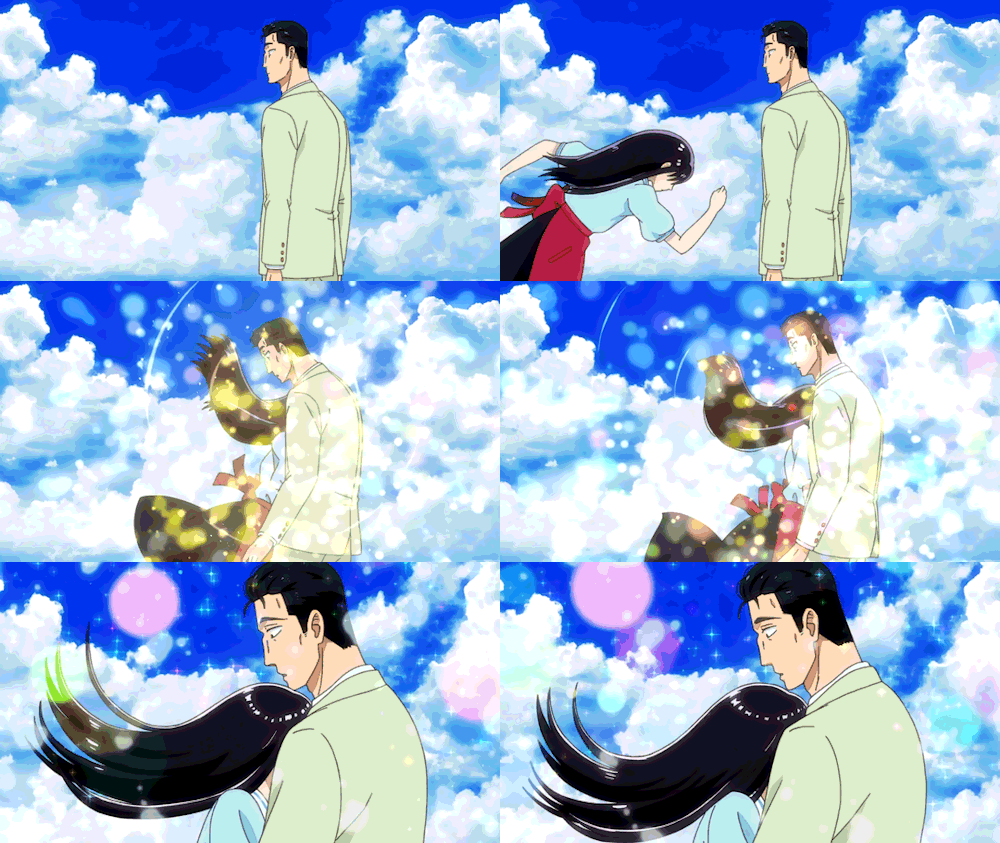
Which comes to where the show does excel, which is on its aspect of character drama. As the show continually institutes new characters, adding complexity to the narrative, different threads that will eventually be handled or otherwise strummed for emotional payoff, After the Rain spends its time analyzing the characters, their thoughts, their ambitions, and how they all interrelate. And it's quite skilled at this! After the Rain frequently takes a quieter approach to things, allowing scenes to play slowly and breathe, while also not going out of their way to bore you. Instead, small scenes of silence speak larger volumes. From simple shots of a pensive, love yearning, teenage girl gazing at the ceiling from bed, to more stupendous shots of sharing a literary quote while staring at the full moon, these scenes along with their gorgeous artwork highlight the subtle storytelling at play. Of particular note are the various dream-like sequences, which heighten emotional thoughts or climaxes with filters and sound-effects that give an emotional resonance, allowing the largely spoken-word screenplay to pull you around. As a character drama, After the Rain excels, with a fair if frequently somber and melodramatic emotional payoff by the end. But c'mon, if you're reading this far, you already know that this is a heightened melodrama.

It's when that character-analyzing melodrama ricochets over the more prominent romantic arc where things get tangled. After the Rain is inherently about Tachibana and Kondou, but because the show strings along the romantic aspect of the show, it ends up spending more time solving their personal problems without tying together their romantic disparities. It's the equivalent of going to see some shooting stars, but the sky is overcast; sure, maybe you can see glimpses through breaks in the clouds, but the payoff seems lackluster if your expectations were set on a more complete package.
What can't be faulted is the artistry on display. The subtle yet lush animation delivered by Wit Studio is great, and a very big diversion from their typical Attack on Titan flair, leaning more in line with the quiet, almost magical prominence of something like Ancient Magus' Bride, with less of the overt fantasy overtones. The animation features straightforward but earnest visual metaphors to balance out the narrative itself, and harnesses some of the sleekiest animation in the industry for some really enthralling shots. Meanwhile, while the music is also enjoyable, its quite forgettable, beyond the stunning ED Re:frain by Aimer, which you would be a fool to skip at the end of every episode.
If we are to judge a book by its cover, then how would one judge After the Rain after experiencing what it has to offer? While the premise is intriguing, the follow-through can leave a lot to be desired. While there is fantastic drama and realism within After the Rain, there is a lack of romantic bonding and execution on some of the narrative's core themes. And while After the Rain is certainly not a bad viewing experience, it might leave those who have high expectations leaving ultimately disappointed, not because the experience itself is unenjoyable, but because the execution was not as enlivening as it could have been under different circumstances.
35 out of 57 users liked this review
