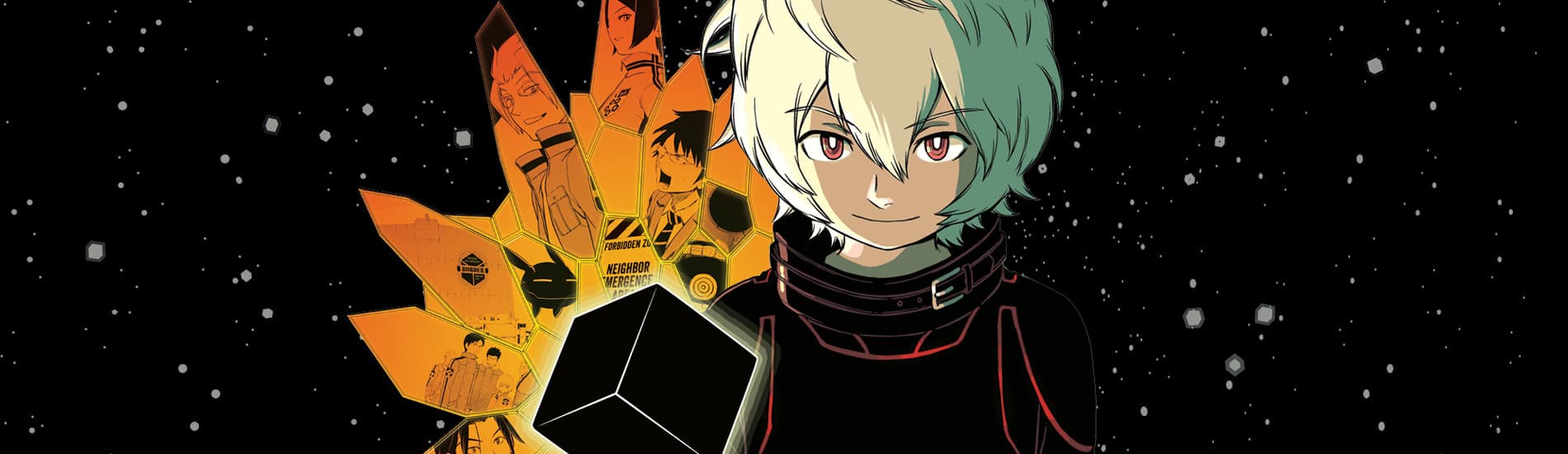

World Trigger by Daisuke Ashihara is a series that defies numerous expectations associated with the shonen genre. If it were poorly written, it'd be easy to make the case that these subversions exist to simply give it an initial "pulling edge", and cover up otherwise unremarkable writing. That's why I'm very happy to say that World Trigger's tendency to play with established shonen tropes is a side effect of the already fantastically-written world and story it wants to tell, rather than a band-aid to cover up a mediocre series.
Premise
The series' premise comes off unambitious and unassuming, almost deceptive in its simplicity: One day, a large portal opened up and a part of the world was attacked by monstrous beasts known simply as "Neighbors". In order to protect humanity from this threat, an organization was formed known as "Border", which uses Neighbor technology to combat the Neighbors. Everyone lives without worry, showing confidence in Border's ability to combat the Neighbors. The story centers around Osamu Mikumo, an awkward yet amicable young man going to Junior High. One day, a mysterious, white-haired kid joins his class, introducing himself as Yuma Kuga. When a Neighbor makes an unexpected appearance inside the city, Osamu takes it on, revealing himself to be a member of Border - and Yuma helps him out, only to reveal himself to be a Neighbor - a member of the same group that Border was established to fight!
#Plot
World Trigger initially feels like it's going to follow a fairly straightforward formula of "invasion happens, stop it, repeat", and for the first few chapters, that is most definitely the case - the first 10 or so chapters, outside of providing bits and pieces of info about the world, are almost mind-numbingly repetitive and formulaic. However, it slowly starts planting seeds, introducing characters and fleshing out the world of Border and the Neighbors, and as that happens the series begins to veer in a different direction. It soon becomes apparent that the premise is less about the concept of humanity against invaders, and more about the sides of Border, the different Neighbor factions, and the characters' growth in combat.
The plot structure is clean, sensible, and comprehensible - what's especially commendable is Ashihara's attention to logical detail. Very few times will you have to suspend your disbelief for the plot. Characters will never do something they shouldn't realistically be able to do, and anything that seems like it could cause problems later is openly discussed and addressed. The way everyone interacts and approaches things in a realistic, believable manner instead of handwaving plot elements for the sake of quick progression makes the scenes with talking or discussion just as entertaining as the action sequences, if not moreso. There's many lite-politics elements and tons of great worldbuilding to go around, and it's all plenty engaging. The plot reaches a high point during a very particular arc surrounding an invasion, which is full of revelations, high stakes and everyone fighting against the clock. The progression of the immediate narrative can be on the slow side, which might put off some people, but it’s done effectively in the name of expanding on the character, mechanics, and world.
#Battles
Shonen battle systems can range from simple to complex, and battles can be emotionally driven, logical, or simple. WT is firmly in the camp of "complex and logical". I can say with no exaggeration that it boasts one of, if not the best fighting system in an action shonen. World Trigger's fights are based primarily around teamwork and strategy. Though skill undoubtedly plays a role in more personal encounters, a large part of the fun is seeing how well a team will coordinate to take their opponents down. The Trigger system is based around characters using guns, swords, and all other manner of ability to dispatch their opponents, and Trigger rules are very well-defined and consistent throughout. The characters are all certainly intelligent and at the same time you can still feel where the gaps in their skill lie when they make decisions, making it easy to earnestly theorycraft about the outcome of a fight or what a character could have done better. The battles tend to involve a lot of characters at once - sometimes up to 4 teams taking each other on, and they're elaborate, intense, and an absolute blast to follow.

#Characters
The series is thankfully no slouch in the character department. Though Osamu Mikumo starts out not doing much, he begins to slowly grow into his own, learning to improve himself in a way that matters to the people he wants to help. He's an earnest “do-gooder” type of protagonist, but he is a very weak person in a world where you can't get stronger by wanting it hard enough, so that makes his drive all the more meaningful. Osamu's good intentions and realistic perspective make him feel refreshing and very likable. What's especially commendable is Ashihara's commitment to Osamu having a slow yet realistic rate of growth. Osamu, as a protagonist, has next to nothing going for him - no innate talent or skill. What he does have however, are powerful teammates, great teachers and a great drive to improve himself. It becomes clear early on that Osamu will never hit a point where he's more powerful than the stronger characters in the universe - he'll be useful and good in combat without necessarily being the strongest guy in a skirmish. Some find the fact that he's so weak to be bothersome, but if anything seeing how he improves is one of the most interesting parts of the story.
The deuteragonist, Yuma Kuga, balances out Osamu's straight-laced and kind nature with a goofy disposition and pragmatic attitude. Their dynamic is strong and lets the audience see how they learn from each other and care about each other. The series also has a very interesting female lead in the form of Chika - a timid girl with a sweet temperament plagued by insecurities and gifted with immense power, she wants nothing more than to rescue her brother and friend from the Neighbors. Chika is soft and sweet but this is never used as an excuse for her to never get in on the action. Instead, Chika's friends do their best to make sure she knows how to fight and contribute the best she can to their team.
There are a number of other characters introduced throughout, and even when they don't get as much screentime as more important characters, they all have a little something that makes them worth liking. From the dry, snarky Kikuchihara, to the stonefaced yet sensitive Murakami, there really is a character for everyone to like, and I guarantee you'll probably have a few favorites amongst the secondary cast. Ashihara writes his characters in a manner that is very believable - he gives them their own struggles, but doesn't make them angst dramatically if there's no reason for it, and instead prefers to convey their feelings and actions subtly. An unfortunate consequence of there being so many characters is that we may never see them all fleshed out in detail, but at the very least they serve a solid purpose to the story and we do get to enjoy them in one way or another.

#Artwork
If this series has a weakpoint, it’s arguably the artwork. Ashihara’s art is not bad in itself, but relative to other series such as Black Clover or My Hero Academia, the style is rather plain and lacking in shading, values, etc. Characters also have an odd thing where their expressions feel “stiff” - they don’t emote very well, as if the artist is afraid to play with their facial expressions too much past how he initially drew them.
However, on a positive note, the characters, despite being simple in design, are drawn with distinctly different faces, making them easy to pick out. The inking is also extremely clean, crisp, and conveys motion well, making action scenes a joy to follow - I don’t often feel like things are too cluttery or confusing on the eyes. Comprehensible art is arguably extra important in a series like this, where there can be up to five people attacking each other at a time. Ashihara excels in illustrating dynamic action, where sword strikes and speedy maneuvers are felt. Each fight feels cinematic what with the use of interesting camera angles and powerful perspective, further helped by the sprawling backdrops. I find the art to be a total treat during these scenes, but I acknowledge that it may come off plain to some.

#Overall
World Trigger is fantastic, and can only get better from here. What with a diverse cast of characters, delightfully intricate combat, and an engaging setting and plot, there’s little reason to not recommend it to anyone who wants a refreshing battle shonen to enjoy.
Content Warnings/Other Notes?
World Trigger's use of sexual fanservice is almost nonexistent. There's only one out-of-place joke involving a character who sneaks touches at the butts of uncomfortable women, which happens twice early on and never again. Character designs are all extremely tasteful and respectable. The nature of the series means there is a lot of decapitation and impalement, but it's bloodless and safe thanks to the artificial bodies everyone has.
The manga's English release is provided by Viz - the translation is fantastic, being of a very high quality and with minimal typos and inconsistencies. There's nothing wrong with the official release here, and physical volumes are available for the shelves aswell.
#Should You Watch The Anime?
No. World Trigger’s anime adaptation (handled by Toei) suffers from numerous issues, including but not limited to: horrendous pacing, subpar animation, absurd censorship, lower-quality artwork, and an abundance of filler content. Though some of the filler actually does do some very nice things to expand on the characters and foreshadow later events, I can’t say that any of it makes it worth watching the entire adaptation. But if you absolutely don’t mind these things and have time to spare, feel free to check it out. The anime stops midway through the B-Rank Battles arc, before the Galopoula Invasion, and as of me writing this is unlikely to continue.
UPDATE 11/4/20: The anime is set to continue from the Galopoula Invasion mini-arc, being helmed by a new director and staff. The quality looks to be better than the first run, but only time will tell for sure.