Yuri!!! on ICE
a review by KawaiiNyan
a review by KawaiiNyan
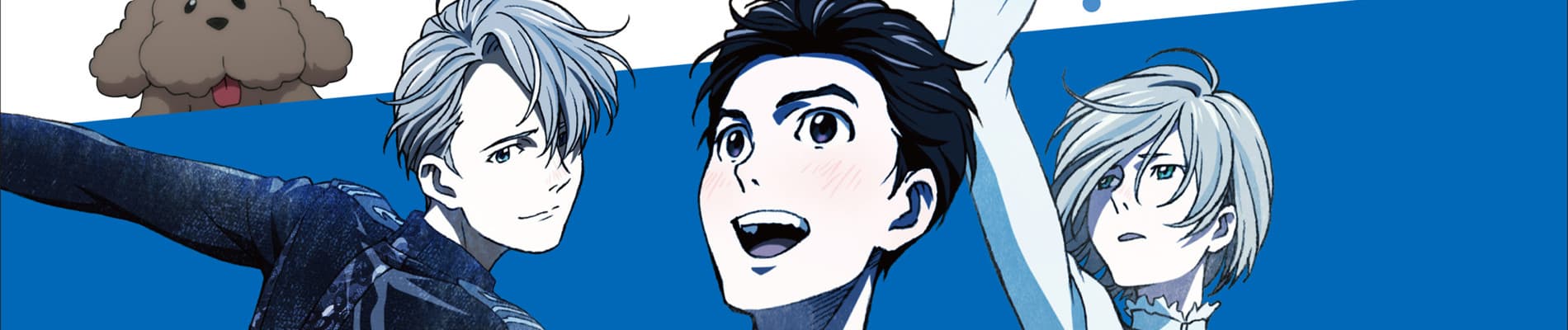
Yūri!!! On Ice follows a boy of twenty-three named Yūri Katsuki, who was once Japan’s most promising figure skater. However, after an agonising loss during the Grand Prix Finale, he returns home to consider his options for the future. One day while practising some skating at a local rink, a video of him performing his idol’s—Victor Nikiforov—programme gets secretly uploaded to the internet, where he reaps near-instantaneous fame overnight. In the wake of this viral video getting released, Victor catches sight of it and decides on the spot to head to Japan so that he may coach Yūri with his skating endeavours.
Before I jump into the main focus of this post, I would like to briefly discuss some of the more technical traits of Yūri!!! On Ice. The animation quality is mind-blowingly gorgeous! The artistic style implemented for the scenery around Japan is calligraphy inspired watercolour designs. The colours are vibrant and fit the respective seasons on such a marvellous level aesthetically speaking. During Autumn there’s dark orange with hues of purple and gold. Winter comes around the it transitions into darker purples with varying shades of blue, white, and greys. The outlines alternate between thin and thick brush strokes that captures the essence of traditional Japanese art. You see similar designs for each of the relative countries that the series takes us to, such as China, Russia, and Spain. On top of that, the vast majority of the show was rendered using 2D animation only, a feat that is nearly unheard of in today’s digital and technologically advanced climate. Yet, even with all of these things, my favourite aspect was the meticulous use of details that were woven into both the backgrounds and foregrounds. It made everything else pop in a subtle manner, while adding layers of dimension to the visuals.
The music is gorgeous as well and isn’t limited to Japanese instrumental styles or straight European classical songs, as would be expected from a series focusing on figure skating. We get music from around the world with songs in English, Thai, and more. The opening tune, History Maker, is filled with energy and romance that is the perfect compliment to just about every single motif explored.
The pacing is perfect! My expectation was a slow start with a rushed middle and an ambiguous finale. Things do progress a bit faster in in Yūri!!! On Ice than your typical anime, but it sticks with the initial pacing, and because of that everything else is wonderfully balanced to fit a twelve episode timeslot. There are three competitions that the characters go through and each one is given no more than two episodes a piece, leaving plenty of room to include actual storytelling rather than just one battle (so to speak) after another.
Those three technical facets tend to be make-it or break-it aspects for me when I pick up an anime. Everything else usually takes the backseat. If these three things are decent, then I know my overall viewing pleasure will be a rather… well, decent one. The only other thing that I positively adore with anime are themes, and when a series has a plethora of amazing themes to discuss, it can be so difficult to choose just one!
The theme I’d like to discuss is one that is quite near and dear to my heart, and also something that you may not see that often in otaku narratives but is finally making an appearance in some of the more contemporary serials (Banana Fish comes to mind instantly) and that is the theme of breaking common gender roles and expectations.
I recall from when I was a far younger individual, probably from around the time that I was between the ages of seven and eleven, figure skating was viewed as a prominently feminine sport. If there were male figure skaters, I would almost always be surprised to find them married to women. It had always been instilled into my head that figure skating was a sport for girls and any guys who partook were obviously gay. This terrible and outdated line of thinking wasn’t something I ever truly contemplated until recently.
How often do you see a guy wearing certain types of clothing, or even certain bright colours, and your automatic inclination was to view them as being “gay” or “girly”? The same can be said about their mannerisms. Yet, Yūri!!! On Ice takes those godawful stereotypes and preconceived ideals of what gender roles entail and blows them to smithereens, and I fucking love it.
I’m a gender non-conforming person. Growing up, I felt so weird buying clothes from the “girls” department. I didn’t care for dresses or fluffy, pink, and glittery things. But my mum loved that shit. Then as I got older, I would go look at clothes in the “men’s” department and I’d discover that those feelings of anxiety and discomfort never went away. Why is this jacket labelled as a “man’s coat” when it is literally the same thing as the one in the women’s department? Why can’t we just have “people” clothes and “people” mannerisms and etiquette? What is with this incessant desire to put a sticky note on everything with a tag that says “man” or “woman”?
Typically in anime—notably in sports anime—since there are so many male characters, you always have ones that are more ladylike in presence and behaviour, and they are almost always portrayed to be Queer. The same can be said about sports shows centring on female athletes, where the Queer ones are shown to be quite masculine. I find it to be offensive more often than not because I know plenty of gay men who don’t behave in such a way. The vast majority of them are just normal people that can’t be distinguished on appearance alone. I love that this specific series doesn’t use femininity as a gratuitous means of exhibiting homosexual dudes. It actual takes expectations and shatters them into tiny pieces by making these characters exactly what you wouldn’t normally expect.
These skaters dress in costumes laced in designs that shine and sparkle in the light. There’s mesh and nylon and satin and a lot of them tend to be very provocative and transparent. When you look beyond the attire of skating, you have individuals who are very masculine in nature. Yurio is the most obvious one with his rebellious attitude and attire of hoodies and chucks. Then you have another skater, named Otabek Altin, who wears a leather jacket and rides around on a motorcycle. He is the epitome of what people would label as “manly;” someone you may not expect to be a professional figure skater by far. It would be like imagining Dean Winchester doing a triple axle. Even when they put on their costumes and skate, their personalities never change. They don’t turn into these highly feminine individuals with a proverbial flip-of-the-clothing.
Likewise, you have a couple of characters that are feminine—to varying degrees—with their personalities and the ways that they engage with other people, such as the Italian performer, Michele Crispino. Some of things that he says and the flowery way that he engages with his sister, whom he’s quite protective of, can be construed as being rather effeminate. Yet, compared to Jean-Jacques Leroy (aka JJ), Crispino is quite low on that spectrum. JJ can be viewed as sensationally feminine. He exudes sexuality and a distinctly erotic vibe that most people would associate with a man that is gay, chiefly because his personality is exactly the same regardless of where he’s performing or not. Yet, he’s not gay at all!! He’s engaged to a woman.
Another more relevant example is Yūri himself. Victor is teaching him to step outside of him comfort zone in order to become the best figure skater that is possible for him. The song he’s tasked with performing to is all about being super erotic and seductive, and conveying sensuality, similarly to JJ but without garnering such a strong presence of sex. Yūri flirts with his eyes and his body movements, which allows him to create one hell of a programme. Not once did I ever feel him as being one gendered role over another. I simply saw him as a person. One individual that is working hard at what he loves.
Yūri!!! On Ice does a phenomenal job of breaking stereotypical conforming gender roles by showing watchers that men can behave in whatever manner that suits them and it’s not emasculating on any level and that there is nothing abnormal about it. You also see this with the women who tend to be gruffer and stiffer. Yurio’s ballet instructor and co-coach is an older woman who has a deeper voice and quite a masculine way of presenting herself. Nevertheless, she wears make-up and instructs ballet dancers on how to encapsulate pure beauty in astoundingly disciplined ways.
Terms like masculinity and femininity have no place in the anime and I strongly believe that they should have no place in society either. I do use them in my post here, but that is to convey the point I’m trying to make, not because I believe in what they stand for. Every single character is highlighted as a distinct human being who isn’t categorised into Box A or Box B because they have a penis and like to wear fancy costumes, or vice versa. Most of the folks in the serial who epitomise conduct outside of their assigned genders aren’t even anywhere close to being gay or Queer. When you do have people that are Queer, such as Victor and Yūri, their relationship is viewed as any heterosexual one would be: a gradual building of emotion between two people who get to know and understand one another in a highly intimate manner and setting. It is the most natural and lovely type of slow-burn romance that I could ever ask for.
Characters aside, another example of these moulds being broken against the ice is the way that figure skating itself is depicted. It is treated with utmost respect and shown to be one hell of a challenging sport that has many obstacles to it, none of which are gender specific. I always knew on a subconscious level how competitive figure skating is, mostly from my time watching the Olympics as a child, but I never knew all of the smaller details that these skaters have to learn in order to perform on such an outstanding level. Ballet, for example, never crossed my wee little mind as something that skaters would need to learn. However, in hindsight and also post- Yūri!!! On Ice it makes total and complete sense that things like ballet and also gymnastics would be relevant things to partake in to be a professional figure skater.
Whenever I learned something new about the different types of activities that skaters had to learn, to the mental and emotional pressure of outperforming your rivals and how unbelievably close it can get, to the expectations of people with specific established careers or folks in certain age brackets—none of these ever screamed out to me that it was all women-specific or stringently feminine. Hell, none of them even hinted at any specific gender roles whatsoever.
I have read many reviews for the show that were mostly written by people who watched the first two episodes of the series and then dropped it because they felt like it was a girly series that made then uncomfortable. Or they felt that there were “too many gays” for them to really connect to the story. Yet, after having seen the whole thing, I call super fucking bullshit. It’s because you don’t get this sort of shitty dehumanising crap from Yūri!!! On Ice that makes it such a brilliant series to watch.
Overall, Yūri!!! On Ice is damn-near perfect in every sense. Whether you are a person that prefers breath-taking visual cinematography, excellent music, character-rich stories, narratives about the underdog, themes on persevering, or just a show that is straight up fucking inclusive as all bloody hell, then you need to watch this anime as soon as you can. You honestly won’t be disappointed. It will make you laugh, cry, and feel so, so inspired.
8.5 pork cutlet bowls outta 10!
32.5 out of 38 users liked this review
