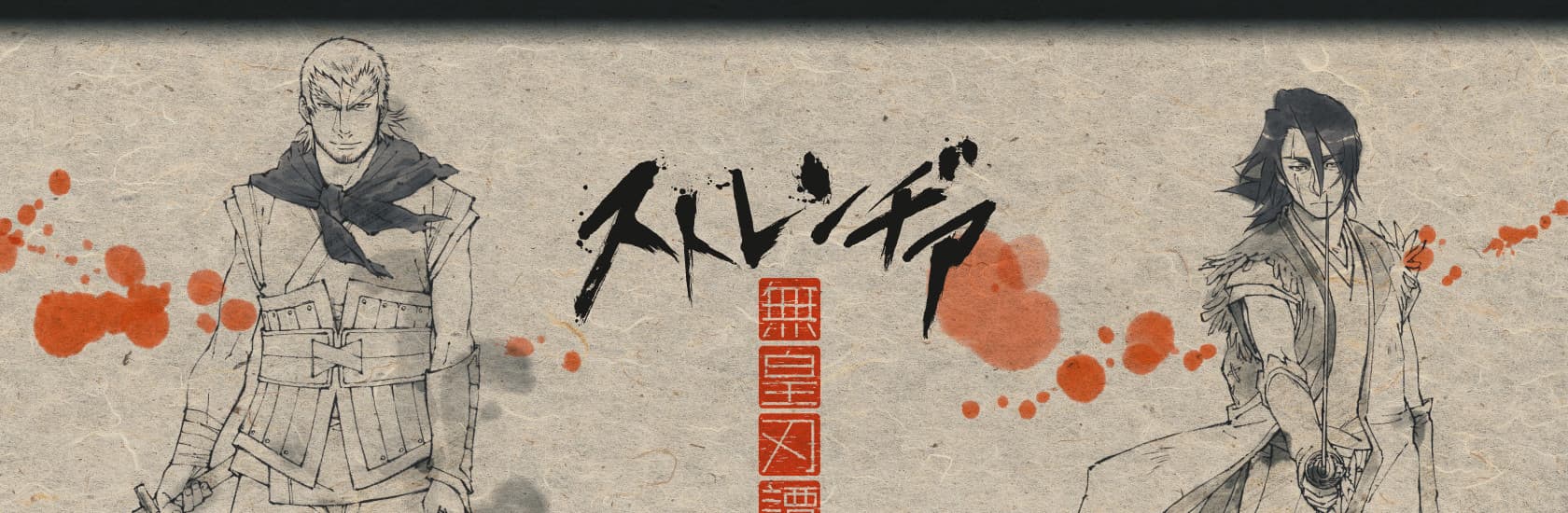
Sword of the Stranger takes place in Japan during the Sengoku Era (Age of Warring States, c. 1467 to c. 1568) and follows a young orphaned boy named Kotarō, and his doggie, Tobimaru, as they are being pursued by China’s Ming Dynasty warriors for unknown reasons. Along their journey, Kotarō and Tobimaru encounter Nanashi, an unnamed rōnin (master-less samurai warrior) who has vowed to never draw his sword again due to a dark and malevolent past. Through various plot happenings, Nanashi agrees to guide Kotarō and Tobimaru to a place of reprieve for the boy, thus building a deep bond along the way.
Please note: there will be spoilers for the film in this review, which will be marked when they appear. Read with caution. Thank you.
I am at a loss for where to begin with my review for this film because everything about it is so damn astounding. The premise, the animation (especially the action sequences), the music, the contemplative motifs—all of them work together to complement and enhance one another to build a film that is literally a masterpiece, never overshadowing one for the other. It is evocative, dark, and exquisitely revelatory of the era’s more twisted climates as well as human nature.
On the surface, Sword and the Stranger is about relationships and making amends. We have a young boy who has no parental figure or mentor in his life. It’s just him and his puppy against the blazing world. Then Nanashi enters the picture and shows the boy what it’s like to have that warmth that stems from having a father. A bond formulates between the two between mindless bickering, lessons of horseback riding, and intimate revelations of each other’s melancholy past. You see two deeply lonely individuals come to terms with the fact that they may no longer have to be as such. A pure and basic story at its heart. However, the execution of said story is prolifically breath-taking.
The film originally released in 2007, which was eleven years ago. BONES was doing fantastic work in terms of animation (Eureka Seven and Darker Than Black immediately come to mind) during this time, really testing out which bounds to push, and which ones weren’t up to par. With Sword of the Stranger, we are finally able to see their full potential as creators, as the film was one of the very first ones to utilise a seemingly flawless implementation of CGI graphics into hand-drawn cinematography to produce something that is sensationally fluid from one scene to the next, with vividly mind-blowing action sequences, character designs, and lush, splendidly detailed landscapes. From the opening scene, where rain and mud waltz in a flurry of defensive foot movements and swishing sword fighting to the serenely calming scene where Kotarō and Nanashi are riding horseback through the shores of a beach amid a backdrop of the setting sun. Both are culturally very Japanese in nature and highlight the best part about the animation: the details.
The intricate focus on details is what ends up sealing in the film’s beauty and raising it to the level of masterpiece. Close-ups of rain drops preparing to land upon the forehead of a dying soldier, the slight movements of straw as another character’s hat is sliced open, the gentle caress of the wind upon the bloodied fabric that holds Nanashi’s sword snuggly within its sheath—these minute aspects are layered one on top of another on top of another to formulate such a smooth and all-encompassing watching experience. It is damn difficult not be drawn in by the animation, given how stunning it is. All of these things are further accompanied by the musical composition.
There isn’t a lot of heavy or consistent music in Sword of the Stranger, which is another facet that is quite akin to Japanese aesthetics, uniquely of classic literature. If you have every read Haiku poems or anything by Bashō, these things will stand out to you almost instantly. It’s limited in quantity, but whenever it does make an appearance, it does so at pivotal points to the plot—when two warriors who are to battle to the death finally meet, or when Kotarō and Nanashi hit a note in their harmonising friendship—and instils within you a sense of profoundness, insidiously building up the tension and anticipation for the ultimate climax to come. So, it’s basic but brilliant. It’s intelligently psychological and gorgeously moving, more so when you contemplate the deeper meanings portrayed beneath all of the simple elegance of family and redemption.
Spoilers ahead.
Duality. This is my favourite thing about Sword of the Stranger. The consistent and multi-faceted exploration of the duality of death and what it means to be alive.
The Ming Dynasty warriors all take a special type of drug that renders them literally immune to pain and torture, thus allowing them to fight and fight and fight until they no longer draw breath. Only one character—Luo Lang—working on the Chinese soldier’s side, refuses to partake in the drug. He is someone who searches for that rush that you can only get by feeling everything around you, specifically in battle. There is no feeling quite like the one you get when you are facing death in the face with the chance of having your heart stabbed through or your head lopped off to make you realise that you are truly alive. Numbing himself to this sensation is without question unacceptable and disrespectful.
Then you have Nanashi. All he wants it to feel numb, to forget his past; to find some black, ugly corner where he can go die. He doesn’t take drugs to stifle his pain and suffering as he does this via alienation and avoidance. Feeling alive is the absolute last thing that he desires in the world because then it makes the sins of his past real. It makes all of the wrongs he’s done a ghost that he cannot run away from.
This duality of death that you see—one where the idea of death is exhilarating and the very essence of why someone should live to their fullest capacity, and one where the idea of it is a welcome escape—is everywhere in the film; softly woven into the conversations between Nanashi and Kotarō; slipped in between the battles that the mysterious Chinese soldier has with others, as well as the ones that Nanashi has with Kotarō’s pursuers; even forged into the swords that both characters fight with.
You see the duality outside of the two characters as well; a whisper in the overarching plot that’s never blatantly voiced, but meticulously implied. The Ming Warriors are sent on a mission that deals with a very twisted belief that the Chinese emperors of the dynasty were obsessed with—immortality—and this obsession was astoundingly anti-Confucian. During the Warring States period, within Confucianism death was viewed as something to be accepted and embraced, just as life was. If you didn’t understand how to live, you could never really understand death. Emperors were hell-bent on running away from death as much as they possibly could, thus defying this pivotal belief; a belief that their entire culture—at the time—and government was built upon.
Luo-Lang was the perfect encapsulation of the Confucian ideal of life and death while the Emperor that he worked for and the warriors that surrounded him were the epitome of anti-Confucian belief. He was very much the walking, talking, sword-fighting personification of the dual-nature of death during the time period; two sides of a single coin, as it were.
End Spoilers.
When you take all of the motifs into account—as there are quite a few that I haven’t even mentioned here—while setting everything else aside for a moment, you will see that Sword of the Stranger is an amazing allegory for the struggles that both nations faced during the time period, particularly where the dynamics of leadership and the impoverished people, who are struggling because of said leadership, are concerned. The wrongs of the king are never worth the blood shed by the peasants to propitiate those wrongs.
All in all, there has never been an anime that has ever come close to being what Sword of the Stranger is: a perfect blending of excellent storytelling, complex characters, flawless animation and visual cinematography, superb melodic structure, and true-to-era exploration of the political climate. It is provocative, emotional, intellectually pensive, and one of the finest works of art that I have ever had the pleasure of experiencing in my life.
As someone who rarely gives out perfect scores (five out of five for books, or ten out of ten for cinematic media), I feel that giving this film anything less would be a disrespect to what it is and what it stands for. Sword of the Stranger is one of those fundamental creations that I can honestly say: they just don’t make them like this anymore.
9 broken vows outta 10.
48.5 out of 51 users liked this review