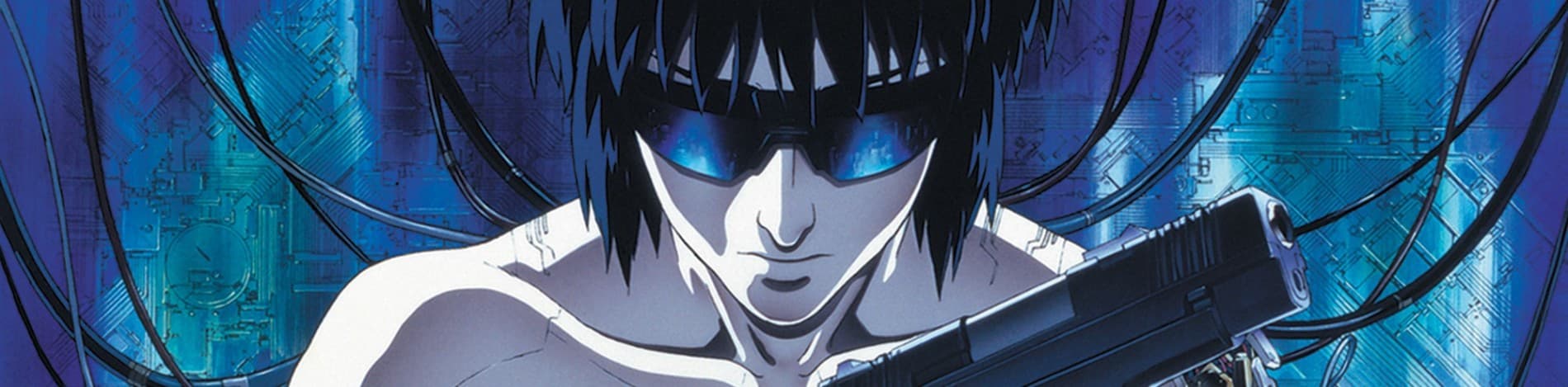

Ghost in the Shell (1995)

I believe that the act of explaining any subject matter is equivalent to the act of killing. In that regard, can a meager writer such as myself overcome the dire obstacle and responsibility that is explaining a movie like Ghost in the Shell? Am I a murderer willing to deliver verbal assault on something so sacred and cherished?
Unfortunately for all of you... I am.
I'm not here to argue a masterpiece case for Production I.G.'s tour de force (...kinda contradicted myself there); rather, I'm here to offer my own insights into the symbolism and thematic points of the film. With that being said, let us descend down the rabbit hole that is Ghost in the Shell.
In-depth review
CAUTION: POTENTIAL SPOILERS AHEAD
The year is A.D. 2029, a cyber hacker known only as "The Puppet Master" is being hunted by Japan's Internal Bureau of Investigations. Leading the hunt is the esteemed and stoic Daisuke Aramaki and his highly trained group of cybernetic anti-terrorist investigators: Public Security Section 9. Chief among them is Major Motoko Kusanagi, who's intense level of cybernetic augmentation seems to connect her on a certain level to the elusive Puppet Master. However, not everything is as it seems.
The world in which these characters inhabit is a cyber one. The Internet has become a collective unconscious that any person can tap into without a moments notice, thanks to brain enhancement. It's effectively stripping away our physical shells, and in this case, bringing Major Kusanagi ever closer to her soul in the process. It is what she may have been referring to as her "ghost". In plot terms, a ghost is a cerebral line of memories and brain function embedded into a cybernetic brain. But Kusanagi seems to be leaning toward a more loose interpretation. In her efforts of understanding this idea, she will become one of the first in a new stage of human evolution. Although, there is one other who's journey seems to parallel hers: The Puppet Master, aka Project 2501. Their relationship is one of many in Ghost in the Shell that tends to hook our imaginations.
Speaking of relationships, Kusanagi's partner in crime, Batou, has a very interesting dynamic with the Major. Their connection seems to be one of philosophical contradiction. Batou is down-to-earth and concerned with the material world, where as Kusanagi is grasping at the immaterial. In one of their conversations, she blatantly questions the significance of the human experience, comparing it to a simulation of sorts (An idea the Wachowki's would further explore in The Matrix), even doubting her originality. This is one of the elements of "cyber-punk".
As is the case with the cyber-punk genre (a genre practically popularized by this movie), there is a juxtaposition of high functioning technology with low functioning human flaw, especially in the case of city-scape. For instance, in one of Oshii's previous films, Patlabor, there is a deliberate display of poverty stricken districts alongside enterprising skyscrapers. Following his modus operandi, Oshii does the same here. This presentation seems to mirror humanity's willingness to throw away our past for the sake of future development. Yet, there remains remnants of our past to this day, almost like a ghost.
In a similar vein, the ghostly visage is present in physical terms as well, given the military use of therm-optic camouflage. As the opening scene indicates with the use of said technology, there is a heavy political tinge to the entirety of our story. To The Puppet Master, whom itself is a computerized entity, twirls governments and politics like a play thing. A political ruse orchestrated by Project 2501 serves only one purpose: Get closer to Section 9, and in effect, get closer to Major Kusanagi. In order to achieve a new sense of being, the consciousness that is 2501 must "merge" with the consciousness that is Kusanagi, who is in some way deemed like The Puppet Master. This is its goal.
Throughout the film there are omens foreshadowing the Major's fate. Whether it be short glances at a distant doppelganger, or ascending to a reflective sea floor, the Major cannot foresee the inevitable.
Concerning the inevitable, the closing stretch of Ghost in the Shell remains, for me, one of the most fascinating exchanges of ideas present throughout the film. And as of this writing, this has been a very personal study of a film that has long perplexed me. I hope my efforts have in some way pulled back the curtain, but even I understand that my views are limited, and you will have to come to your own conclusions.
Anyway...
Twas a good movie.