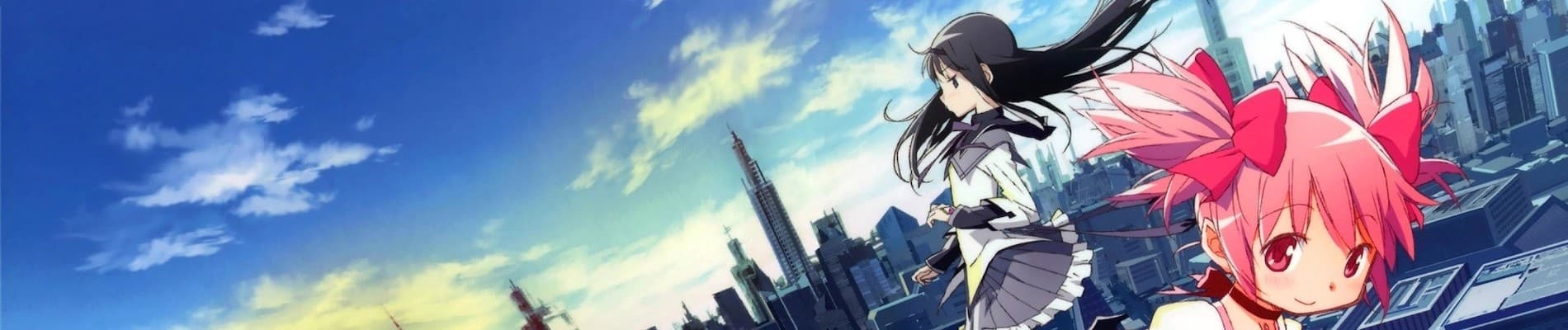

Here’s a hypothetical for you. Can a series that relies largely on a plot twist--some kind of tonal pivot at the very least--still be compelling if you already know it’s coming?

That’s not actually a hypothetical, of course. This is the perspective I went into Puella Magi Madoka Magica with. Eight years late to the party, an inhabitant of a media landscape the series has undeniably helped shape. PMMM is something of a genre sea change point. There is the mahou shoujo genre before Madoka, and there is the mahou genre after it, it’d be hard to mistake either for the other. In this way, despite many other easy overdone comparisons, I think Madoka is actually most similar to Alan Moore’s Watchmen. An outsider perspective on the genre that for good and ill, irreversibly altered what followed in its wake.
Every single magical girl series since Madoka has had to reckon with it in some way. This is the thread that unites things as disparate as Flip-Flappers, Symphogear, Wish Upon The Pleiades, Revue Starlight, later Precure seasons, and on and on. Curious that Madoka could be argued to be as much a cause as a symptom. Few other than Magical Girl Site predecessor Mahou Shoujo of The End are remembered today, but PMMM was not the only thing doing “magical girls, but dark” in its era. Why then, has this one grown so tall, and eclipsed the rest, permanently casting a shadow on the genre that both birthed it and that it irrevocably changed?

Well, that’s the question I went into PMMM hoping to answer.
Talking about yourself is bad critical form, but it’s impossible to separate an evaluation of this kind of work from the environment in which it’s watched, and in which it comes out. I was 17 in 2011, and I had absolutely no time for something like Madoka. My anime taste at the time was very limited, and I loathed depressing fiction (I’m not fond of it to this day, honestly), and well, you know how teenagers are. I thought that since so many people liked it it must be overrated. Caring about things is a form of vulnerability, so pointedly not caring about them is an expression of power. I was an asshole as a teenager, and for these reasons and many more, I very loudly Did Not Watch Madoka.
For years afterward, I was convinced I’d made the right decision. Like Watchmen, PMMM has a lot of detractors and fans alike that fail to understand the work in question or blame it for the effects it’s had on its genre. I was in this camp myself for a long time; as I got more and more into both magical girls as an idea and the mahou shoujo genre proper, I came to resent the series for so thoroughly blackening its outlook. I’ve since come to believe that this is unfair. Nobody goes into a show thinking they have something bad on their hands, but conversely, few people know they’re about to drop a classic.
But even when I got over that I had one last hangup. I reasoned that, well, I know how this story ends. Kyubey turns out to be an eldritch terror with the goal of using magical girls’ souls to stave off entropy. Madoka becomes God and sacrifices herself to save the world. Roll credits. I know that and as I’m typing this, have still never seen an episode of the show. If you’re reading this, you almost certainly know it too.

So why go into this now? So long after most people have settled their feelings and drawn their lines in the sand? Two reasons. For one, Symphogear, undeniably a series that is a response on at least some level to Madoka, is getting its final season in just a few days. I have a long, running review of that entire franchise that I wish to finish after it concludes. How can I possibly form a truly qualified opinion on it if I have not seen the series it was allegedly made at least in part, to converse with? Honestly that’s a question that applies equally well to many shows that engage with this one, and there are a lot of them.
The other reason is simpler; to look for more reasons. I want to like Madoka, and, dear reader, you and I are going to confront this colossus together. So whatever that little number at the bottom of this page ends up being, I am hoping that the 6 hours of my life I’m about to spend will leave me with a greater understanding and appreciation for the genre on the whole than what I had when I started.
Let’s begin, shall we?
To me, it’s clear that the main thing that Madoka shares with its parent genre is a certain enormity of emotion. This only makes sense, if “regular” (for lack of a better term) magical girl shows are fueled by the power of love and all other manner of positive feeling, then to make a “dark” one is to examine the flip side of that coin. The power of tainted love, bitterness, fear, all that jazz. An example; what eventually spurs Sayaka to accept Kyubey’s contract is not a desire to help people or anything of the sort. Her wish is to fix the hands of her apparent crush, a former violin prodigy who is suffering from the aftermath of an accident, so he can play again. Is this selfish? Absolutely, but it’s also very human.

Describing it that way makes it sound somewhat obnoxious, maybe even meanspirited, but unlike its contemporary (and fellow influence on the current crop of dark magical girl anime) Mahou Shoujo of The End, nothing about Madoka actually feels that way at all. Either by intent or by strength of craft is only so relevant, the show does what it does in this area well.
Emotions being big of course, does not mean they’re necessarily happy. Over the course of its run, Madoka, unsurprisingly, gets pretty damn grim. A lot of this revolves around the character of Kyubey, who, if you’ve been on the internet at all in the past decade, you likely already know as the creature that gives girls the “contracts” that make them become magical girls in the first place. He’s also the main villain, as you likely also know. Kyubey is something that anime villains only occasionally are, which is genuinely top-to-bottom detestable. He’s a wretch, and knowing about his real goal ahead of time, and that he genuinely thinks he’s in the right, somehow makes the whole thing worse.
 (no but really, fuck this guy)
But even with the rest of the cast--especially the core ensemble of magical girls--emotions run high, and run black. Sayaka’s crush is taken by a close friend, Kyouko’s father killed himself and the rest of her family after learning that his ‘new religion’ was only attracting adherents because of Kyouko’s magic. It goes on like this, and while the scenes about this kind of thing are definitely well-made, they’re also a lot to handle, and I’d blame pretty much no one for being put off because of them.
Then there’s Madoka herself. Madoka is fascinating specifically because she seems like such an ill fit for such a somber series. In a ‘normal’ magical girl show, Madoka’s character would lend itself well to being that of the protagonist. She has a very real belief in the inherent goodness of people, and spends much of the first couple episodes idly dreaming about how great it would be to be a magical girl so she could save everyone. In this show, by all rights, that should make her a terrible fit to play the lead role. This is a story where the world is puppeteered by eldritch horrors from beyond the stars. In fact, for much of the series’ run, it seems like Madoka has mostly been relegated to a supporting role in her own series.
 (sometimes literally)
The thing is, even someone with her personality is not immune to being ground down by the kind of situation she’s in. The series is not shy about showing the depths Madoka sinks to over the course of it. This is true for every character to a greater or lesser degree, but with Madoka it feels more intense.
Then there is Homura.
Is there ever Homura.
Homura is interesting because the kind of character she is in many ways comes from outside the genre entirely. Homura, as we eventually learn, is a time traveller, jaded by countless repetitions of the same span of time in an endless quest to right a wrong. The tenth episode gives us the details. In it, it’s her who occupies the ‘protagonist’ spot in what would be a normal magical girl anime. By the time she meets Madoka and Mami in her original timeline, they’ve already become magical girls. Eventually, they both die, and in desperation, she makes a contract with Kyubey, asking to do it all over. In the next iteration, she joins them as magical girls, but they still ultimately die and in Madoka’s case, become a witch respectively. This repeats. Endlessly, living the same month over and over, until we get to the timeline of the show, her personality drastically changing over time.

Homura’s story in particular also unfortunately reveals something telling. The show’s greatest narrative strength is its tone, it’s not afraid to go all-in on tragedy. But, because of the nature of the genre it adopts, it’s also its greatest weakness. Episode 10 is the first time I really felt the tragedy of the situation as it unfolded. Why? Because for better or worse, the tonal space that PMMM works in is one more aimed at the brain than the heart. Homura’s arc and the consequent dovetail into the finale are something of an exception, here.
The show has mountains of symbolism, the narrative is legitimately interesting, and the visuals and soundtrack are superb. Madoka has craft and talent for days. What it seems to have trouble with until its final few episodes is connecting in the same way that more straightforward magical girl anime do. The things that the girls go through are genuinely awful, but the immediacy of their tragedies is to a point dampened by the surreal horror of their situation. It doesn’t quite feel real. Until the last two episodes roll around and offer something of a solution.
Famously, the finale of PMMM involves Madoka becoming the apotheosis of hope itself. This is, narratively, the show’s grand statement. Madoka becomes not just a magical girl but every magical girl. A Christlike figure who exists at the beginning and end of time to absolve the other magical girls of their karma before they can turn into witches. As a story beat, it is a good ending to the series.
But conceptually? Beyond the bounds of Madoka itself, within its wider place in the genre?
It’s a little arrogant, isn’t it?
What Madoka puts forward, and indeed what drew Kyubey and the other Incubators to humanity in the first place, is that it is humanity’s capacity for emotion that makes us so remarkable. Madoka ends up embodying one of those emotions, but in the process of doing so, rises above humanity itself. Madoka disappears. Despite her attempt to assuage Homura’s fears in-show, the fact remains that from any reasonable point of view, this is a huge sacrifice she’s made for the benefit of everyone.

And that, right there, is the one splinter that keeps me from loving this series instead of just respecting it (though I do respect it. Much more than I initially expected to, honestly).
Even in the show itself, Madoka’s absence is felt keenly in the closing episode. And this is all painted as a grand statement--again, Madoka as not just a magical girl but an avatar, as every magical girl. In its last moments, the series offers us this:

It’s again a nice statement in a narrative context. Given the constraints of her universe, the universe Madoka creates is undeniably a better one. The problem though is not on a narrative level, it’s in a broader, meta sense.
Madoka isn’t every magical girl. There’s Sailor Moon, the countless Pretty Cure teams, Nanoha, the eponymous Sakura of Cardcaptor Sakura. There’s countless magical girls from the 80s that predate western awareness of the genre. Beyond traditional genre standards there’s Papika and Cocona, Hibiki Tachibana, Karen Aijo. Hell, there’s even Shoutan Himei, somewhere way out in the weeds. Perhaps looking on with envy.
Why the list? To emphasize that despite Madoka’s stab at universality, the story it tells is actually a very small one, one mostly about Madoka herself and Homura.
On this level, understood just as much as part of the ‘world story’ genre that also includes frequent point-of-comparison Neon Genesis Evangelion, Madoka makes much more sense. Honestly, taken that way (and consequently much more charitably), it’s a great entry into its genre.
However, part of experiencing art is living in the culture it spawned. And as I pointed out near the top of this review (and several real-world days ago for myself), we live in a world that is thoroughly post-Madoka, and the series’ impact has been largely on the magical girl genre. Has that impact been negative? Well, it’s hard to say.
Certainly, as much--if not significantly moreso--than the meaner “it’s magical girls but daaaaaarrk” stuff like Mahou Shoujo of The End, Madoka has spawned no shortage of imitators and disciples. Curiously though, a lot of those shows hit the sense of universality that Madoka aims for better than the series itself does, at least the ones that take the right message away from it.
And if Madoka has a message, it’s the same as the one found in an old phrase I heard once long ago, that I cannot recall the source of; To everything, even sadness, there is an end.
It’s bittersweet and imperfect--much like Madoka itself--but in the right circumstance it can brighten your life, and make it feel not so bad. Similarly, while my own feelings on the show are a bit more muted than I might’ve liked, it’d be genuine arrogance to act like I don’t understand why it means what it does to so many people. Sometimes you really do just need a reminder that always, somewhere, someone is fighting for you. That none of us are ever truly alone.