The phrase, “That which does not kill us makes us stronger”, is one that's been made popular over the last century through various means. Originally coined by ‘entry-level’ philosopher Friedrich Nietzsche, paraphrased later by the likes of award-winning artist Kanye West and only last year, happened to be used by me: one random person on the internet, in reference to the anime community and its initial reaction to the 2018 anime, Goblin Slayer. With it I pleaded to the community, fans and haters alike, to learn from the controversy it garnered off a single implied rape scene lasting no more than 15 seconds. To not cast people aside with shoddy labels that only commit more harm, and maybe, just maybe, grow stronger as a community from all this.
It’s six months later, and I’m upset.
In no more than two weeks since Goblin Slayer finished airing, we all got ourselves up in arms again. For another popular anime series had started that deserved all the vitriol received, well deserving of the titles thrown towards it. Disgusting. Outrageous. Repugnant. A dozen other adjectives synonymous with the terms aforementioned. And a complete abomination in the eyes of the community. But it was not due to using horrendous-looking cell shading CG that could have possibly caused eye-cancer, nor did it feature explicit and gratuitous fanservice to sexualise numerous female characters, or even repeat the sin of its predecessor with another rape scene. No, instead the thing that really got underneath everyone’s skin was simply the use of a false rape allegation…
I apologize for having to bring this up, but this is important to mention. Community discussions of seasonal anime deemed controversial, whether on Reddit, Twitter, internet forums, etc. seem to now become the focal point of how the average joe is likely to judge the show’s quality. How much does this piece of media adhere to our beliefs and who are the people this series offends are questions becoming more apparent as time goes on. While I believe there’s value in viewing a fictional work through this sort of lens, there’s something we need to understand. We can ignore the fact that we’re applying these notions upon Asian cartoons, made primarily for an Asian audience, probably speaking to the social issues and politics of Asian countries if anything. Because just as these aspects have been disregarded by the vocal side of the community, so too were attempts to critique the series for quality.
Does the use of a false rape allegation intrinsically equate to bad writing? In my opinion, no. I find it difficult to say any mere concept or premise is of inherent poor quality, instead being determined through the presentation and execution of such. But Lord Almighty, with a series like this, it certainly tests the extent of that view. Make no mistake, I am not a fan of Rising of the Shield Hero, nor was I a fan of Goblin Slayer, but these two series were bad to me for more… defensible reasons. Reasons that relate back to the core elements of the show and will be further explained in my review. So sit back, relax, have a cool beverage beside you and let the catharsis commence. Might as well call this ‘Late Registration’, cuz you know I’m takin motherf***ers back to school.
*THIS REVIEW CONTAINS SPOILERS*
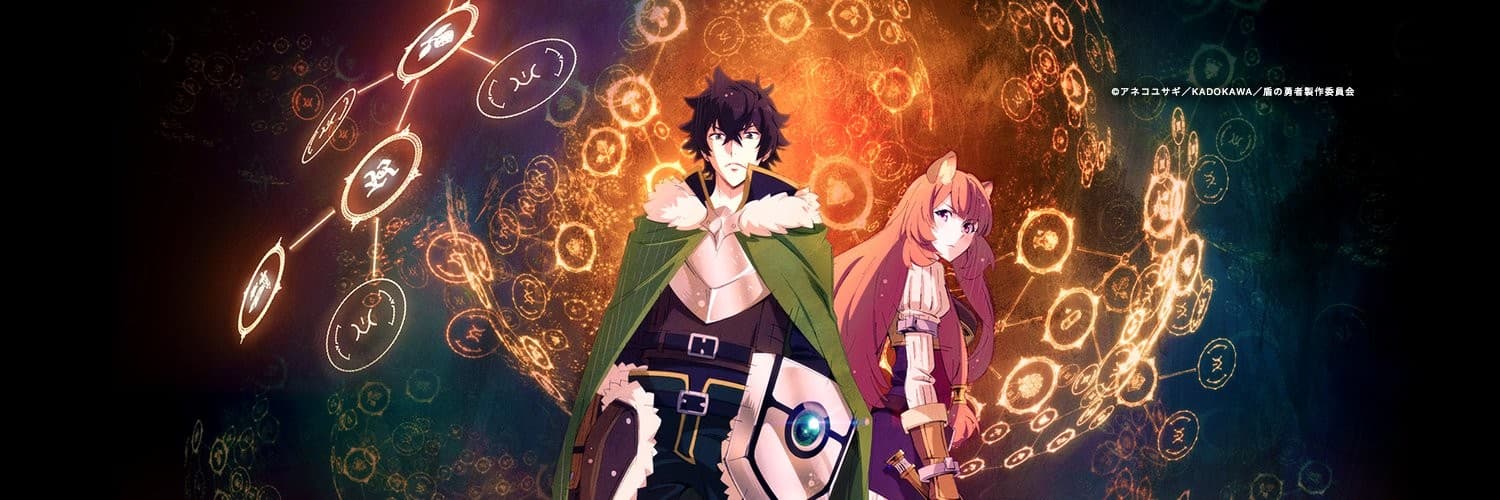
Rising of the Shield Hero initially seemed to be the most typical of isekai light-novel adaptations in the last decade. Naofumi Iwatani, the protagonist is introduced as a completely run-of-the-mill otaku, who through reading a generic-looking light novel is transported to a standard RPG-themed fantasy world alongside three other ordinary otaku who must become heroes of the land. Sounds like a typical isekai, right? It even goes so far as to provide some of the shallowest reasoning for why people dislike Naofumi: out of the four who wield legendary weapons, he is burdened with a shield – the “weakest” of the four weapons that only bad MMORPG players would use. Because what kind of elite gamer would ever play a support role? Omegalul. Regardless, the series appears as though it’ll follow the standard formula of many isekai stories that came before, forming a fantastical adventure centring around a main character who may lack in personality, but has generally good upstanding morals we can all appreciate. Right?
Well fellow gamers, it ain’t that simple.
One of the most common tropes of isekai stories in recent memory is how circumstances are created largely to garner as much sympathy onto the protagonist as sincerely possible. But here, forget the last three words of the previous sentence. In one day since arriving to this new world, Naofumi’s world is turned upside-down in a way only conceivable through the power of isekai. He’s falsely accused of rape in a matriarchy by Princess Myne, one of the most powerful women of the land, for motives implied as a way for her to gain the affection of another hero. This is not the first instance where rape has been used in fiction, but it might be one of the densest examples, even in the anime medium. It was explained in the same episode how the four heroes were prophesized to save the world from total destruction, only for her to risk that just for attention. What kind of self-centred egomaniac would one have to be, to do this when already being a princess and potential heir to the throne? It doesn’t do the show any favours to demonstrate how obvious of a false accusation it is, from explaining how no trial or investigation can be made, to the princess rubbing this fact in the protagonist’s face. Tactfulness on such topics can go a long way to evoking genuine emotion from an audience, and here they’re simply treated to outline the most disastrous sequence of events that could have occurred to dear Naofumi.
It’s no secret the show paints its protagonist as the picture-perfect example of an innocent victim. His situation is as unfair as one can imagine; literally everything goes wrong for him in the span of one episode, with almost no one wishing to lend a helping hand. The royal family hate him, the other heroes are disgusted with him, regular civilians see him as less than human and on top of that, he is exiled from the Kingdom. It’s probably the show’s biggest strength with how easy it is to root for someone in Naofumi’s position no matter how contrived and exaggerated the events that led him there were, akin to rooting for a clear underdog. But there’s a limit where the show goes out of its way to demonstrate how much garbage is piled onto Naofumi’s shoulders, that it becomes hard to take seriously. And the rubbish is constantly brought up throughout the series progression. As soon as someone is considerate for his troubles, you can bet money on the chances that a villain is right around the corner, specially to remind the audience about his victimisation. As a result, Naofumi is no longer receiving as much sympathy as intended; instead the emotions evoked are more along the lines of anger and frustration towards the series and its direction.
To the show’s credit, it does play around with the limitations placed upon Naofumi. While he is reduced to a supporting role on the battlefield at first, the story utilizes clever ways to him to still act in a valuable way by making the shield the most versatile of all weapons. Possessing what appears to be an unlimited skill tree for abilities that coincidentally factor in to how he is able to survive after being outcast, that simultaneously explores the internal mechanics and lore of the series noticeably. But he still cannot attack effectively, and thus is reliant on using companions to fight for him, the first of which being a sickly demi-human girl named Raphtalia as a slave. In all honestly, I found this to be interesting setup; bringing some of the lowest of the low in society together and grow stronger, co-operating in a relentless struggle to overcome all the obstacles thrown their way, and maybe have something to say on the nature of slavery. And while most of these do happen, we have to remember: this is anime, and adapted from a light novel at that. Even these expectations aren’t met with satisfaction.
What showed promise as a character drama that slowly builds a respectful relationship between the two is also exiled from the conversation. There are potent moments worth commendation, like Raphtalia confronting her fears and regret, as well as the pair declaring their loyalty to one another. But these moments are few and far between the amount of times Naofumi treats her as beneath him – an almost exact parallel to how everyone else views him, and this continues past these scenes of reaffirmation. Whenever Naofumi has shining moments of noble morale, he always reverts back to his brooding nature and clear disdain of women. It’s not like one could miss the latter fact about him either, with the series continuously portraying him as a self-insert main character who just so happens to have multiple monologues detailing on how terrible everyone other than him must be, especially women. Because why else could he have such intense hatred towards everyone around him? They all must be guilty of this. This would have been much easier for viewers to digest if it had shown Naofumi significantly learn from this and find trust again in others, except that his development (if at all) is so drawn out, inconsistent and the fact that we are never shown what the character was like previously besides Mr. Generic 101.
The show never views Naofumi in the wrong, with anyone allied alongside him being good and everyone pitted against him being bad. Classic black and white dynamic with Naofumi hailed as the arbiter of morality, regardless of how questionable his ethics really are. Let’s not forget that our protagonist and epitome of goodness justifies his “tough love” towards Raphtalia with the reason that at least he gives her basic necessities such as food and water. Kanye may not have been great at articulating his thoughts on slavery, but they come off as truly profound compared to the protagonist’s morally-bankrupt mindset. Not once does the series condemn his views or actions towards others, and it’s this kind of favouritism toward the most important character that no longer makes him the underdog of his own story.
If you haven’t realised it yet, the protagonist is also a clear-cut Gary Stu, even with being hated by the majority of characters. Not only is Naofumi the owner of truth and knowledge, he happens to have the most overpowered weapon in the world, overcomes nearly every obstacle set in front of him with little to no sweat and, by pure accident (of course), is surrounded by a harem of attractive women. Seriously, even with all the unfair disdain put on him, this seems like a dream scenario for otakus around the globe. Even with a defensive weapon, he is still shown to be the most powerful of the four heroes, even overwhelming one on several occasions. The shield is versatile, so much so, that it almost nullifies the initial limitation put on Naofumi. This shield can:
At what point here can we call the shield broken like a mother****er? Of course, he has to always get a sudden power up from “pure hatred” when it’s convenient. But Naofumi’s overpowered abilities aren’t just restricted to battles; he doesn’t even have to fight someone, just put Naofumi in a race with a 2-day old bird against cheaters and he’ll still find the ways to win fair and square. There's no excuse. How can one man have all this power? This is the type of lazy writing you can find in more episodes than not. It’s concerning when your self-insert protagonist has incel-like tendencies, and the story panders like this to the wish-fulfillment part of the fanbase. When you constantly push one character up on the highest pedestal, other characters are unintentionally going to be pushed down, which leads me to every other character in the show. Because while everyone might hate Naofumi in the world, it’s everyone else in the show that actually suffer.
Naofumi’s harem is comprised of a few distinct characters. Raphtalia, the demi-human that went from loli to “maybe” legal over the course of a couple episodes. Filo, a Filorial loli who hatched from an egg and openly calls Naofumi her master ( ͡° ͜ʖ ͡ °). And Princess Melty, a good-natured woman whose main service to the plot is acting as opposition to the woman that accused Naofumi in the first place. Out of the three, Raphtalia is the only one to receive any focus from the narrative, but even then her arc is scattershot. Wanting to fight for Naofumi and essentially falling for him in the first few episodes, to subtly vying with Filo over his attention. She is given an interesting moral dilemma in multiple episodes about whether or not she should kill a slave master. Only for her to not have to decide as the man falls from the windowwwwwwwww, to the floor! That is the general overview for Raphtalia over this season. It may not seem like much, but that is still more than either her companions had. The most development Filo had was how she reached “adulthood” in just two days. As it stands, Filo is only there to fight and look cute. As for Melty, her motives are simply to restore whatever relationship there was between Naofumi and the King, and wherever Melty goes, her sister is always close by, waiting to give more reasons to pity the Shield Hero.
If you thought the characters above sounded bad, you do not want to know about the villains in this show. Thankfully, there isn’t much to tell, since they can all be summarised by “everyone hates Naofumi”. This is the extent for everyone that is not helping Naofumi on his quest. The other heroes aren’t exempt; they turn out either oblivious, stubborn, delusional, or a combination of the three nearly all the time. Ever since the first episode aired, fans of the source material promised that the arc where both Princess Myne and the King got their just desserts was all worth it. I cannot comment on how accurate the arc was adapted, but here, in the anime world, this arc proved just how insufferable these characters can be. It took this show over 20 episodes to get to this point, and finally – after months of build and anticipation – FINALLY, the heroes take off their invisible blindfolds, remove their imaginary earplugs, and finally stop acting so mentally challenged towards Naofumi. The sad part here, is that you could feel this was meant to be the show’s climax, regardless of how juvenile it was. And they could have gotten any with it too, if it weren’t for all these characters being forced into a position, where they had to go along with everything that was so obviously propagated against the protagonist…
It's been six months, and I’m upset.
I’m upset because even with the crass use of rape allegations, the contradictory worldbuilding, the lacklustre characterization, the Gary Stu, the inconsistent development, the fact it's another f***ing isekai, etc. I don't hate this show as much as you would expect. For all the issues I’ve described, there was still part of me that kept hoping, yearning and wanting this to turn out alright. It’s easy to want to root for an underdog, and even with being one the most popular shows of the season, it got laid out to dry by the community almost instantly. No concept or premise is inherently bad, at least that’s how I feel. And what better way to prove that, than to see a show take one of the most controversial topics in the current day and turn out something special. I sincerely wanted this show to succeed, but Rising of the Shield Hero was not meant to be. There are still parts I like about it though: the shield’s versatility is still very intriguing, the animation and sound while inconstant and not great is still better than many other past isekai shows, most of the battles that took place were enjoyable, there’s still an insane amount of lore for the series to explore… And I do feel some sympathy for Naofumi’s character.
This was not the show for me, but very well could be a show for anyone interested in the isekai genre, MMORPG’s and a story about one man given the worst circumstances, overcoming the hatred of the world and, maybe somewhere down the line, can learn to trust again. If this is a show you enjoy, all the power to you. While it wasn’t my personal cup of tea, we each have our own unique tastes, and I can respect that.
43 out of 55 users liked this review