Mirai
a review by bitchassdarius
a review by bitchassdarius
In the planning stage of Mirai no Mirai, significant consideration was put into the designing of the house in which the majority of the movie is set. In fact, director Mamoru Hosoda employed a real architect, Makoto Tanijiri, to design the Oota house. The house is a series of four levels, not quite stories as it were, connected by a series of steps on one side of the house. It's a peculiar layout, as noted in a throwaway comment made by the grandmother at the beginning, designed in-universe by the architect father. A sloped tracking shot near the beginning of the movie, similar to Wolf Children's famed lateral tracking shot, moves between each level to show how they are attached. The first level is a den, mainly inhabited by the four-year-old son, Kun, and his train sets and toys. The next level up is a lawn-type outdoor area, followed by the kitchen and living area, then finally the bedrooms. Tanijiri planned the house so that a "child will be able to see the bottom room clearly from the garden, but an adult will only be able to see what's right in front of them." The effect? "The child's view will change as he grows up.”
What seems like a small detail of the movie is in fact the most important, as it sets up the entire thematic structure. In contrast to Hosoda's previous grand cinematic declarations on family and life, underlying the superficial coming-of-age story of Mirai is a focused meditation on the architecture of time. Of course, true to his nature, Hosoda interprets time and space as relative to our family histories. For Hosoda, time does not move laterally, rather it flows back and forth through the levels of the family tree, just as the aforementioned tracking shot shifts repeatedly between the levels of the house. Each generation experiences time on their own distinct level, yet the time of their ancestors and descendants are always within reach.
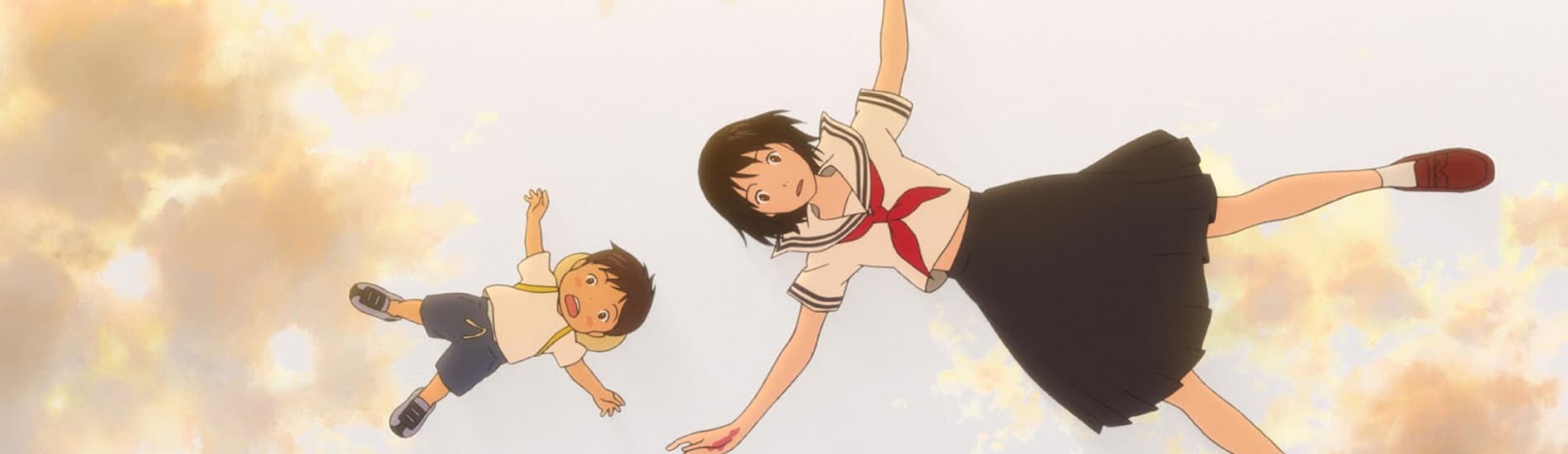
In Mirai, this platitudinous reading of time isn't a reading at all; it's the extraordinary reality of the movie. The expanse of the narrative finds Kun, in the garden of the house, drifting through time to meet anachronistic versions of family members he currently knows. The first instance of time-travelling antics (though not the first scene of garden fantasies) delivers Hosoda's vision the best. Kun, frustrated with his parents doting on the newly born Mirai, runs into the future, middle school-aged version of his sister, along with their anthropomorphic dog. The scene is filled with Marx Brothers-styled hijinks and light exploration into the logistics of Mirai's time traveling. But the scientific implications are quickly abandoned because time travel isn't really the point. Kun goes on to meet the past versions of his parents, and then their parents, learning a lesson or two from each encounter, and these subsequent scenes are more mired in heart tugging magical realism than heart pounding sci-fi. Some may find the episodic structure to be off-putting, but given the design of the house, a matching series of seemingly contained yet faintly connected stories appears to be more than appropriate.
The kicker is that pretty much the entirety of the movie, time traveling and all, takes place inside the Oota house, in the garden, in the present. And this seems to be Hosoda's insinuation: the past and the future are united in the present via the family tree, a statement he articulates in the wonderfully directed climax in which present-day Kun and future Mirai witness landmark events from their relatives' pasts, including a deeply touching famed race mentioned by the grandparents earlier in the movie.
At certain points, Mirai no Mirai offers glimpses of Hosoda at his compulsive, unrestrained worst. Pregnancy fetish and furry scenes can be checked off the "obligatory Hosoda-isms" checklist within the first act, and his penchant for exploring enclosed dimensions, seen in his earlier works, returns in full masturbatory force during the worst scene in the movie, the lead-up to the climax. Animated mostly in (decent) CGI, it's visually incongruous with the rest of the movie's style and thematically divorced as it has little to do with the nature of time or family. It's full of those (POV travelling?) shots he employed so daintily in Wolf Children, but instead of snowy knolls and forests, it's ugly, repetitive train tunnels. It also lingers for far too long, almost ruining the climax. But these pockmarks are minimal and eclipsed by moments of Hosoda at his most honed, absolute best.
12.5 out of 16 users liked this review
