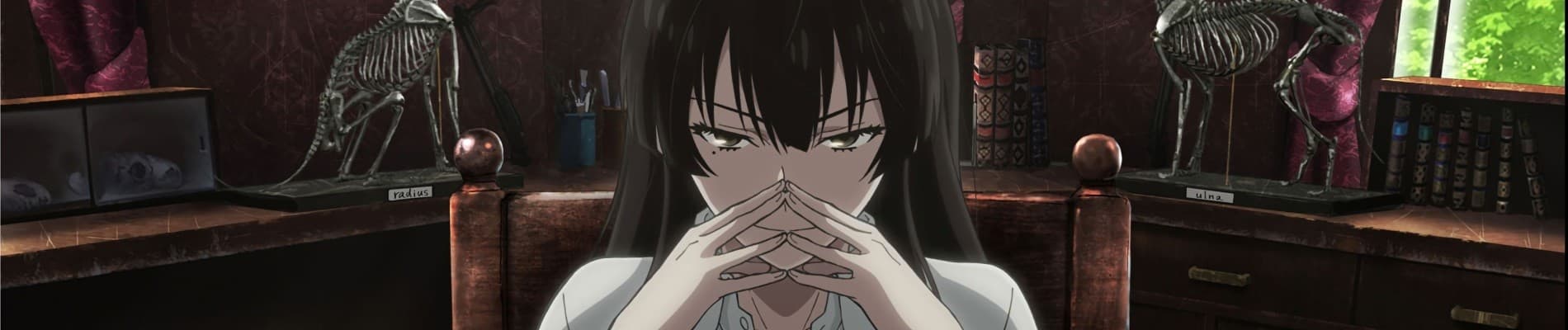
There are a million variations on the saying “the only thing certain in life is that it will eventually end.'' Benjamin Franklin’s quip, also invoking taxes, is probably the most famous version in the west. It’s true, though. The world over, all human cultures are united by the inevitability of death. Those who occupy themselves with a fascination with finality while still living tend to be viewed as a bit odd. In some cultures respected, in others feared, in some, merely looked at with a cocked eye.
The titular Sakurako of Sakurako-san can in some ways be seen as this trait taken to its logical extreme. Anime (and narrative fiction in general) is built on archetypes. The tsundere for example, is a cartoon reflection of a real behavioral pattern. Sakurako broadly falls into a similar reflection, though a less common one. She is a ‘mystical woman’, removed from the day-to-day of ordinary life, isolated by her calling. In this case, she’s an osteologist, forensics expert, and amateur (by professionalism, not competence) detective.

Sakurako is haunted by the recollections of those she’s lost. Most notably her younger brother and her two cats. There’s more than a little indication over the series’ run that her bone-collecting is as much coping mechanism as genuine interest. It is here where the meaning of the tagline that opens each episode comes into focus. As much as any of her “clients”, it is Sakurako who is trapped by her past.
Really, Sakurako is an absolutely fascinating character. Her peculiar, sideways morality is highlighted a few times throughout the show’s run, the woman never turns down a case that could give her access to a skeleton to pick at. Her backstory is drip-fed, slowly, with only small bits and pieces being revealed over the course of its twelve episodes [and only actually becoming clear at the end of its final arc]. I’ve seen her compared to Sherlock Holmes and the comparison makes some sense. Sakurako is intensely antisocial, often straight up rude (ostensible protagonist Shoutarou Takewaki frustratedly “Sakurako-san!”s at her enough times to tell her off for it that it almost becomes annoying), and has keen observational prowess. The process of using which she describes--in a deliciously melodramatic turn of phrase--as “connecting the bones”.

Takewaki, as mentioned, the other protagonist, is not quite as compelling. This is less damning than it might sound--it’s hard to stack up to a character as memorable as Sakurako--but he’s definitely the weaker half of the duo. Takewaki is pretty ordinary and serves mostly as a grounding rod for Sakurako’s weirder impulses. He also harbors a massive crush on her, which, as the show progresses, turns into a sort of open-hearted admiration. It’s certainly possible to read it as romantic if you’re so inclined, but, it’s clearly intended to be read as a mentor/student sort of relationship. Something that’s actually rather rare in the medium, outside of certain stock shonen archetypes. The two's relationship ultimately helps free Sakurako of her self-imposed shackle to her past, and it's nice to see this sort of thing work out for both parties without becoming romantic.
As for the show itself, ultimately much of what Sakurako-san is about, as much as the character arcs of its protagonists, is the realities of death in Japan. The many ways it can come--by chance, by violence, by tragedy, by simple accident in one case.
Often, Sakurako-san focuses less on the deceased themselves and more on who they leave behind, and how the loss affects them. The show’s halfway point--the sixth episode--features a lengthy scene in which schoolgirl Yuriko and her teacher, Isozaki argue about whether they have the right to track down a woman they believe to be suicidal. The show takes neither side explicitly, not until a number of episodes later, but it is Yuriko--of the position that they not only can track her down, but must--who presents the stronger argument, aided by the fact that we know that she lost her grandmother just a few episodes prior.
In general it is the living, despite the subject matter, who create the tales in Sakurako-san. On the flip side of mourning is those with secrets to keep hidden. More than once, some form of foul play is involved, and the series is not afraid to delve into the ugly gristle that would compel such foul play in the first place. Lots of reputation-based face-saving and desperate grabs at sentimentality on the part of the characters here.

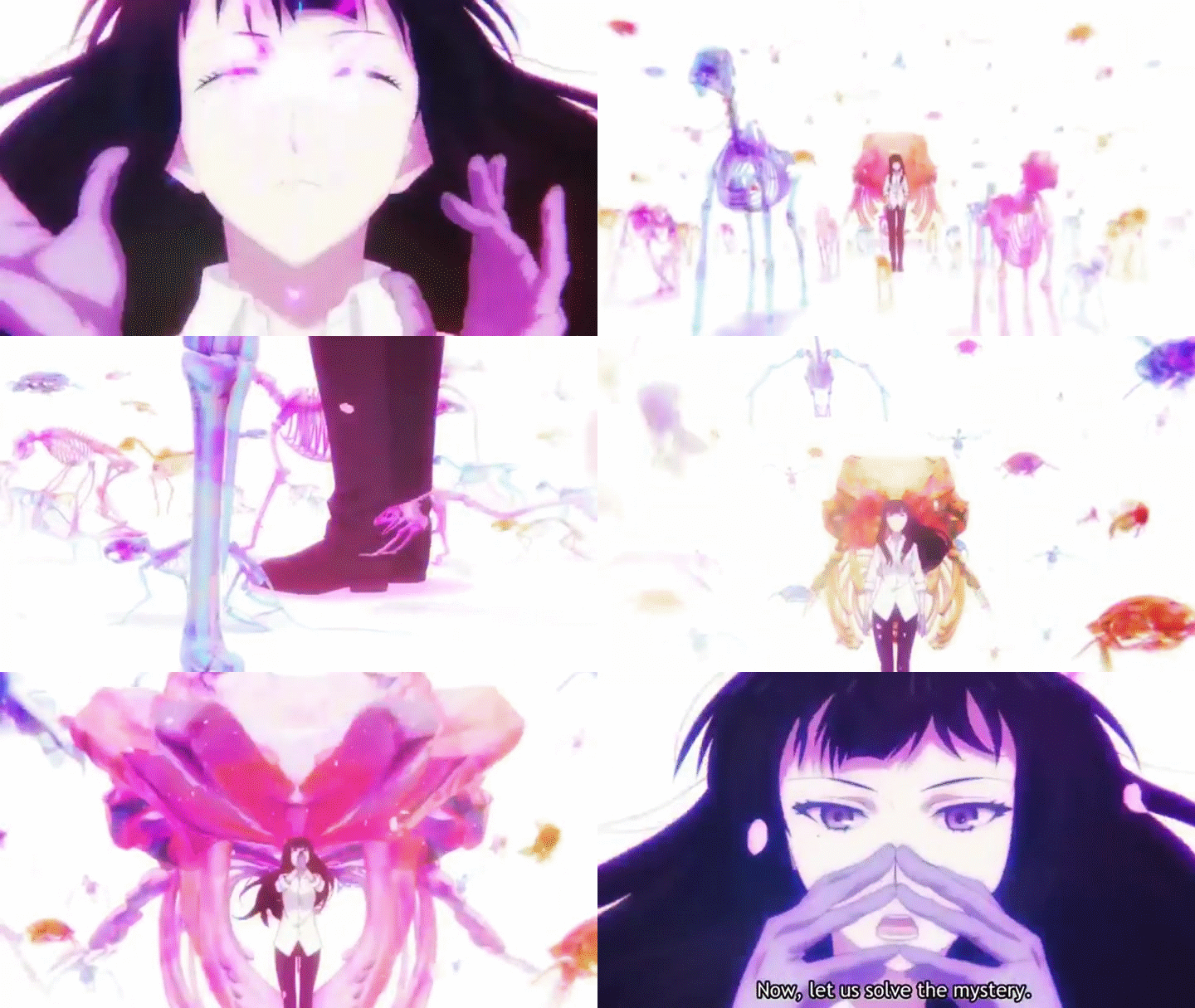
Despite what this might imply though, the series projects a similar dusky liminality to more overtly-mystical works like xxxHolic and the quieter episodes of the Monogatari franchise. Probably the show’s single most famous element is Sakurako’s “let’s clear up this mystery” sequence, a bizarre, sideways homage to magical girl henshin transformations that would be out of place in Sakurako-san, if not for the fact that Sakurako herself often seems like such a mystic enigma.
Honestly, for its by-necessity gritty subject matter, Sakurako-san is surprisingly devoid of much that scans as terribly macabre. Sakurako-san finds romance in dirt and bones. Would-be lovers and a mother and child are united in death. A woman frees herself from her past by casting a ring into a river. A depressed salaryman is saved from suicide-by-painting. A grandmother’s tragic accident in the woods is because she wanted to see an inspiring sunrise her husband had painted years before. It is a melancholy but undeniably romantic--even strangely hopeful--worldview, and if allowed to seep from Sakurako-san’s bones into your own, intoxicating.
That’s not to say it’s exactly relaxing. The show’s final arc in particular dives into much darker territory. A story about a murder egged on by a mysterious, from-the-shadows manipulator who raids dead bodies to steal their sphenoid bones (it is here that the show finally ties its odd fixation on CGI butterflies to something).

In what I must imagine was a controversial move at the time, the final episode does not actually conclude this arc, leaving it unresolved. An opaque question mark over the finale, which is, otherwise, surprisingly upbeat--even romantic--given the series, and arc, that it ends.
And indeed, the most surprising thing about Sakurako-san might be how much solace it finds in the unending march of time.
Sakurako-san seems to have been relegated to the “cult classic” bin by the tide of history, but, maybe that’s fine. A minor hit at most even in its day, the past few years have done little to raise its profile, and indeed the frustrating quibble remains that it seems to have been made with a second season in mind--one that has yet to materialize, and possibly never will. Yet, this flaw aside, there’s very little wrong with Sakurako-san. If you’re looking for something that contains a whirl of contrasting emotion--by turns melancholic, tragic, frightening, joyful, romantic, and just a touch gross, you might want to let yourself fall under Sakurako’s spell too. If there’s a final word on the Sakurako-san, it’s that it’s a life-affirming show that just happens to be about death.
38.5 out of 42 users liked this review
