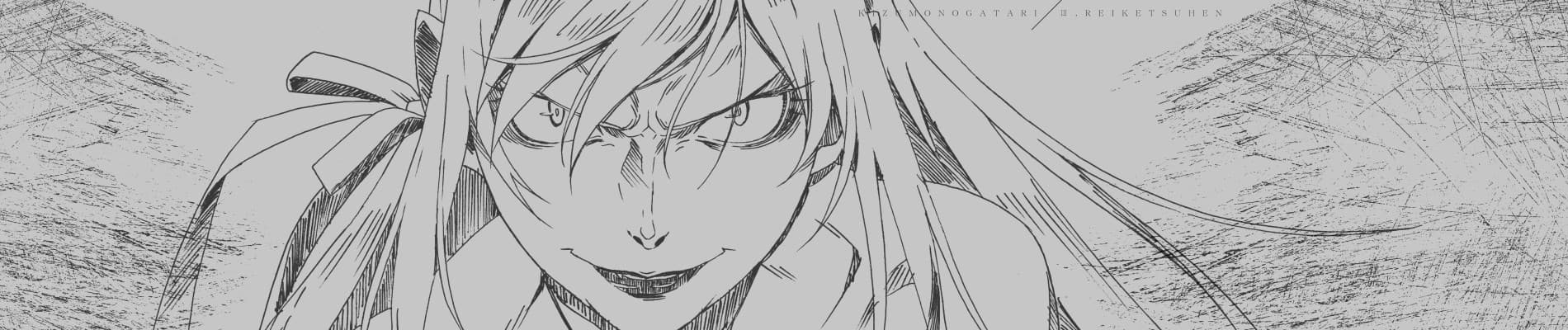
The weaknesses of each individual movie — uneven pacing, abrupt endings and dubious adaptation choices — are erased when seen in its proper form. Up-and-coming director Tatsuya Oishi vanished into a cave after 2009's memorable style-piece, Bakemonogatari, and emerged several years later with his over-3-hours-long prequel. Aniplex trisected its release but fortunately a local theater ran a back-to-back triple-screening: the only worthwhile way to watch it.
There are three ways to approach the task of adapting Nishio Isin's pulp novel. One is to clean up its more dubious aspects and present it to a mainstream audience. Another is to adapt the material faithfully to please preexisting fans; the TV anime's route.
Oishi's adaptation takes a third path, arguably the most honest path: amplify the source material's trash appeal until it becomes visual comedy, turning what was already a mild parody of itself into a much greater one. The progatonist's classmate, ally and sex object, Tsubasa Hanekawa, is redesigned into a grotesque uniform-stretching tiddy-monster with a cat's grin. The boob-touching scene of the novel is now an over-the-top spectacle that prompts guffaws of laughter and disbelief. (I'm glad I saw it with an audience.) Its vampiric showdowns also become strings of imaginative sight gags in Oishi's hands.
But calling it subversive would be a step too far. It still performs its perfunctory duty. Reams of dull, expository dialog form connections with preexisting franchise lore. And what it is, fundamentally, hasn't changed from novel to film — an escapist, nostalgic pulp genre story that is self-aware but not especially critical.
Within those constraints, however, we get a bold, deliciously stylized visual reimagining of the "Monogatari" world that makes it difficult to return to the cookie-cutter TV sequels. One wonders what's next for Tatsuya Oishi. Maybe he'll reassume his place in the Aniplex-Shaft sequelization assembly line. Maybe he'll disappear into another cave for a new special project. Or maybe, like many Shaft directors before him, he'll decide that he's outgrown the nest.
In any case, if you can only watch one "Monogatari" product, make it this movie trilogy.
My impression that the original novel (which I've read) is a "parody of itself" comes from a knowledgeable person's explanation to me of Nishio Ishin's place in Japanese literature. His novels aren't necessarily light novels, or young-adult literature. They are for nostalgic adults who grew up reading LN fare.
25.5 out of 28 users liked this review