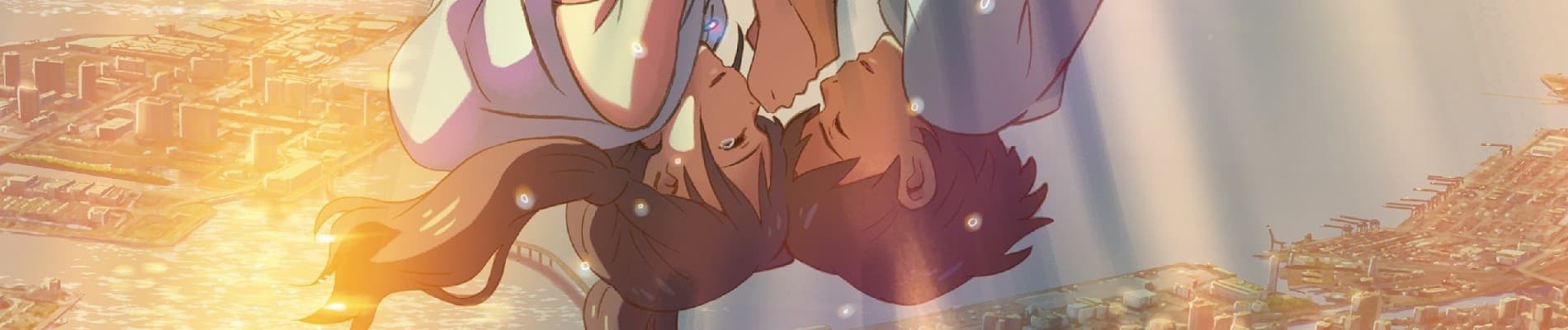


I first saw Weathering With You in Japan with no subtitles, barely a cursory knowledge of the language, and an empty stomach. But I still cried my eyes out.
Being in Japan felt surreal, like I was swimming through the fog of a waking dream. Every time I went to sleep, I dreaded waking up in my room back in America, staring up at the small wobbling fan which looked closer and closer to falling with each spin, but my Japan trip was indeed real, it was no dream. Going to the bakery every morning with shuttered eyes and a drag in each step was as real as the blue sky settling into its place amongst the clouds. Each badly-enunciated Japanese phrase, each jumble of a word, each ignorance of a social cue causing a slap to my head from myself because I know the right words! Saying them, however, was an entirely different ordeal. It was with this stumbling clumsiness that I tripped into a showing of Weathering With You, directed by the legendary Makoto Shinkai.

Makoto Shinkai is a man who needs no introduction. Famed director of Your Name, a blockbuster so worldwide it garnered Elon Musk’s endorsement, Shinkai has reigned supreme over the “boy meets girl” genre in the animated form, and has been ever since going solo with his first project, Voices Of A Distant Star. Voices Of A Distant Star is an interesting case, because he animated the entire film all by himself. Though it blows through its short runtime (a brisk twenty-five minutes), the fact that it was Shinkai’s and Shinkai’s alone raised a lot of eyebrows towards the fledgling creator, and its concept, an ever-so-melancholy boy meets girl story that would fit right at home within Barnes & Nobles’ YA section, also helped assist in its acknowledgement. A boy and a girl are separated, due to one’s recruitment in the military, and the other remaining earthbound. As the story goes on, the text messages between our couple take longer and longer to send, until finally…Nothing. They can’t be together due to some cruel twist of fate. A simple conceit, to be sure, but one that would pervade through all Shinkai’s works through the coming years. Apart from Children Who Chase Lost Voices (an unabashed Studio Ghibli homage teetering the line of staunch plagiarism), Shinkai has stuck to this basic thematic constraint and threaded it through each and every one of his projects to date. No doubt there was a formative experience in Shinkai’s years that caused him to take this to heart, and thus imparts this overwhelming melancholy throughout everything. So perhaps it’s not in the changing of the story we should look for, but in the way that it’s told, for there are many ways to tell the same story.
The thing Shinkai is most well-known for, aside from his tried-and-true story formula, are his backgrounds, with these glossy, well-lit landscapes reflecting each ray of the sun and popping with color. His character animation, maybe not so much, but it’s the loving detail he packs into each and every background which throws you into the world Shinkai has created, soaking in the often rainy atmospheres and making you take in the air of the place. You can really get a sense of his love for the world’s beauty and how it correlates with the passage of time. For example, in Five Centimeters Per Second, his love of summer sunsets reflecting the protagonist’s fling, or the blistering chill of the winter winds as the protagonist runs to see his lover, waiting for him at the train station a few miles away. And in Weathering With You, he really turns the climate knob to eleven.
Weathering With You follows a our downtrodden protagonist Hodaka meeting a peppy heroine Hina, who we find out is able to pull back the oppressive rain from Tokyo to make way for the sun. (Though people can change the weather in this film, the most unrealistic thing about it is the ease with which Hodaka finds a paid writing job.) Because of the central concept of Hina changing the weather, there are two distinct moods of the movie: raining and not. You’d think this would be very binary, as in, there would either be very gray skies or not-a-cloud-in-the-sky sun, but as I stated before, Shinkai is a master of climate. He takes the gray skies and jumbles them up, making them darkly intimidating in one scene, or with patches of blue in between lighter hues in another. Same with the sun; Maybe we do get the blue sky, but we also have hints of the rain coming back with the clouds in the background of the shot. It’s in the minuscule details that really shine, and this goes tit-for-tat, even in terms of the narrative.

The story is between these main two for the most part, but towards the back half of the film, we explore characters that Shinkai really hasn’t delved into before - secondary characters; Characters that supplement the main character and his journey. To clarify, this isn’t a deftly calculated slap at Shinkai’s face he’s just…literally never had anyone else but his main couple. So color me surprised when Hodaka’s surrogate father and Hina’s surrogate mother give them talks about life, romance, and more. It was the riffraff of this found family dynamic in the movie that really gave Weathering With You more color than Shinkai’s other works, really painting this slice of Tokyo in a comfortable light. These characters feel like people, as they’re supposed to, with lives and personalities and worries that extend from beyond the scene. Shinkai even delves into the mom and dad’s dynamic with each other, how it was falling apart before Hodaka’s arrival, and how he (and Hina) changed their lives for the better. Weathering With You definitely takes a step or two back from Your Name’s fast pacing, but I feel like that’s for the better, because instead of a lightning-in-a-bottle plot, we’re given time to get to know these characters. It makes Weathering With You feel distinct amongst Shinkai’s catalogue, no doubt showing the master at work. He may be making the “same story” over and over again but, damn it, if it isn’t getting better and better with each iteration!
I wanted to review Weathering With You again because I didn’t feel this same connection with his most recent work, Suzume. To reiterate, the backgrounds are as gorgeous as ever, but I found myself missing the melancholy that Shinkai sneaks into every page of his films. Suzume felt impersonal, as if he was finally forced by the general audience to “make something different” though that may not have been what he wanted to do, so Suzume tasted like something different, it tasted like…you guessed it, Imitation Ghibli. Again. The worst part is, Shinkai is capable of so much more, and we’ve seen this with his oeuvre, but _Suzume _felt like an obligation rather than a project, at least to me. I’ll be sure to bite into my strong feelings for it, or rather, against it, in a later review, but for now I wanted to at least remind myself on why I felt such a connection to him in the first place. I saw Tenki No Ko (Weathering With You) during my last night in Japan, on impulse with my friend Jack, who changed his mind from not seeing it to a sudden “let’s go” paired with a wave from his hand. I’ll never forget those three weeks in Japan, but even if I did, I’d never lose that night. The nights of Katana Zero blasting through my iPod earbuds, the clack of the tracks, the large open skies, the compact city blocks, the hustle & bustle, the great people, the smack of hot ramen against my chapped lips. Until I can make it back to that hallowed ground of mine, I’ll have these memories. But I swear to not dwell on these memories forever! I’ll get back there on day. I swear the half-finished udon I left at a dining room table because I was too full of the tonkatsu, I swear it on the rusted bike I rode around the ports of Ashiya, and I swear on the ‘gracias’ I said to the cashier at the Sanrio store instead of ‘arigato’.
Thank you, Shinkai, for creating this piece of me I’ll never let go.
