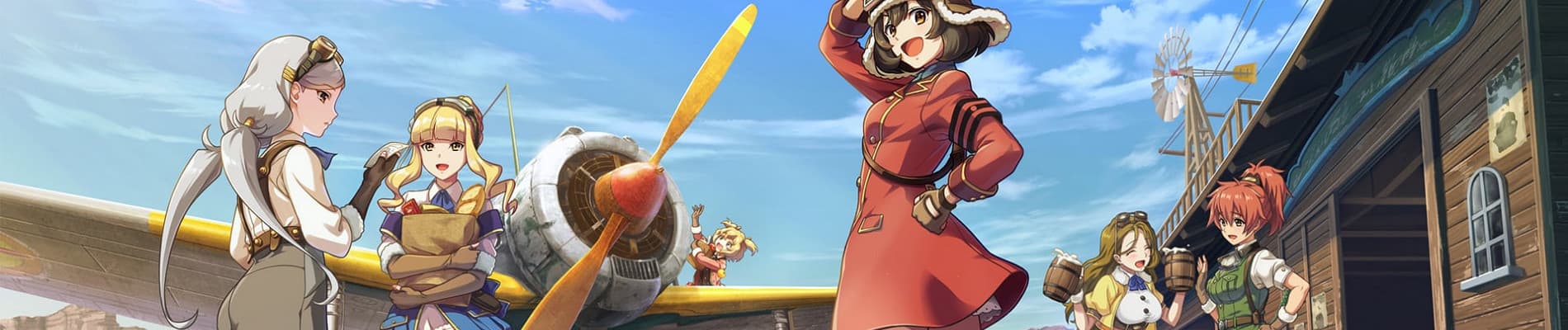

In another dimension, or astral plane, or something, exists a world named Ijitsu, that looks a lot like Australia -- mostly howling wilderness. It used to have an ocean, but a wormhole of some sort opened up, destroyed the oceans, devastated the countryside and dumped a lot of military technology (including every type of Japanese WWII fighter), plus curry, rice, and pancakes, onto them. This all happened courtesy of the Yufang, who appear to be alternate timeline Japanese.

A town like Alice
Now the people of Ijitsu live a hardscrabble existence in a scattering of tiny outback towns, tied together with zeppelin flights and bepestered by air pirates. The six girls who are part of the Kotobuki Squadron* fly escort off of one of the zeppelins, fighting off the air pirates and making sure their cargo, or passengers, make it through safely.

Carrier based aircraft
Unfortunately, there's a shadowy organization, the Brotherhood of Freedom Union, led by Isao, the mayor of the biggest city on Ijitsu, a guy who can smile and joke while ordering the destruction of entire towns, and who wants to exploit any new holes that appear and use that technology to take over the world. The Union employs dozens of fighter units and is systematically intimidating all the small towns to join up. The Kotobuki Girls are not really interested in this. As with Firefly, they just want to find a job, find a crew, keep flying. Of course, they get dragged in, end up as part of the big final battle, and are instrumental in destroying a newly opened hole and the death of the mayor.

Girls at war
Got that? Good. Now ignore it. The heart of the anime is the flying, and everything else is just an excuse. Every episode has a multiplane dogfight, and every dogfight is of heart-stopping intensity. Along the way we get to see all of these WWII fighters in action, plus some machines that never made it into the sky on our timeline -- the Kyushu J7W1 Shiden, of which only two were ever built, and the Nakajima G10N Fugaku heavy bomber, only ever seen on the cover of model airplane boxes.
 The bomber that never was
I suspect that Director Mizushima is doing what Miyazaki was unable to do in The Wind is Rising, celebrate the warplanes of WWII without having to insert an extended apology for Japan's role in the war. Even though he ended the film before the start of the war, Miyazaki was still criticised for not saying enough about it. But if you have Japanese fighters shooting down Japanese fighters on an alternate world on an alternate timeline there's no way you can be guilty of glorifying the Pacific War, right?
 George and Betty
Meanwhile, we have the Kotobuki Girls. Each of the six has her own personality and her own reason for flying.

Come as you are
They are portrayed in 3DCG, and are not quite ready for prime time -- their faces are stiff, and their movements seem more like those of marionettes. Be that as it may, they are all individuals, and you find yourself rooting for them in all of their fights.

Fight's on!
And the heart of the series is the dogfights. You see the action from all sides, and from inside the cockpit. You hear the clang of bullets hitting metal, and you hear the creak of that metal stressed to its limit. At the end of every episode, I had a bad case of the leans, from following the planes as they pulled g's.

Another kill for Kotobuki
The ending is a magnificent swirling fight in and over the capital city, and under the newest hole. Parts of it make you think of the trench run in the first Star Wars.
 Turn right at the next intersection
In the end, Kotobuki sacrifices their zeppelin to close the hole,
 They'll never catch this dirigible!
the good guys win, and fly off into the sunset.
 All's right with the world
From a flying standpoint, anime artist's license excepted, I have two complaints about the air battles.
First, it’s too hard to tell what’s going on. All of the fights are big, multi-plane furballs, presented as a series of vignettes featuring one-on-one engagements (sometimes with a saving intervention), but there’s nothing that gives a good view of the overall structure of the battle. In Garupan, you always had the feeling that you knew where everyone was and that you knew how the fight was rolling out. Not so with Kotobuki. Now, air battles are notoriously hard to follow. You dive in, you engage an enemy, and suddenly you are alone in the sky; or an enemy jumps you, you dive away from them, and when you recover, the fight’s move on. But usually there’s some preliminary structure — “You draw off the fighters, you go after the bombers” — even if it breaks down on contact.
Which brings me to my second complaint about the flying. There’s no sign of any real teamwork. In WWII, the US developed a number of leader/wingman concepts, which gave us a significant advantage over the Japanese, even though our fighters were outmatched by the Zero, one on one. In Kotobuki, everyone piles in on their own, and if they see a chance to help a team-mate they will. That’s good team spirit. It’s not good team work. As a result, The Kotobuki Girls are protected mostly by plot armor.

Preflight check
From a drama standpoint, if I have one complaint, it's that the action is all bloodless, at least on the Kotobuki side. Josh Whedon once said that if you have a fight and nobody important dies, people just say "Oh, look. They're shooting." That's the way Kotobuki is.
Despite that, I'd still call it magnificent.
*Kotobuki, 寿, A Yufang word meaning good fortune, congratulations, or long life, but we don't find out about that until the end.