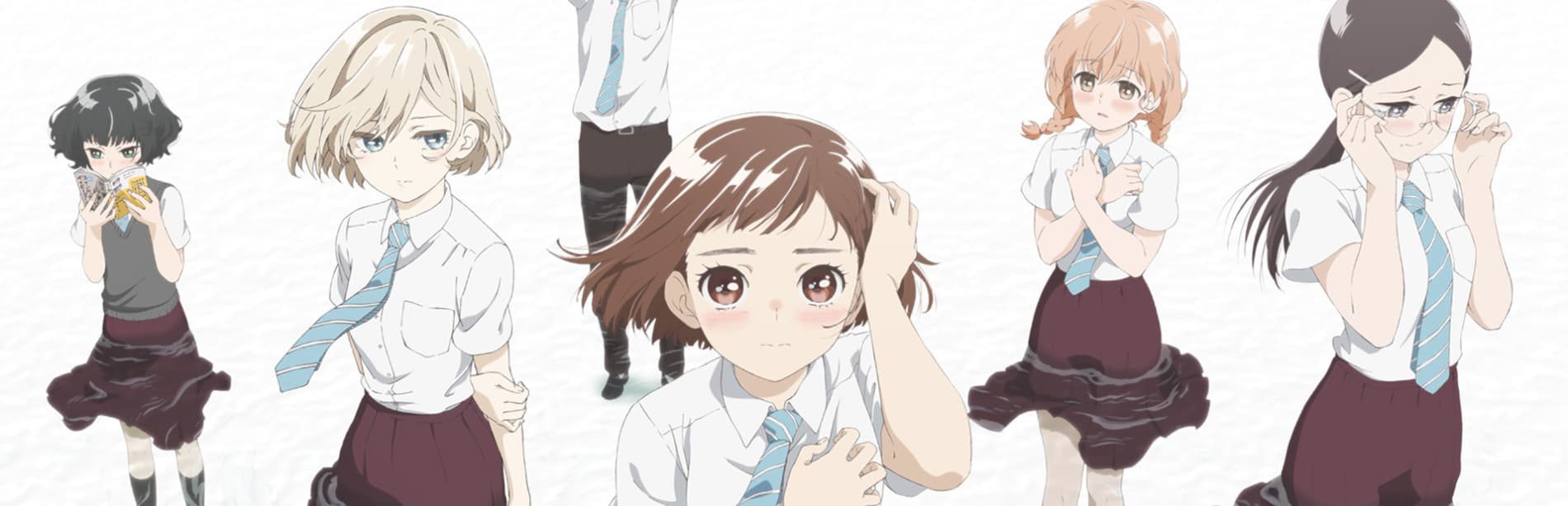

Two years ago, I said (in a piece whose relevance will quickly become apparent), that the best anime leaves you feeling like it's changed your life. O Maidens In Your Savage Season is the latest from Mari Okada, a divisive writer known for scripts that absolutely burst at the seams with emotional intensity, and I can definitely imagine it changing someone's. It's that kind of show.
I’ve seen Okada's work called “melodramatic”, and I actually think that’s a very apt descriptor. What she understands is that melodrama is not an inherent negative, it’s a tool--like any other tone--and can be turned toward productive ends. Maidens, before it is anything else, is a wildly successful threading of the needle in that regard. Make no mistake, it is melodramatic. Sometimes extremely so, but never for no reason. Okada is very, very good at making you feel for her characters. Maidens is that skill cranked up to 11. Through all the awkwardness and mistakes, you really feel for these characters.
Okada is prolific enough that people first encounter her work in different ways--I was introduced to it via Black Rock Shooter, which I remain convinced is one of the decade’s great underrated television anime. Maidens is not as aesthetically out-there as BRS (it’s not an action series, for one thing), but they share that same tendency toward emotional rawness.
But to emphasize just that aspect of Maidens would be a mistake. The show is sold as a rom-com, which is not strictly correct (way too much happens for that to be the beginning and end of its genre classification), but it is, in addition to its bareknuckle emotional intensity, extremely funny.
The first half of the series in particular is filled with a lot of A) dirty puns and B) absolutely stellar pull-face gags. In regards to the former, HiDIVE’s translation team deserves some credit here, for managing to creatively rework the fountain of sex jokes that the show’s first half throws down and still keep them funny.
There’s also what quickly became Maidens’ first signature scene--protagonist Kazusa streaming down the street in the first episode, screaming at the top of her lungs in frustration at her inability to turn off her own dirty mind. That downright *FLCL*ian scene is what ended up selling me hard on the series, but there’s a lot more to Maidens than just that.

Like any good dramedy, Maidens lives and dies by its characters. Our core cast consists of the five members of a high school literature club. There’s Kazusa, our female lead, and the “everygirl” of the cast. There’s Rika Sonezaki, the prudish (and secretly very maidenly) head of the club. Hongo, an aspiring author with a cybersex hobby. Niina, a beautiful former child actress who the other girls find a bit aloof and mysterious, and finally, there’s Momo who…well, we’ll get to Momo.
Each of these girls have their own character arc, and contrary to what might be expected of a standard single-cour-length 12 episode anime, they’re actually woven together pretty well. The show does not really delineate these arcs episode by episode, instead often cutting between them and divvying its episodes up into a number of different segments. Together, these congeal and tie the girls’ individual arcs into a wider whole. This is how Maidens can be the story of five girls in a literature club and also a broad commentary on the trials and tribulations that teenage girls in general face. There’s a lot going on here, suffice it to say.
It’s tempting to try to plot the arcs out one by one, but the show’s structure inherently frustrates that impulse. Take Kazusa, by far the most straightforward member of the cast, as an example. Kazusa’s arc revolves around her relationship with Izumi, her next door neighbor and childhood friend. In what ended up being another of the show’s signature scenes, Kazusa ends up wandering into his room unannounced in the first episode, and catches him masturbating. This sets off a domino effect that ends with her realizing she has feelings for him, and she starts pursuing him romantically.
That’s all well and good, but that’s only the first third or so of the series, and it’s here where the straightforwardness ends. See, to keep talking about this plotline we have to rope in Niina, who initially gets into a misunderstanding where Kazusa thinks she’s trying to steal Izumi from her. Niina, subjected to a lifetime of people assuming she’s trying to steal their man, plays into Kazusa’s assumption, and ends up actually falling for him too in the meantime.
That’s just one of many ways that Maidens twists its characters plotlines together, and this kind of interlocking is actually surprisingly rare in the medium.
None of the character arcs present here would really work without the others with the possible exception of Sonezaki’s. Her arc, where she (among other things) learns to get over her prudishness, ends up falling for and then dating a boy in her class, and reconciles with a gyaru she fought with in the first episode, is probably the one least connected to the other girls’, though even it’s not entirely separate. Plus, that gyaru gets pregnant in the show's penultimate episode, returning only in the epilogue--happily living with her partner. Maidens doesn't even let minor side characters not be involved in its main themes.
So what’s the point of all this knotty, complicated relationship stuff? Well, in a way, the knottiness actually is the point. Maidens is primarily a portrait of the infinitely multifaceted experience of being a teenage girl. The focus is demographically fairly narrow (all five members of the core cast are roughly the same age, are Japanese cisgender girls, all go to the same high school in an urban area, etc. etc. etc.) but the experiences here resonate incredibly well. One of Okada’s talents as a writer is using the specific as a signifier of the general. Melodrama transfigured into genuine pathos.
For example: Niina’s arc involves a lot of internalized misogyny, she’s dealt with an entire life of people assuming awful things about her and the way she copes with that is by willfully falling into a “bad girl” role and actively thwarting attempts to help her by putting on an air of maturity and of being above the situation. The specifics include her past as a childhood actress and a history with a pedophiliac director
who is up there with Suishou from Granbelm as far as being among the most actively hateable characters of the Summer 2019 season. The generalities--that internalized misogyny, pretending to be above the things that go hand in hand with your own age--are going to be broadly relatable to many people, and it’s on that intuitive level that Maidens marks its first major success. You will end up seeing yourself in at least one of the core cast, if not many of them.
The other element to all of this is the direction. Maidens’ visual symbolism is so strong that it’s occasionally on-the-nose. There’s an absolute ton of train symbolism. Kazusa’s main squeeze Izumi is absolutely obsessed with the things, and while his railfan characterization is endearing on a surface level, picking that method of transportation in particular is not an accident. Using trains entering tunnels as a visual metaphor for sexual intercourse dates back to the censorship-happy postwar era of Hollywood, if not farther, after all. It’s here we have to shout out director Masahiro Ando too, because while this is ultimately Okada’s brainchild, it’s Ando who makes all of this work in the moving world of anime.
Both quiet one-offs like Kazusa literally reflecting in a mirror while reflecting on her actions, and longer setpieces--Niina walking hope as a barfly drunkenly sings in a nearby karaoke parlor, the entire finale in all of its blunt color symbolism--work incredibly well, and the show wouldn’t be half as engaging without the strong visual element backing it up. That the animation comes from the still-young Studio Lay-duce (who last year also threw their weight behind RELEASE THE SPYCE) makes me hope they get more projects like this. They’re damn good at it.
Visual side note here: all of the cast are great, but Hongo (whose plotline where she ill-advisedly plays a game of what This Week In Anime columnist Micchy called a game of "sex chicken" with one of her teachers is the boldest risk the show takes, that's a hard line to walk) probably has the best expressions. Not bringing this up at all would feel like a crime.
There’s one last thing we need to give Maidens credit for, which is having a canonically queer character in a show that’s not specifically about that. Momo’s arc--to greatly simplify things--involves her coming to the realization that she’s attracted to Niina, and, consequently, girls in general, not boys. Maidens is not really “Momo’s story”, but the show makes room for her regardless, and that she’s focused on at all really makes the series’ inclusive message hit that much harder. That she’s a great character on top of that is just icing on the cake.
To put it plainly, Maidens is the second anime in as many years to fall into a very specific, very exciting archetype. Shows driven primarily by women as creative forces, about the experiences of young women, that effortlessly transcend the confines of the genres they initially appear to be. For last year’s A Place Further Than The Universe, that was the school life genre, which it discarded early on to blast into a full-on adventure series. For Maidens, the transition is quieter. By the time you realize that it’s no longer playing by standard romantic drama rules, it’s already got its hooks in you. Maidens takes a similar tack to Further in its relation to its parent genre. There’s nothing in Maidens that scans as antagonistic to romdrams, but it sets itself well apart from them.
The show’s finale, an explosion of colors both figurative and literal, is one of the most spectacular to come out of anime in 2019, never mind the fact that it has the sheer gumption to end on what’s essentially a title drop. The final plotline, where our girls stand up for Sonezaki through dramatic action, is what Maidens' real core is. No matter what life throws at you, young girls are strongest together, emotionally honest with each other. To throw back to an old truism: there's no force in the universe stronger than a determined high school girl.

As far as left-of-the-dial, emotionally-resonant storytelling, Maidens has not had a lot of competition this year. But the truth is, even if Maidens had dropped in a much stronger year it’d still be exceptional. I’d say you don’t get stories that hit this hard very often, but, as mentioned, Maidens actually does have an obvious, fairly recent bedfellow. Perhaps, then, this is the start of a trend. I’d certainly love for it to be, you can never have enough things like Maidens.There will always be a need for stories like this, for as long as there is someone to hear the messages they put into the world.
And if you liked this review, why not check out some of my others here on Anilist?
Edit Note, 3/29/24: This review is old enough that some of the images in it have broken. I don't have the original files here anymore, so I've removed them entirely and left the ones that remain. Unfortunate, but probably necessary.