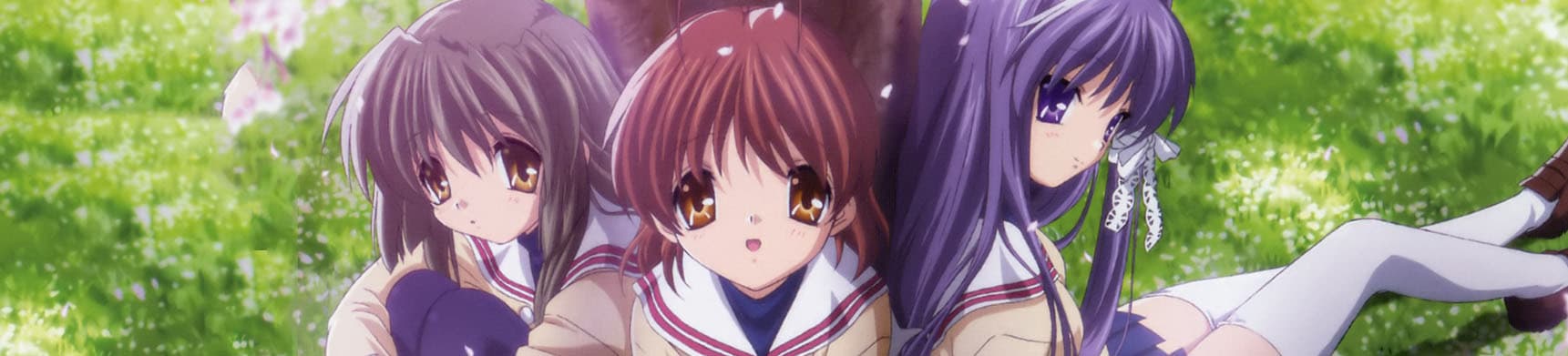
Clannad
a review by zachbrownies
a review by zachbrownies
So I’m still pretty new to anime, and I went in to this very tentative based on the art style and the poster, thinking “Is this a serious show or is this just for people who are attracted to 16 year old anime girls?” After finishing the season, the answer is… mostly the former. (Mostly)
It did take me a few episodes to adjust. The way every character is drawn in the same style and has the same facial structure, combined with my sort of colorblindness making the girls’ various shades of blue/green hair look the same, made it hard for me to differentiate all the characters, and I’d extra focus during the opening trying to learn their names. (I thought Kyou and Tomoyo were the same person for a while) But once I got used to the style, it is actually quite nice, and I had no problem with it. I said at the start the characters (even the adults) all look 8, but… you get used to it in the end.
Various ramblings, full season spoilers:
Anyway, after the first few episodes, I started to find it quite sweet. There was nothing super investing going on so I can’t say I was enthralled or dying to see more, but the relationship between Tomoya and Nagisa was cute, and the character’s antics were pleasant. I enjoyed it. Then the Fuko arc took off and as it reached its climax, I realized I had become completely drawn in. The episode where they all start forgetting her, followed by the wedding and Fuko’s final goodbye after giving her blessing to her sister, completely broke me. I didn’t expect it at all since I didn’t think I was emotionally invested in that way. That storyline was fantastic.
I have to say, after that arc, I felt the show sort of lost its way a little bit, and that the second half was sort of formulaic. Immediately after Fuko’s arc ends, Kotomi’s arc starts, and it feels sort of like a copy/paste. “Tomoya befriends weird awkward girl, helps her make friends, turns out the girl has a tragic story which comes to a climax but then they solve it with the power of friendship, rinse and repeat” But I didn’t think Kotomi’s arc was as satisfying, because it didn’t have as much of an active goal, and it relied heavily on flashbacks. With Fuko’s arc, there is a clear plot to be invested in – her sister’s wedding, and we learn things about her past naturally through conversations through the episodes. With Kotomi, they sort of give you a bunch of hints something is weird, then (and the episode where Tomoya visits her house and remembers their past was pretty cool) you get a bunch of flashback explicitly telling you her problem, and then they solve it and have a birthday party, and then it’s over. The birthday party isn’t really as sweet of a climax as the wedding, imo. And it also doesn’t provide as much closure – Fuko’s story gets a real ending. Kotomi gets a resolution ish but it’s not as neatly wrapped up, and then after that… she continues to exist in the show, but she gets no more focus and no more plots, and it’s kind of weird.
The plot structure continues to be sort of weird after that, because it looks like you’re sort of getting a third character arc for Tomoyo, who until then mostly was on the side, you have a couple of episodes again of Tomoya getting to know her and it’s all fun and games, then she reveals her tragic backstory, and then… well, this one doesn’t go anywhere immediately. Her plot goal is to save the Sakura trees, but we move away from this and go to the final arc with Nagisa, but then we do actually go back to Tomoyo in an alternate universe and get an ending to this.
The final arc with Nagisa finally putting on the play was very nice and was the only other section that I felt rivaled the first arc in terms of emotional investment. There was still a little bit of what felt like a mislead here, because with all the alternate world flashes, and the way they foreshadowed “Nagisa did something to hurt her parents when she was young, but she must never know about it”, I thought there was going to be another supernatural element here related to the paralell worlds (which I assumed from Kotomi’s plot would come up again) but it ultimately was just totally normal stuff. But it’s a really sad story and the final climax of Nagisa learning the truth, seeing her father’s dreams on video the day of the show, and then crying on stage and needing to be supported by everyone was really sweet, and at this point I really do like Nagisa and care about her, so it was very emotional and I was fully invested in it.
The show also did this interesting thing where it really messed with your mind about if it has supernatural elements or not. It starts with all those weird scenes of the girl alone in the alternate world, plus Nagisa keeps saying vague things under streetlamps, and you think there’s something weird going on. But then it turns out to be nothing, but then there actually is a literal ghost, so the show is not about ordinary life. But then… after that, there actually isn’t anything else! And this is weird, because Kotomi’s plot is about the fact that her parents are studying alternate worlds, so you really think “Oh, I see, this is how they’re going to transition to that being the main plot, Kotomi is really important, she’s probably going to continue her parent’s research and go to the alternate world” but then… nothing happens. And then the alternate world is actually nothing supernatural at all, it’s just foreshadowing for a play? Now, maybe this gets explored more in the sequel, but it’s a little bit weird for this season as a standalone.
Overall though the show does a very good job of making you feel like you are part of a nice group of friends, and every character ends up feeling endearing and fun to watch. I can see why people are really into this sort of anime that makes you feel good watching it, and it also helps make you feel connected to the characters so you get hit harder by the emotional beats.
In terms of theme, the main thing I eventually noticed is that every arc is related roughly to the ideas of the intersection between family and dreams – Fuko can’t follow her dreams anymore, but her dream is for her sister to achieve her dreams. Kotomi’s parents follow their dreams at the expense of their family, while Nagisa’s family in direct contrast give up their dreams to support their family, and then encourage Nagisa to explore her own dreams. Tomoyo’s brother being hospitalized prompts Tomoyo to begin following her dreams and connecting with her family, similar to how Fuko being hospitalized helps her sister. And, this one is less obvious, but all the girls dream of being with Tomoya, but in the end, they are happy for Nagisa when he chooses her, because they are all family. The message seems to be something like: you can choose your own family (even if it means making the choice to accept your own family), and you can be happy as long as someone else in your family achieves their dreams, even if you yourself don’t – because supporting your family can be a dream in itself.
So, my one gripe goes back to what I said at the beginning. Is this just a show for people who are attracted to 16 year old anime girls? No, there’s a lot more going on, and these characters do have depth and serious plot lines. But also partially yes. I don’t mean to sound like a feminist SJW here, but all of the female characters end up having a plot line where they are romantically interested in the main character. And that just feels sort of like… why can’t these female characters exist on their own and have their own stories that aren’t all about falling in love with the same guy? I don’t hate it, because it’s fairly natural and it makes sense they’d all have a crush on him, but still, it just felt a little… I don’t know. It’s the only thing that made me feel that this sort of anime really is the sort of cliché that it seems to be, and made me feel a bit embarassed to be watching. When critics talk about wanting strong female characters nowadays, one of the main criteria as I perceive it is, we want female characters who aren’t defined by how they are meant to be attractive to male watchers. And it does feel like these characters are created to be waifu bait essentially, which is… I mean, they succeed, they’re great waifus. Anyway this is probably a really contentious paragraph already for anyone reading this who is an anime fan so, I don’t mean any offense to anyone, just trying to describe how I feel.
Beyond that, I was a bit underwhelmed that the arcs didn’t all come together in any major way – Kotomi’s plot doesn’t go anywhere after her arc, and even though Fuko, Kotomi, and Nagisa get clear conclusions, Kyou (and Ryou) don’t end up having any character-defining conclusion to their stories, nor does Tomoyo really, besides the alternate ending. Maybe the next season will address this, not really sure if this season is meant to stand alone or was always intended as just a first season. But I guess not every anime needs to build to some large epic conclusion, and putting on the play was a nice climax for the season.
For character rankings…
I like Tomoyo the most, I think. Fuko grew on me and even though I felt her ending gave her closure and was worried that showing back up would take away from it, her appearances throughout the rest of the season were really funny. Nagisa was ultimately very sweet and I cared about her a lot, she does a good job carrying the show as the lead heroine. I liked Kyou (and Ryou). Kotomi was the weak link for me, I didn’t find her quirks or personality very interesting. Oh, and why doesn't Ryou get a segment in the Opening Credits?! Tomoyo > Nagisa > Ryou > Fuko > Kyou > Kotomi.
Overall, I enjoyed it quite a bit, but I didn’t think it ever hit the high that episodes 8 and 9 hit again. Looking forward to the sequel.
10.5 out of 13 users liked this review
