
Ess Eee Batsu. Or as it’s more often known – sex.
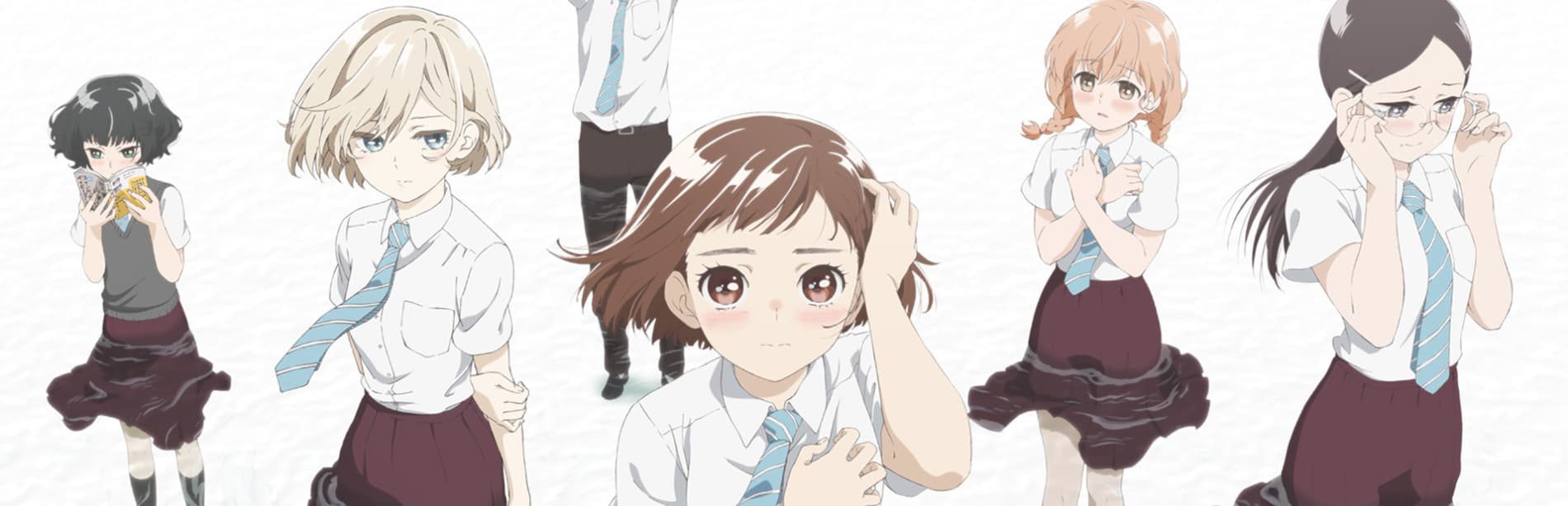
O Maidens is about 5 high-school girls as they go through the part of puberty where sex begins to take root in their schema of romance. They are maidens in their savage season, so to speak. What ties our protagonists together isn't their age or social status (they aren’t all in the same class or even the same year, and range from popular to loners to plain uncool), but that they are all part of the Literature club. What I love about this use of setting is that it makes the characters a lot more literate -- they all have a poetic way of thinking about love which stems from the literature they read from within the club. It's not a major element in the story, but its effects are definitely noticeable which makes it a lot more relevant than a lot of other anime that just use the club to bring the characters together but the club itself has no greater bearing on the story.
The show starts off as a comedy, as awkwardness regarding sex is very easily turned to comedy, but it does this without going overboard. The thoughts of the main perspective character – Kazusa – remain relatable throughout, as does her character arc. Most other comedies would either blow out of proportion of the sex-related jokes or, as all the lead characters are girls, mask their teenage sexual desires as “love” as a lot of other anime/manga do when telling Shoujo romance.
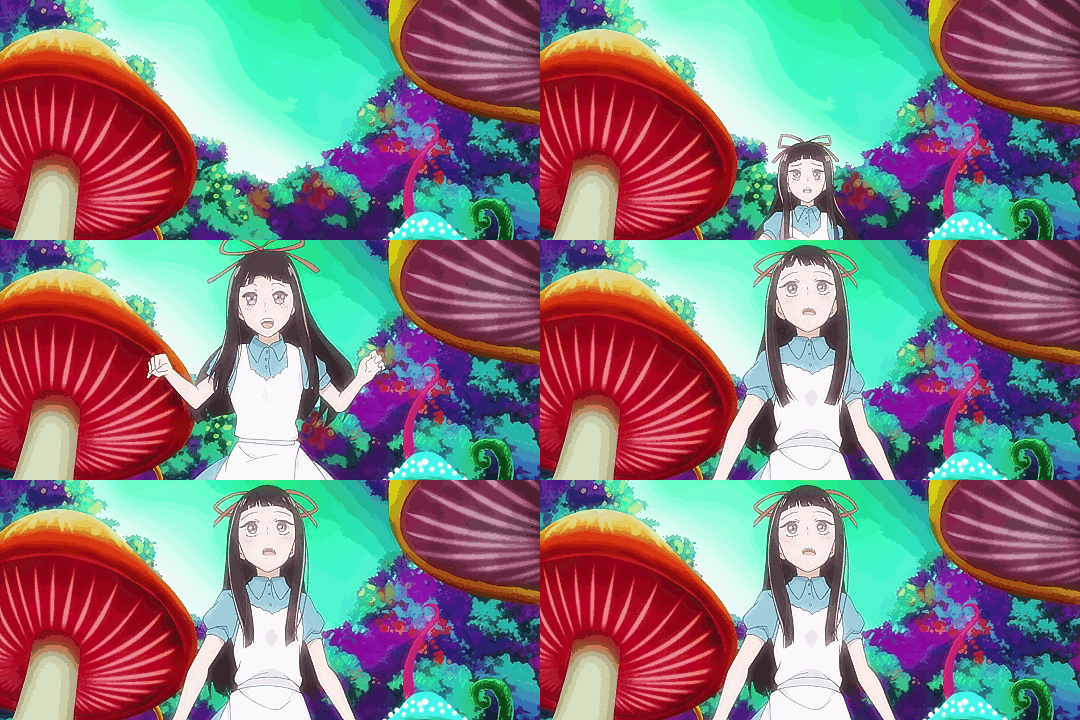
However this isn’t to say that the other character’s arc go into those territories; the head of the Literature club – Sonezaki Rika – has her romantic arc set in a much more “pure” setting. She initially is uninterested, and disgusted by the growing sexual relations and interests in her fellow classmates and wants no part in their world of romance, but prefers to relate to an idealised version of sex in the literature she presumably forces upon the literature club to read, seeing it as “poetic” while in real life it is vulgar; she wants a poetic romance that she believes can’t be achieved with anyone at her school, but with a magical person who will appear out of nowhere and create the perfect romance with her. Very Shoujo-manga like.
Her character arc is probably the most introspective of the bunch, as while she tries to have a pure romance for herself, she learns that not everyone has that, or even wants that. Rika views all the other relationships in the school to be those driven by sex, and when she does begin a relationship herself, she pushes to keep it secret out of fear that she’d be viewed the same as how she views others. Rika sees the people in her class delving into their animalistic instincts, and therefore animals themselves, even calling literal pigs in the first five minutes of episode 1.
Enter Jūjō.
A gyaru and the epitome of what Rika views as the impure romance. However Jūjō takes an interest in her, and initiates conversations whenever she gets the chance, and while they have a lot of differences, they find a lot of common ground as well which allows for Rika to view Jūjō (and by extension – others) as other complex human beings, which results in her taking a very different stance than she initially would have on a turn of events at the end of episode 10.

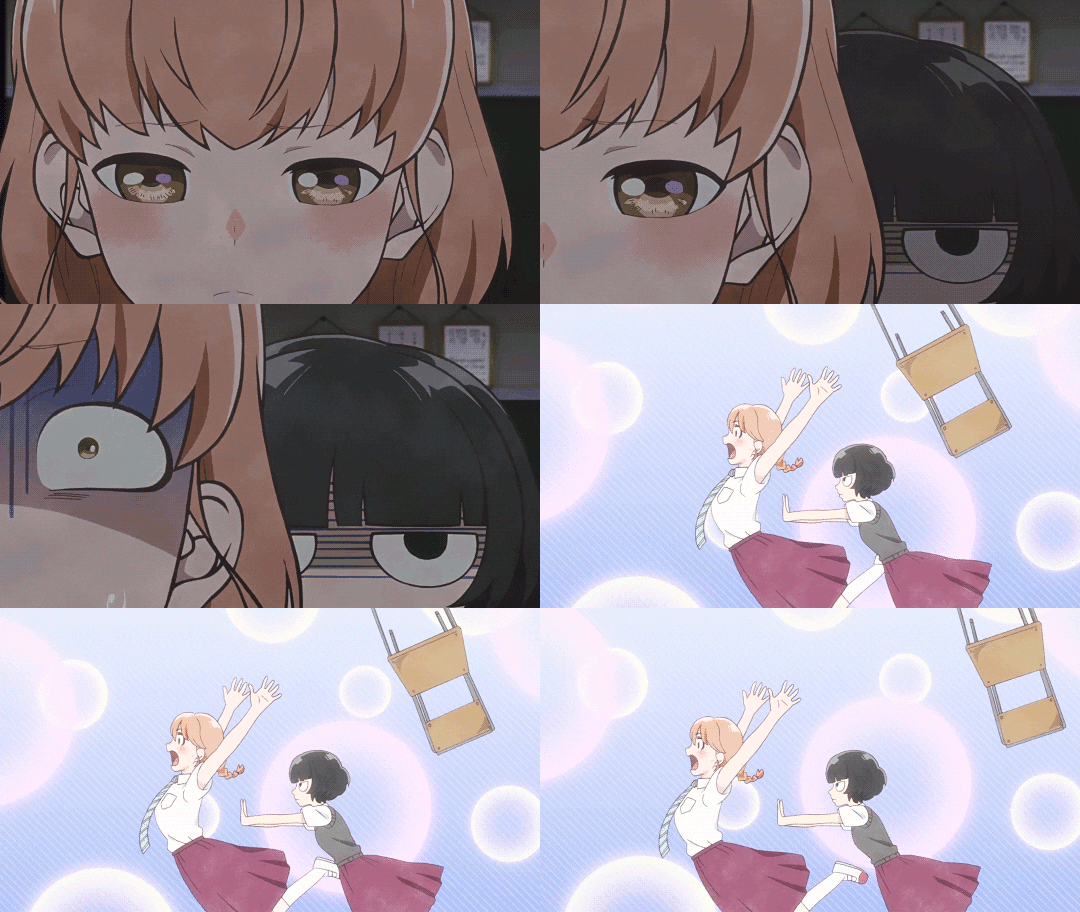
The show also goes for the more “absurdist” romantic and sexual situations anime may be more prone to give, mainly through Hongo’s story as well as Niina’s. However the prior is played more to the comedy of the show where the other weaves with the show’s tragic side. While this is the case, while the five story-lines cross a broad amount of colour, it still fits into the same palette. The same rules are in place in all of the five stories, meaning they all fit wonderfully together and don’t feel disjointed from one another, although some of the stories do feel unlikely, not impossible, just unlikely.
Niina seems to be people's biggest issue with the series from what I can tell, because she makes some selfish choices. However, looking at her character I personally think it makes sense for her to do what she does from her perspective, especially with her backstory and goals she stated in episode 1. What I think should also be on people's mind is she's experiencing emotions she's never felt before when she makes these...unsavoury decisions. Once again with this show, it operates in a very realistic setting even if the structure of their individual stories aren't, but that's the point -- to see how real life would change these more tropey and polarising romances. Niina may be selfish, but what teenager isn't?
What I honestly feel may be one of the show’s strongest points, is how it handles Momoko. Minor spoilers for this bit as while it isn’t the culmination of her arc, the revelation is the turning point of it and some people may want to experience along with the show, even if it is a bit obvious:
Spoiler, click to viewclick to hide
She’s a lesbian, and it is handled so fucking well. I feel in anime, either homosexuality is either the main topic of the show and ends up being used as bait with little else to it. And if it isn’t the focal point, LGBTQ representation in characters make them ridiculously over-the-top, and in quite a lot of cases, generally unlikable. If you’re like me and when you hear about gay love stories and it just doesn’t interest you – believe me, when it’s done well, it really will.Why I personally think it’s so well done is that she’s just there. For good or for bad, her arc probably gets the least amount of time in the sun and arguably could just be used to add more drama to the main love triangle of the series. But that’s real life. The story for the most part revolves around Kazusa and everyone else is "there", as people. In most other shows the inclusion of a gay character would be added after the set-up of the love triangle has been established, at least in the author’s mind. I feel with this series, Mari Okada made her characters first and then let them lose in her setting, ultimately creating organic drama. Momoko isn’t gay to add drama, her being gay and all the complexities that brings in a teenager's life when no one else is like you added drama itself.
What I feel should be stated is how this show ends – it goes for a thematic conclusion. What I mean by this is that all the in-world plot-lines don’t get answered in the world of the show, but symbolically to the audience at the end. This can turn people off as there is no hard conclusions to some of the story-lines however I see this as standard for Mari Okada. With Anohana (spoilers for that obviously but that anime is like 8-years-old now), for example, we only see the story for the period Menma is “there”. We don’t see what happens to the characters after Menma departs (excluding in that recap movie) because we don’t need to. What happened to the characters will affect them for the rest of their lives, but we don’t see every ripple it will have. O Maidens is the same; not every plot-line can logically be resolved in the time-frame the series takes place in, so it doesn’t try to jam it in, especially where some issues definitely need the maturity of being an adult to properly be resolved. That’s why it goes for a cathartic ending with a message in the meaning of their final actions – a old-school “moral to the story” so to speak. And that’s exactly Mari Okada’s ball-game.
I will say, however, this transition doesn’t happen seamlessly. The end of concluding story-lines within the world of the anime happens at episode 8. I was thinking after episode 8 “How will they possibly end the other story-lines?” and technically they don’t, at least not in the same way, which I can see annoying people. I started to think it would be an anime-only ending that might be a bit underwhelming as they usually are before the wait of new content for a second season. But then I looked it up and I found Mari Okada is the author of the manga is also the scriptwriter for the anime, meaning she would be the only person who would know how to make an anime-only ending for the show. I also then found out when the anime was finishing the manga was also ending, so both versions of the story end in the exact same way. The reason for the change on in-story narrative to an out-of-story narrative (not real terms, sue me) was not because of anime scheduling and lack of manga content. It was completely planned. And with that lens I feel I can appreciate what was done a lot more, knowing it wasn’t a cop-out but it was done (hopefully) with the knowledge that the stories being weaved could not feasibly be resolved in the term of less than a school year.
As a Maiden’s savage season can last her whole life.