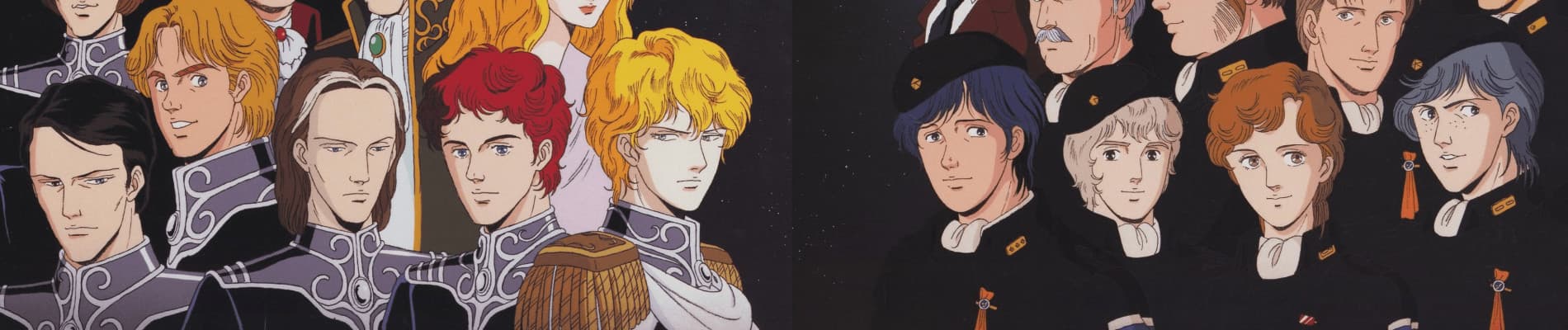
Often times, we end up with shows that are praised merely for attempting what they attempt, and not for what they actually execute in practice. Legend of the Galactic Heroes (from here on out shortened to LotGH) is one such show - while the show has an incredibly niche following and is a cult classic of sorts, it's beloved for supposedly being a hyper-realistic story about a clash of ideologies, military might and will, with a fanbase that'd religiously defend it - to the point where almost every time I'd update my progress with the show, chances are some fan would either PM me or write an angry comment on my wall, asking why I gave the show a low score.
So, my curiosity over its insanely high rating and cult following drove me to try and experience the show. On my first two viewings, I'll readily admit that I actually fast-forwarded the show - I couldn't handle its slow, bland presentation and incredibly choppy pacing. I tried to give it an above average score and convince myself that maybe something about the show wasn't to my liking, maybe I didn't understand it. In the time between my second and third (and proper) viewing, I started a Masters degree in International Relations, got my best friend - a Biology graduate - and finally decided to sit down and experience the show for what it is.
What I found blew my expectations to pieces. The show isn't bad. It's straight up one of the worst pieces of fiction I have ever seen, and fails on so many basic levels it's astounding.
The story essentially is a clash of ideologies between republican democracy and authoritarian (it's implied that it's theocratic but this never gets addressed in clear terms) monarchy. Both empires are inspired by French and Prussian ideals respectively, which due to how much Germanophile sentiment exists in Japanese society in general (most probably due to the alliance between the Axis powers in World War 2), has the narrative obviously side with the Prussian authoritarian monarchy. While I do say this, flaws in both systems are frequently addressed and discussed, but never genuinely resolved in a meaningful way. This is part of what the narrative tries to do - instead of end things on a positive note leaving the future up to interpretation, it tries to portray the cyclical nature of history, and how inevitably, conflict will start anew, and whether said conflict is good or bad is left up to the interpretation of the viewer. I can admire this kind of theme presentation if it weren't for a certain flaw in the narrative.
The show leaves absolutely nothing to the viewer's interpretation, and I mean that in the worst way imaginable. Long, drawn out narrations about the history of this and that region, location or conflict. Entire episodes that are literally mini-documentaries about the backdrop behind this or that event. Conversations where the exact same bloody point about the cyclical nature of history and how democracy despite its flaws is better than dictatorship are repeated ad nauseum. Characters often speak information to each other that they already know only so that the audience would know in ways no human beings would speak like - this is an issue in Japanese media in general (and I'd happily admit plenty of things I love also do this), but never have I seen any work of fiction abuse it to the same extent as this show.
The worst part of it is that the potential for interesting, exciting moments are there. Plenty of scenes have these dramatic instances with classical music blaring in the background with characters that have been around for a long time dying - and then promptly this gets interrupted by the narration, explaining how this or that character is feeling, making any emotional investment impossible due to the show being absolutely incapable of presenting a story in any meaningful way. Several scenes come to mind that I won't mention due to them being heavy spoilers, but I find it difficult to believe that even the most diehard fans of this show didn't find this at least somewhat grating.
Another major problem is the show's pacing. The show is not entirely sure if it wants to tell things in a linear or non-linear fashion, and this makes it unwieldy and unfocused. Often times, important events happen but aren't addressed until later, and the narration would stress how important they are despite no tangible impact having been felt in earlier parts. This particularly becomes a problem in the last stretch of the show, where the pacing slows down to a crawl and it becomes clear that both scriptwriting and production - already absolutely abysmal as they are - decline even further. Uprisings happen, for example, but the narrator stresses their historic importance to the narrative - even though we as the audience have already seen what happens in the aftermath of these events and no real impact was felt.
This leads into the show's editing and direction, which is astonishingly bad - scenes are just edited together with no real flow, so often times you'd watch the show and the show'd randomly switch focus in the middle of a conversation for no reason. At first I thought this was the show trying to raise suspense or build up tension, or even maybe leave something to the audience's interpretation. This is anything but the case - the show's pacing is just that atrocious and poorly edited together, and the direction makes any attempt to invest in the show worthless. This applies to everything from random closeups to characters' faces and endlessly repeated frames in order to pad out screen time - while this is a normal tactic in anime, generally speaking especially the further back you go, the show completely abuses it and it ends up ruining the pacing further.
OK, so the budget is unimpressive, the direction is choppy, the editing is questionable and the narration is the worst thing ever. What about the more superficial aspects? Are the battles tense or interesting, or hell even just fun on a basic level?
The answer is no. The battles are usually these still images of spaceships with terrible flash effects, with the occasional spaceship moving slowly and awkwardly the later the show goes on - this means that the focus is not really on the spaceships' action, but rather on the monologues and strategies between these commanders shooting at each other. This is where a big part of the show's renown comes from - it's often praised for this instead of putting substance aside and letting the superficial aspects came over.
OK, no problem. So how does the show portray these monologues or battles then?
By having these drawn out simplistic as hell tactics involving surrounding enemy forces using basic as hell pincer attacks, and with every tactic being extremely obvious to the audience. What makes things worse is that almost every enemy to the main character(s) that isn't another main character(s) is dull, generic mook who's making dumb decisions and refuses to listen to their soldiers about the obviously dumb decisions they're making. This flanderization never genuinely stops throughout the whole show and gets worse the longer the show goes on - the show is unbelievably formulaic after a time and loses the ability to surprise the audience very quickly because of this.
This extends to how the show sees spoilers - there's no real point to not spoiling LotGH to anyone who hasn't seen it yet, and the reason is because the show is both incredibly obvious with red flags and incapable of having its narrator shut up and not spoil the audience on events that are about to happen. You know that infamous meme title episode everyone makes fun of with the title "X dies?" Now imagine that every few episodes being done again and again and again. It's boring, tedious and grating, and since the show already fails on so many levels outside of this, makes the watcher incapable of enjoying it even on a superficial level.
This drags me to yet another issue with the show - the extremely obvious plot armor. And look, I can enjoy shows with more plot armor than a piece of Swiss cheese the size of Mount Everest, but here it gets even worse because the show already fails at being suspenseful or engaging on a basic level. With some exceptions that only happen in order to force the plot to progress in a supposedly meaningful way, LotGH's main cast have some of the most ridiculous plot armor I've ever seen. Soldiers often have their guns pointed in the general direction of this or that important character but randomly change their mind and shoot elsewhere instead of just killing them. Characters lose an entire tank worth of blood but somehow are still walking and fine the next day, and the show often has characters catch fatal diseases that should have them be impossible to move, except somehow one character later on somehow manages to knock up his wife, go to battle, act around as if he's only slightly exhausted and only has a fever. To call this absurd is to be a comedian; the show lacks self-awareness of just how ridiculous this is, and due to most audience members not being educated on basic scientific facts (which clash directly with the show, in most cases being common knowledge even in the 60s) this flaw gets overlooked.
What the show is absurdly terrible at, more than any other show, is having any kind of meaningful climax; important events sometimes happen with no meaningful payoff or self-reflection, and this makes this show in a certain sense quite literally talking the talk but refusing to walk the walk - characters sometimes say absurd things like willing to abandon the military and not minding if their comrades die, or casually joke about having an entire population below a certain age die, or characters straight up joke at their superiors in the middle of battle with their superiors promising to punish them once the battle ends. Nothing comes of any of this - there's no meaningful conflict in the show, and characters often speak what they want to speak in ways that no one in an actual military or especially in the middle of battle would, let alone any actual likable human being. I'll get back to this point later on.
The show doesn't stop there but also is thematically incoherent; it wants to talk about the cyclical nature of history and conflict, but also stubbornly refuses to avoid the pitfalls of classical realist approaches to both history and politics. This means that the show's assertions are extremely securitized and always top-bottom rather than bottom-up, meaning that if you don't view things from those lens you're immediately alienated from how the show's portrayal of politics is soulless and humanless. Very little is shown of how society changes under Reinhard's rule beyond simply assertions by the narrator - with nothing to show for it most of the time - and this is more grating when looking at the Free Planets Alliance, where politicians are shown to be nothing but incompetent buffoons who have no idea how politics or the military works and on several occasions running straight into bullets when cornered by enemy soldiers in a blind panic. This extends to the judicial system, police institutions and everything else in the show - despite this being supposedly a democratic state where individual civil liberties are protected, it takes the classical realist approach that democracy is irrelevant and all states are these hyper-rational actors that only care about security and nothing else (despite very little rationality actually existing in these characters' actions, but we'll get to that later) and as such, equates an authoritarian state where people are murdered for being disabled or impaired with impunity with a state where civil liberties are protected. While this hypocrisy is addressed, it never goes into a meaningful thematic point. The show ironically also kind of self-proves it being dated as hell by never really stepping out of this theoretical framework; in many ways it feels like an academic wannabe wrote a political drama with how he thinks people act from a theoretical approach rather than start actually see how people act, making the show both irrational and theoretically inconsistent as well as laughably dated and unrealistic.
I'm not the kind of person to care about realism in my fiction. But the show fails on such a basic level at researching basic theories and facts it's actually astounding. This brings us back to an earlier aspect involving the show; its insistence to end significant plot points with anticlimaxes. Major events often just happen involving major characters and development either is minor or negligible, and this easily adds to the increasing apathy and disillusionment involving watching this. An easy example is how on one particular occasion, a character almost gets assassinated for his abysmal policies and there are traces of an internal conflict that starts to brew, contradicting that character's policies and slowly altering his relationship with another character. This never leads to meaningful drama, and aside from one passive-aggressive stance against that character is never mentioned again - the empire continues its horrific policies and nothing changes. This kind of writing is spread all across the series, and it makes trying to care for the show's piss poor attempt at raising stakes insanely difficult when the show keeps resolving plot points left, right and center like this.
A minor point to make as well is the subtitles; it's clear after a certain point that if you as an audience member has seen more than a handful of shows that at times the subtitles used for this show are desperately trying to make its boring as hell script more engaging and interesting. Characters repeat sentences across the show so it's not hard to instantly catch when the subtitles aren't meshing with what the cast or narrator is actually saying, and a lot of the script is generic fare otherwise. This ultimately adds to an extent to the non-existent enjoyment of the show, especially during the hilariously edgy ax battles where characters would scream words that they're clearly not actually saying - but your milage may vary on whether this is a good or a bad thing.
So alright, the plot isn't competent, the battles are anticlimactic and dull as hell, themes are incoherent and nonsensical, it's anticlimactic even with its characterization, its direction and editing is abysmal and it's dull and predictable due to the narrator refusing to shut up and let any kind of atmosphere within the show exist or leave anything to the viewer's interpretation (despite the narrative attempting to do just that). OK, so now let's finally move past the terrible story and plot and onto the artwork and animation quality; is the show at least pleasant to look at?
The answer to this question is still a firm no. Even by the standards of its time, animation is extremely muted and often entire stretches of dialogue that can last for most of an episode happen with talking heads sitting on a table and repeating information and questions that the audience have more or less memorized, while the same handful of frames are repeated over and over. The show disgraces the medium of animation by literally having no point in being animated; I can't think of any moment where the show's visuals ever showed something the audience that the show wasn't already literally telling, minus a few glances or body movements but then again most anime have the basic decency to have that kind of body language, so we're scrapping the bottom of the barrel here.
There was never a moment where I particularly thought the show looked good; while the backgrounds are decently-drawn, the muted colors and often unremarkable as hell shading made it difficult to pay attention at times, and this isn't a problem limited to the show - but coupled with all the flaws addressed previously, it made the show unpleasant to look at. This brings me to an aspect the show gets praised for; the artwork.
LotGH's base character designs look strangely repetitive and often character faces are copied and pasted ad nauseum. This isn't necessarily a problem for me - most artists in the medium copy and paste the same exact face on every character, and the fact this show has characters that have extremely distinct designs should award it points in its favor. Where they compensate for this, however, is having digital coloring take over in order to make characters look more distinct to an amatuer while in reality it's the same face over and over - LotGH's digital coloring absolutely blows and it made telling characters apart (especially in the first season of the show) an absolute headache. In a certain sense, despite clear effort by whoever did the character designs for this show, the show looks even worse than your standard same face syndrome template anime because its coloring is insanely dull to look at. I don't mean that to mean that I want your standard brightly colored anime hair everywhere; what I'm referring to is the way the show is shaded is strangely mute and uninteresting, making the show extremely unpleasant to look at in general. This doesn't just apply to the characters - even when visiting all these varied locations that could be interested there's this strange feeling that whatever cities you're looking at look jarringly similar because there's no attempt at making them distinct culturally or socially - this kind of approach is consistent with the show's securitized approach to history and politics, but also helps - in addition to everything else - make the show absolutely lifeless and a pain to look at.
Alright then, the show's plot, artwork and animation are all terrible. What about the sound design and the soundtrack choice for this show? Surely at least those are competent.
You may have predicted this, but those are also poor. The actual soundtrack behind this show is actually pretty great - ranging from soothing violin riffs to classical music to piano pieces to these great orchestral tracks. It easily could've been one of my favorite soundtracks in anime if it weren't for just one thing.
The sound design is absolute garbage; tracks would randomly start playing with no semblance of coherence about the context of a scene, making watching the show bizarrely trippy and had even the few moments where the narrator or characters stopped talking and didn't ruin a scene feel strangely unfitting. This made watching the show a pain, and unless you're a complete diehard fan of classical music and the likes you're not going to appreciate this. This isn't to say that I think classical music or music that's like it can't fit a scene in anime, because plenty of shows have done that and magnificently succeeded in doing so. The show doesn't really try to make the tracks playing fit the scene; they're just slapped on with no real consideration about what's going on on screen.
This isn't where I stop, unfortunately; voice-acting is also astonishingly poor and no real performance particularly stands out, despite an abundance of excellent VAs being in the show. This makes any engagement even harder, since while discussing important events characters sound dull and soulless, and even in the middle of battle screams feel strangely muted, as if someone was lowering the volume of the characters. For some reason, a lot of the time during battle characters would start yelling something and somehow - while screaming - the soundtrack would blare louder than their screams, which I found obnoxious. This gets repeated a lot and was a major reason why I found it difficult to take the battles seriously - the characters simply don't sound like they're in a battle with anything at stake, and everything feels half-assed, like the crew were just thrown into a room, made to voice a line with just one take and promptly leave so that the staff would get the OVA of the month over with.
It's impossible to mention the sound design without mentioning yet another issue with this show; for some reason, the sound in this show'd sometimes spectacularly flare up and decline for no real reason, and on numerous occasions I straight up wondered if my headphones were going bad, a concern that I realized was shared when my friend started saying the exact same thing and wondered what was going on. My friend has a hearing impairment in an ear and she started wondering if she was going deaf - according to her, this is the first and only show that made her wonder this. If that doesn't give a decent idea about how bad the sound design is, I don't know what will - I highly recommend playing this show at a lower volume if you watch it, because playing it at a higher volume makes it absolutely grating when inevitably the volume starts dipping in quality in the show on its own.
Alright, the story, artwork/animation and sound are unimpressive at best. What about the characters? Surely a show of such renown would have likable, complex, extremely well-developed characters that aren't single-note or defined by the themes of the show rather than having any personality of their own, right?
No, they're terrible. All of them are complete garbage. Characters are extremely boring and uninteresting to watch and follow, and they're completely unlikable. Some would argue the show isn't aiming to write characters that are necessarily likable, and I'm going to magically assume this is true (the show isn't really interested in making a moral argument nor is it aiming to do so, so it goes without saying they're certainly not moral). Then the question becomes...why should I care about this? Why does any of this matter? This show never genuinely does anything to settle this.
What's worse is the characterization and how the show is unable to separate who the characters are from the exposition the show gives out. Very little of the show has characters simply doing their own thing, away from the action or politics; instead, it feels like the show is just bombarded non-stop by these characters injecting the plot everywhere to the point where it stops being human. This even applies to personal conversations, where characters would almost never talk about their personal lives but always repeat the same points about democracy and military dictatorship ad nauseam in ways that human beings simply don't do.
What's worse is how the show perceives personality traits; the cast is essentially an ensemble of 80s tropes that may or may not be married, have a lover or have kids. I really hope you're thick enough to think that marital status or how many children you have is a personality trait, because the show is dumb enough to think that. If anyone wants to kickstart a drinking game for this show I absolutely highly recommend taking a sip every time characters mention or allude to having a lover or having kids, you'll be wasted in no time. Who knows, maybe the show'd actually be remotely entertaining to watch if you did that.
But nothing, nothing compensates for the soulless robots that are the main characters of this show. They're complete, absolute Gary Stus with character flaws that never genuinely get in the way of anything they do - and who interject this and that oh so intelligent wisdom about pessimism involving the state of politics in their world. If you don't agree with them then good luck finding anything else to like about them, because the show expects you to agree with one of them and interject yourself into them, essentially turning the show into this bizarre wish fulfillment for hipsters who think being pessimistic about the state of politics is a personality trait. Not a single conversation in this whole show feels like human beings talking to each other. Some particularly jarring moments are when characters are cracking jokes and laughing together, and not a single one of them are funny. If you like sitting awkwardly about characters saying unfunny things to each other, you'll probably love this show because it's filled with characters laughing at jokes that are thoroughly unfunny.
Essentially, this was my reaction every time that happened:
https://www.youtube.com/watch?v=fUh2DuXKOkcThis brings me to the "villains" or mooks behind this show, if you can call them that. There are plenty of shows where generic villains do dumb shit, but it's fine because it happens once in a while and isn't just the whole thing. Now, outside of a handful of characters, every single villain in this show is somehow that generic stereotype. Imagine how fucking grating that is, to consistently watch one of the main characters face off some forgettable, generic mook and take him down. And that happens again. And again. And again. This is not good or exciting. This is tedious. Near the end of the show, the show decides to spice things up by making main characters have a go at each other formally in battle, but at this point any investment had is gone and some mooks are actually still around to ruin this. A moment that particularly comes to mind is in a character's flashback when he's about to get tortured and his torturer comes, and instead of just torturing him he just starts talking for around 3 minutes and the character dodging. I am not joking, that is an honest to heavens actual scene in this show and I couldn't stop laughing at how stupid it was.
So, let's wrap this up and get to my impressions. The show is disappointing in every sense of the word - and the fact it receives such critical acclaim honestly baffles me. I can rag on yet even more flaws - the show's approach to futuristic technology is completely uninspired and generic, and the show doesn't say something about politics that you don't already know from either reading politics, current affairs and the ongoing state of international relations. I'm not even particularly angry about this show despite it being one of my least favorite things in existence - the show doesn't inspire any particular deep emotions, it's just so utterly bland and dry that it kind of becomes memorable in its own right for that reason alone.
I notice the show is approximately 110 episodes with a runtime that varies from 25 to 33 minutes, aka around 47 to 52 hours long. You can do many things in that time.
You can:
What you can also do is not waste your precious time on this show, because you're better than that and you deserve better than that.
266 out of 432 users liked this review