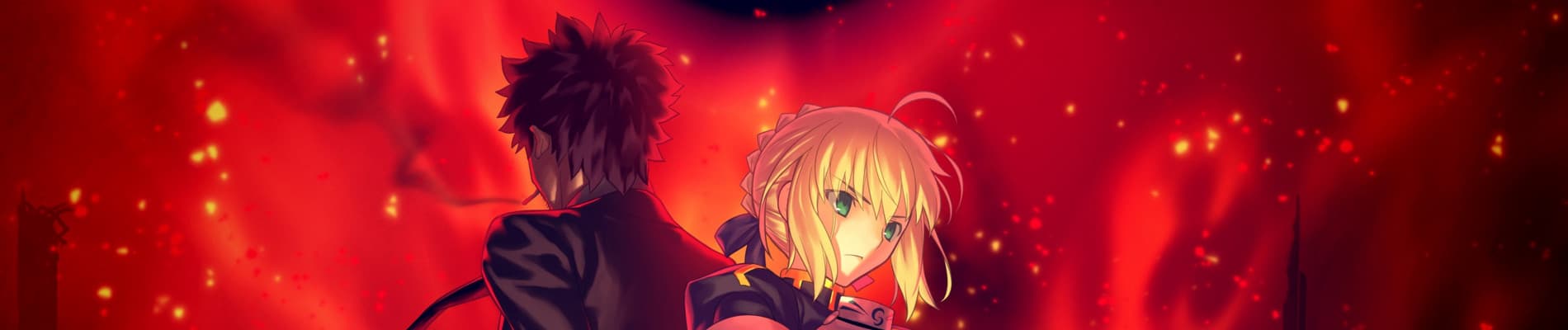
“Glory lies beyond the horizon” -Iskandar, King of Conquerers
No, it does not. Only tragedy does for fools like you and everyone else! This second season you're all trapped in is a symphony of catastrophe, an exhibition of agony, a work drenched in despair. It’s a modern tragedy where everyone, even the audience’s hearts must suffer, and do so splendidly as a crown of thorns is worn by every character that drinks the poison of their own blood. Almost no one walks away, not happily at least as all ideals are viciously destroyed and the cavalcade of bombastic personalities is ground to dust before the feet of the callous victors.
After the cinematic yet somewhat laborious and dubious set-up from the first half of this powerful prequel, this second season delivers a farse so devastating that it becomes one the best installments in the franchise to date. Where the characters in the first season wasted every obvious opportunity they had to kill their opponents with drawn-out monologues and poor decision-making, it seems that now everyone’s in the mood to kill with only some delay. After the first season made me feel that Kiritsugu was nowhere near the killing professional the show talked him up to be, the second season amended my statements and capitalized on his tragedy in a way that reminded me why I found him so compelling all those years ago. Where the first season made him seem melodramatic in cases, here his pain is explored in ways that don’t come across as heavyhanded and forced. Not only did it properly reinforce him as a brutal killer thanks to him finally shooting people, but we got to finally see his view challenged. The more people challenge him, the more resolve he has until by the end, the grail simultaneously hardens his beliefs and eradicates his dream. It was a child’s dream, one so foolish that it would naturally end in the catastrophe that would motivate the protagonist of the 3 main Fate/Stay Night routes.
Kiritsugu’s story is perhaps the most tragic in terms of how it ends and what we learn of him this season, but he’s not the only one elevated in his journey. His foil, Kirei Kotomine, continues his journey from a neutral priest disgusted with the idea of joy to the diabolical and somewhat hedonistic man fans know, one who takes pleasure in people’s struggles and suffering just as his accomplice, Gilgamesh does. The pair takes over as the glorious bastards of the season as the magnificent reign of terror between Ryunosuke and Caster comes to a stunning close. What they realize about themselves at the very end is a lot more profound than one would expect from a duo of eccentric psychopaths who view killing as an art form akin to sculptures. Their bond is almost as endearing as Rider and Waver, whose conclusions are even more bittersweet as one awakens from his lofty dreams while the other carries the torch passed onto him. It’s perhaps the most bittersweet conclusion in the entire show.
Easily the most bitter would go to Kariya Matou, both because of the downward spiral he takes in his quest to save Sakura and make Aoi --the love of his life and the girl married to his newfound enemy, Tokiomi Toosaka-- happy, but also because it feels rushed. The first season is primarily at fault here for doing such a shoddy job of giving him the time needed for his descent to feel earned. Even at the end with the most painful conclusion to a character’s journey in the entirety of the mainline Fate entries, they still go a bit overboard in some regards. He just cannot catch a break both in terms of his trials and the storytelling surrounding it. I even found the fate of Lancer and his master (as well as his wife) to be better executed, though that is because of the purpose it serves in highlighting how far Kiritsugu is willing to go and driving a final wedge between him and Saber. Even his wife, Ilyasveil isn’t impressed, and this is the only time she gets remotely angry with anyone in the entire show. I still cannot cover every character here, let alone all the people who mean something to Kiritsugu, but suffice it to say, all of them have interesting qualities about them, and how each enhances Kiritsugu’s miserable journey is even more captivating than the characters themselves.
Speaking of enhancements, the visuals of this second season are significantly better than the first. While there are a few moments where the frame rate dips, the overall integration of CGI has vastly improved. No more CGI corridors or magic globs. Instead, we have Caster’s gigantic beast from the end of the previous season, a few flying vehicles, Berserker and whatever he touches, and the disastrous red liquid that spills from the Holy Grail. These either look great, or they carry the off-putting feeling they are meant to given the circumstances of their existence. The camera also tries some flashy moves this time, most notably in the inevitable battle between Kirei and Kiritsugu, and in Kirei’s first betrayal. The fight scenes are just as well-animated as ever, and they don’t contain nearly as much drawn-out dialogue to drag things out. Sequences like the “EXCALIBUR” scene at the end of the second episode make for some exquisite highlights of stunning animation. Barring a few off-model moments towards the end, the visuals in this are practically top notch. It’s amazing how much better this looks than the already nice first season when the entirety of Fate/Zero is a split-cour production.
Another aspect that is even greater than the first season is the OST. Most of Yuki Kajiura’s best offerings to the series can be found here, such as “This Day and Never Again”, “Fate to Zero”, “Painful”, and “The Sword of Promised Victory”. These are some of the grandest and most emotional pieces in the franchise, as they truly elevate this soundtrack to its lofty heights as the best Fate OST. The OP, "to the beginning" by Kalafina is a stern yet emotional track, truly signifying Kiritsugu’s wish and painful journey through life and the Holy Grain War. While the first ED theme isn’t that engaging in my eyes, the second one (“Manten by Kalafina) which plays during the flashback episodes of the show, is a much more somber piece. It’s one of my personal favorite ending themes of the decade, and it pains me to not know what to say about it other than how it’s probably my favorite piece of music in the whole show.
Fate/Zero is a beautifully vicious tragedy, where ideals are weaknesses and dreams are destroyed. This second season is leaps and bounds above its predecessor not just due to the generally visceral payoffs it has to several engaging character stories, but also due to the substantial improvements in audiovisuals. No serious Fate title has surpassed this second season at the time of writing, and I doubt anything stands a chance of doing so, even 8 years later. Even with a few blemishes, this is the grandest, most powerful any installment has ever been, and it warrants itself as one of the decade’s most iconic prequels and tragedies.
“This ill-conceived and disappointing play remained a meaningless farce until the very end.” -Gilgamesh, King of Heroes
47 out of 51 users liked this review