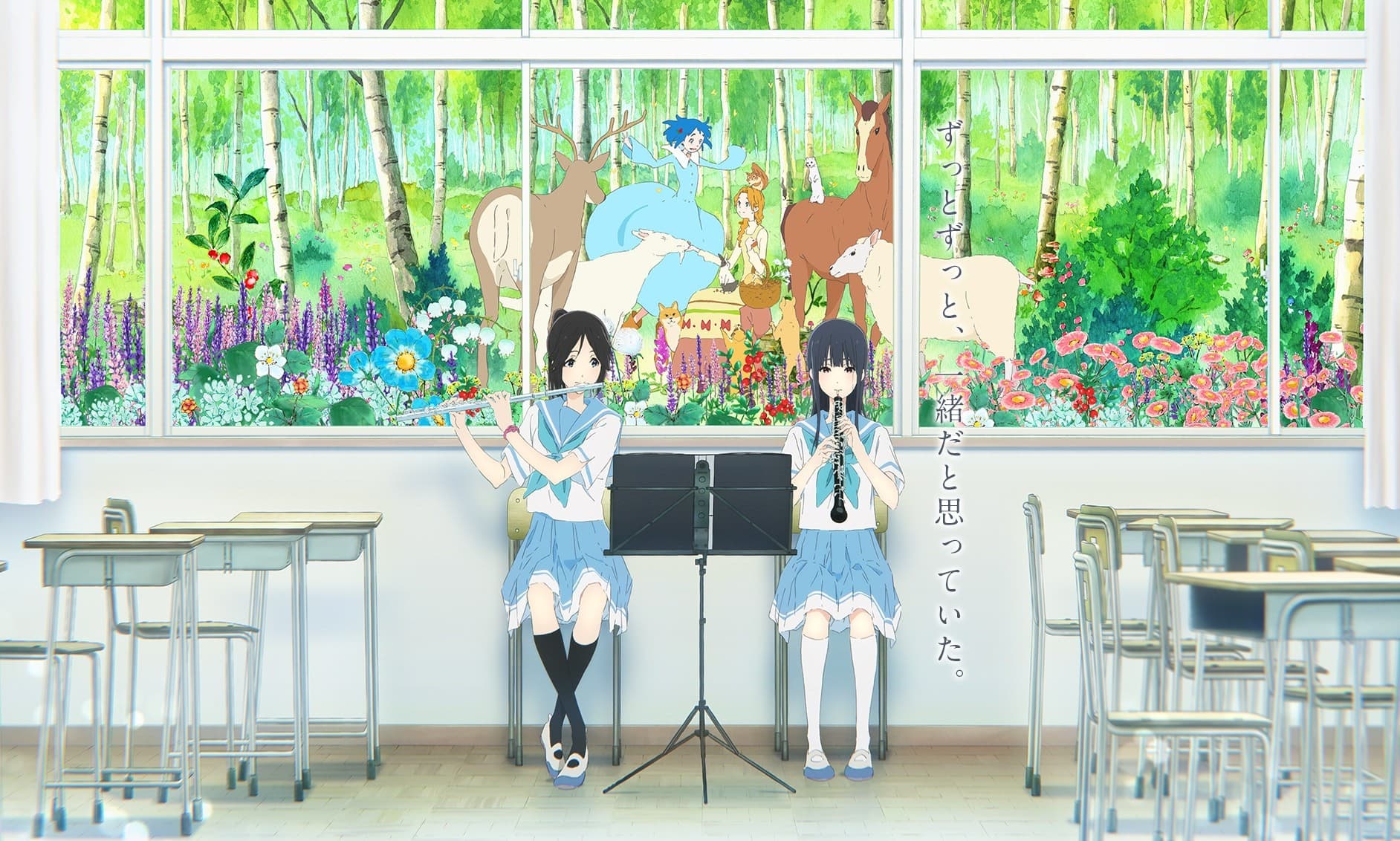
Liz to Aoi Tori is a masterpiece of filmwork with an immense amount of effort dedicated to its creation and refinery.
The story is much deeper than what it appears as on the surface. I'm not one for "whoa dude this is soooo deep" sorts of media, but it doesn't feel anything like the creators of Liz to Aoi Tori were stretching themselves beyond their realistic capabilities as writers to seem "deep". I think watching this halfheartedly out of mere boredom lends oneself to really not appreciating what Liz to Aoi Tori has to offer in its entirety. The storyline is not captivating or entertaining in a traditional sense, instead, it is very human and emotional. Due to this, I really don't think a solid storyline is possible to attribute to this film. The focus for the entire film is the relationship between two friends that feels as fragile and unpredictable as a feather in a hurricane. Liz to Aoi Tori is an unrelenting torrent of many grittily realistic emotions that easily ensnares its viewers into feeling. The writers saw an untapped reserve of potential between two supporting characters in the Hibike! Euphonium series, and they squeezed every last drop out of that potential. The story of Liz to Aoi Tori and the overall relationship of Mizore and Nozomi transcends traditional storytelling to flourish as an admirable masterpiece of anime and film.
Of course, such a beautiful story could not go unsupported by equally beautiful art and sound design. Artistically, there's so much to be said about Liz to Aoi Tori that I'm simply just not qualified to talk about. Symbolism and artstyle were focused on to a pinpoint by the absolute masters working at Kyoto Animation. Certain aspects were modified from Hibike! Euphonium such as the linework to fit in line with the more mature and emotionally weighted themes of Liz to Aoi Tori. After recently viewing some very poorly animated anime, I truly appreciate the effort put into seemingly simple scenes on paper such as walking animations and the immense amount of effort and soul poured into animating realistic and emotional facial expressions, especially when the majority of the film relies solely on emotional expression. The setting for the film is split only between the Kitauji high school and the world within a watercolor storybook. The contrast in artstyle and setting between these two worlds is very deliberate and impactful to the mood of the film. One would think that such a limited setting for media of this length would be boring to a viewer, but the overall design, mood, and constant movement throughout the film always kept the scenery from appearing stale. Beyond these few topics I've covered, there is much more symbolism and impressive feats of artwork to be appreciated by those with more understanding of artwork and how much effort goes into the production of such a film.
Sound design is equally as lovingly crafted as the story itself and the impressive artwork that made the wonderful writing of Liz to Aoi Tori a reality. One thing that particularly stood out to me, and is present in both Liz to Aoi Tori and Hibike! Euphonium, is that most every sound and line of dialogue does not feel like it was recorded in a soundproof recording studio centimeters away from a ridiculously expensive ASMR microphone. If someone is talking on the opposite end of a large room, their voice echoes in such a manner that you would expect in real life from a similar room. The reason this is so, is because the absolutely dedicated individuals at Kyoto Animation often use 1:1 replicas of actual buildings in their work. This was the case with K-On!, as it is with Hibike! Euphonium. Many sounds ranging from footsteps, to dialogue, to orchestral music is all recorded in the actual real counterpart to the building in the animation. It adds so much depth and life to an otherwise unrealistic genre of media, and this amount of dedication to the product is truly impressive. Beyond that, all of the music is recorded with a live orchestra, resulting in every breath, every mechanical sound of a room full of instruments, and every minute flaw coming through into the final production. On top of the extremely detailed closeup animations of musical instruments being played, this amount of attention to detail truly makes the sound design of Liz to Aoi Tori and the Hibike! Euphonium series in general a masterpiece to be remembered. I highly recommend viewing some of the "making of" videos for Liz to Aoi Tori and Hibike! Euphonium. Seeing the painstakingly detailed recording and the unique production of original background music is very interesting and made me appreciate the effort so much more.
Character building is rather restricted when a film is only focusing on two characters and their relationship between one another, but Kyoto Animation uses this restriction to really focus themselves on making very emotionally interesting characters that constantly keeps viewers captivated for the entire duration of the film. The character development in Liz to Aoi Tori is quite satisfying, and significant progression is made by the end of the film for two characters that were otherwise lacking characters in the main series of Hibike! Euphonium that constantly felt like they could be so much more. This satisfying and plentiful character progression makes Liz to Aoi Tori a refreshing take on side stories, something that is so easily spoiled that many studios will just never attempt to make anything of the sort, outside of hollow, unsubstantial, and easy-to-make OVAs for their anime.
Liz to Aoi Tori, while not being the absolute most enjoying film or anime I've ever watched, has so much effort poured into its production that I would consider it an insult to the creators to NOT to call this film a masterpiece. The writing is certainly not half-assed, and yet so much precision and creativity was put into its creation, Liz to Aoi Tori still very much feels human and manages to closely touch our emotions.
28 out of 29 users liked this review