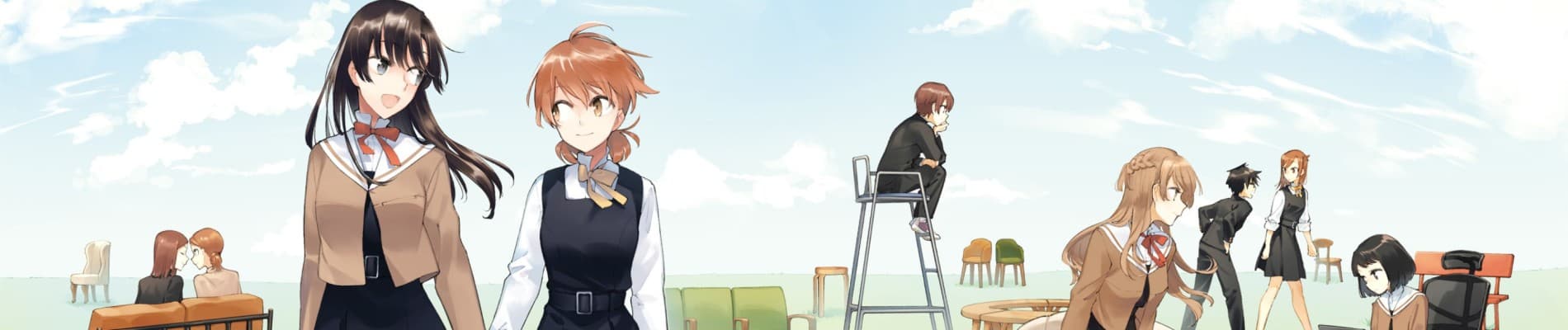
Before I get any further: I love this manga series. I think some parts of it worked and some didn't; I'll give some cursory explanations of this below, but these are not my final thoughts on the matter by any means.
- Intimacy. This series succeeds at precisely the place where it needs to: fleshing out and characterizing a romantic relationship between two women. This is my entry into yuri, so I'm told that a lot of other series misstep right at the start with this one. And Yuu and Touko's characterization truly is lovely: we see how Yuu is able to push through Touko's usual mask of confidence and self-assurance to understand how Touko is feeling. She can only do so because of Touko's openness towards her to begin with, which arose from knowing Yuu's central character trait: her inability to love. Yuu and Touko's main character traits disarm each other, and in fact, act as a catalyst for their relationship. Yuu feels compelled to help Touko because she's one of the few people who know's Touko's flaws; Touko is compelled to give affection to Yuu because she doesn't need to deal with the consequences of reciprocation. It's done magnificently well, and I believe in the depth and humanity of these characters, and the perfect fit between them. It's fantastic.
- Character development. The main piece of character development in this series is that of helping each other move past their defining character flaw: Yuu learns how to fall in love, and Touko learns how to move beyond the shadow of her sister and and present herself authentically. I empathize with Yuu's character arc far more than I do Touko's, but that may only be because I have been in Yuu's position, but not Touko's. I think the design decisions made with these arcs are also suuuper well-done. Yuu learning to love Touko is beautifully subtle and gradual, and is a wonderful mixture of explicit verbal confusion (is she being nice or falling in love? what does that feel like anyways) and nonverbal indicators (Yuu's looks at Touko are always full of meaning, and her conversations with side characters about it also reveal a lot about her state of mind). It's also narratively convenient, because you can show the payoff of them kissing or whatever before their romantic and emotional arc is finished: how clever is that?! Other ways of getting physical before getting together (getting characters drunk, or putting them in a dream sequence) are so dumb and hackneyed, it's nice there's none of that here. Yuu forcing Touko to confront her fear of being herself also works great, I think: I love media inside media, and having Touko perform a play to confront that she puts up an act in front of others? Good writing, to say the least. It additionally works because Yuu learns to love Touko by helping her, and Touko learns to be herself by Yuu helping her; the same actions develop both of their characters! It's so satisfying, honestly.
- Side characters. Things become weaker as we move further from the main duo. Kodama and Hakozaki act as an example of a stable, mature relationship when everything else is up in the air. Maki is a nice supporting character to help tell Yuu what's happening to her by sitting in contrast to her, being incapable of falling in love and not lying to himself about that. Saeki is similar, caring about Touko but being too worried about ruining their friendship to push further. I kinda feel bad for Saeki, though? Like, she's a character that's not essential to Yuu and Touko's character development: she's just here to suffer. And she does suffer a lot, without a clear character arc. There is a character arc there: Saeki falls in love with Touko, but either is too scared or cares about Touko too much to take it further and confess; she later confesses after Touko's character development, thinking she has a shot, and after getting rejected, decides she is happy to support Touko regardless of anything. Is it just me, or do these feelings seem inauthentic? Saeki has been pining after Touko for years, and then Touko gets stolen from underneath her after she meets a girl once. I would be a tortured soul after realizing that all those dreams of romantic relationship with Touko were dashed, especially knowing that it was my fault that I didn't take a chance earlier. My point is: Saeki's actions show someone who legitimately cares about Touko as a person and wants what's best for Touko despite her own feelings; however, we're told that Saeki doesn't concern herself with anything past Touko's public image. These don't line up for me, and though we see a couple of indications that she changes from the latter to the former, there's no emotional coming-to-terms. (There might be one scene? I'll have to look again.) In any case, for all intents and purposes, Saeki has more to overcome than either of the two main characters, but we see relatively little of her struggles; we only see her suffering. Unfortunately, she's also front and center in the weakest section of the manga:
- The plot. I wrote "plot" as the main section header here, but really I'm just going to complain about a contrivance in the second-to-last arc (Ch. 34-39). I think the plot is good, and services the character development quite well: basically, the plot is sparse, and what is there is used to service the development of relationships, which is how I want plot to be used in a series focused around relationships. The only place it doesn't quite work is in the aforementioned 34-39 arc: Yuu confesses her love, and then Touko says sorry (??), which Yuu interprets as a rejection. This miscommunication pushes them apart long enough for some awkward interactions, for Yuu to feel pain from rejection, and for Touko and Saeki to go on a trip where Touko rejects Saeki's confession. I think the events that happen in this character arc are important. Yuu questioning her love for a moment is good, since it's really satisfying when her love is eventually affirmed again after this period of doubt. Saeki is supposed to grow from her rejection, so it should be there. Sidebar: I don't get this reasoning here. I can understand Saeki getting something from being rejected if Touko rejected Saeki for a good reason, like because Saeki didn't understand her or support her emotionally like Yuu did. That way, Saeki can move on knowing what she did wrong and what she can do better. Instead, Touko rejects Saeki because Touko happened to fall in love with Yuu on sight. Touko's love for Yuu is unconditional by design: she likes Yuu because Yuu (1) is hot, I guess and (2) doesn't reciprocate. So, it's not Saeki's fault that she couldn't date Touko, and getting rejected just means that Saeki gets to move on, learning nothing. I think the sequence of events here is perfectly realistic and reasonable, but it sucks a bit that the way it was written robs Saeki of her agency, and makes her actions feel less meaningful. As soon as you see Touko kiss Yuu, you know Saeki has no chance: why try to make up a love triangle that isn't there?
To summarize: this series's protagonists are written so strongly, they have a life of their own. They're iconic. The rest of the story is a tightly-written framework housing giving a look into the magical progression of their relationship. This manga is no more than that, but it doesn't need to be.