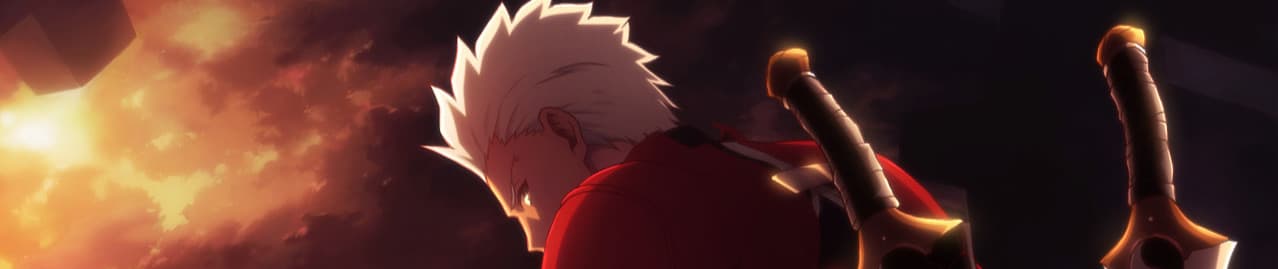
This review covers both seasons of Fate/Stay Night: Unlimited Blade Works and contains spoilers
Fate/Stay Night: Unlimited Blade Works is an aggravating piece of work. Laborious and cyclical to the core, this show manages to stumble its way through 25 episodes of monotonous monologues, caricatures, and dialogues filled to the brim with repetition and wheel spinning. No amount of dazzling light shows or cute interactions can salvage this production, even if they do make the experience less insufferable than it could have been.
Let’s start with the positives before things get too dicey. Studio Ufotable did a fairly good job with the visuals of this show. They have this reputation of always making top of the line visual experiences, and while it’s certainly overblown, I can see where people are coming from. Some of the animation here is quite vibrant and fluid, especially with some of the more explosive attacks showcased towards the back half of the series. Additionally, the character designs and fashion are generally pleasant and eye-catching. The studio's signature post-processing digital effects on the colors and lighting generally work rather well with the artwork and setting, blending itself well with the more ominous moments of the show. Unfortunately, we can't be all positive here since there are some major shortcomings carried over from their previous Fate production. Nothing ever reaches the absolute highs of the golden Excalibur scene from Zero season 2, and Takahiko Miura's direction isn't anything special or noteworthy compared to F/Z's Ei Aoki. There's also a fair amount of inconsistency, not just with the artwork, but with the visual impact of certain attacks, such as the firing of Gilgamesh's swords feeling like it causes explosions at random rather than with certainty when it hits the ground hard enough. The flashy fight scenes aren't always that fluid or well-drawn either, such as the final fight between Shirou and Archer. Attacks feel so overblown at times, and some even add to the inconsistency, like when you compare Rin's martial arts magic combat against Caster in early S2 to her sparring match with fellow student Luvia in the epilogue which causes tons of explosions and sends debris flying everywhere. The CG from Fate/Zero is back and hasn't improved at all, with tons of summonable CG skeletons, locales, and stock fire effects that eradicate the frame rate or otherwise just look hideous. It's honestly a step down from the studio's previous work, and that's a bit of a shame.
The music is also a step down from the previous installment. Instead of having Yuki Kajiura compose like she did last time and would eventually do for future installments, we instead have Hiroyuki Fukasawa doing the score. In fairness, his work is generally decent, with a fair amount of nice jingles for the calmer moments of the show, and a few decent tracks for the action scenes like with UBW’s rendition of “Emiya” and “Sword of Promised Victory” in some of the second season’s bigger moments. A lot of the calmer tracks feel rather reused, however. On top of that, there isn’t anything as grandiose or memorable as the likes of “This Day and Never Again” or “Sword of Promised Victory” from Fate/Zero. The emotional tracks aren’t as potent as the likes of “Kumo wa Somari Yuku” from DEEN/Stay Night or “Painful” from Fate/Zero, either. Hiroyuki Fukasawa provides a pretty decent score, but it can’t quite stand up to some of the franchise’s other works. The ending themes are even more forgettable and bland, with the exception of episode 15’s ending theme, which is a slow, beautiful, and vastly superior rendition of the show’s second ED. Luckily, both openings are fairly memorable and work well for their respective cours. “Ideal White” by Mashiro Ayano is the lesser of the two but it’s still a fairly energetic j-rock song with a nice build and final stretch. “Brave Shine” by Aimer is far more widely recognized for good reason thanks to being more epic with its chorus in particular. However, another Aimer song in UBW outdoes it, that track being the insert for episode 20, “Last Stardust”. While the show gimped the timing with it, the song itself is a slow yet powerful banger that can sell any emotionally triumphant scene, except for the scene it’s used in thanks to it just being another example of the show’s incessant wheel spinning.
“Wheel spinning” is a pretty fitting phrase to describe the main thematic conflict of Unlimited Blade Works regarding our main character, Shirou. From the very first episode (not counting the prologue), you see him start monologuing endlessly about the Fuyuki fire, apropos of nothing, and every time it’s the same damn thing. There’s no new revelation or side of the story, no new information to be found with Shirou’s constant revisits of the subject whenever he starts thinking about it. Sure, it’s nice to see how other characters, namely this route’s love interest Rin, react to his tragic backstory, but subjecting the audience to it about 15 times without any significant value being added is a crime. It’s even worse when his future self (oh trust me, we’ll get to that crock of horseshit later) Archer starts interacting with him. Their dialogue almost invariably amounts to some form of:
Archer: Shirou, your naive ideals suck and are retarded. They bring nothing but misery. Go die.
Shirou: Fuck you, they’re awesome and I believe in them, you amoral douchebag!
Archer: No, they’re dumb and they’re not even yours you stubborn cunt. See the murderous pain that awaits your future, fuck off, and die!
Shirou: So what? I still believe in them, and I will never turn into a miserable sad sack like you!
Archer: I hate you, limp cocksucker!
Shirou: I hate you more!
Archer: GO KILL YOURSELF!!!
Shirou: GO JUMP UP YOUR MOM’S ASS!!!
The worst part is that the middle of season 2 is primarily comprised of this cyclical exchange, with every single solitary scene, including the “Last Stardust scene” being them going over the same bullet points over and over again and coming to the conclusions they’ve long since come to and expressed to each other about why they believe what they believe. Even most online debates have a greater sense of progress than this, and with infinitely more brevity to boot. The idea of Shirou accepting that the typical “I want to save everyone” ideal leads to more misery than it’s worth is fine on paper, but when it’s reduced to nothing more than a series of cyclical diatribes and polemics that, in total, make up about ¼ of the show’s runtime, I just wish he and Archer would die a painful death.
Speaking of Archer being a miserable sad sack, there’s the idea of him being a guardian from the future, and why this solidified UBW’s worldbuilding and writing as a broken, convoluted mess of holes and vague nonsense. I have some questions, and they are as follows:
Where did Shirou even find that thing he interacted with that allowed him to become a guardian? How does that even work? Is it related to the grail in some way? It has to be in order for Shirou to become a heroic spirit, so how does any of that work? What allows it to come into being? How come guardians basically wander the afterlife and retain all their memories of both it and every time they are summoned, but servants do not? The idea of guardians somehow also being heroic spirits from the future is stupid and serves as an asinine outlier in the summoning rules of this franchise for the sake of giving Shirou a whiny foil drenched in blood red. What conflict was Archer hanged for, given that it seems to play a major role in why he became so jaded? They never say. Does Rin mean so little to him that he basically considers her a begrudging acquaintance at best until his final scene with her when in this route, she is his romantic partner when he's Shirou? Why does she play absolutely no factor in his life post-guardian contract? Also, why doesn't Archer just try to persuade Shirou not to become a guardian and instead look for other means to try becoming a hero like say, being a firefighter or something? Did the thought ever occur to him before he went "nah, killing him is a better idea"? Even if he had brought up that he first thought of other solutions before deciding that killing Shirou was the best idea, that would have still been better, more nuanced, and more well thought out than it currently is. This is all directly related to the character motivations of the center of UBW's primary ideological conflict as well as to the dodgy, convoluted, and somewhat nebulous world-building, so what the fuck?
Even if you want to argue that not everything here requires an in-depth explanation since that could risk dragging out the pacing of season 2 even more than the whole Archer vs Shirou conflict already does, there’s no reason to leave all of this out there without even a slight answer. A little clarity goes along way, otherwise, why would the show bother with the whole “guardians” and “I was framed as the ringleader of a conflict and hanged” ideas? They’re underdeveloped and nebulous, convoluted window dressing to Archer’s jadedness that he tries to shove down everyone’s throats. That’s almost the entirety of his character anyway, leaving his chemistry with Rin to be his only redeeming quality. Rin has a lot of cute exchanges with Shirou and Archer throughout the show, which helps make her romance with Shirou all the more believable and naturally developed, at least for the most part. It’s the one major aspect of UBW’s writing that I don’t have significant problems with, even if both characters aren’t very well written.
One last thing to say about Shirou is that the show does not go that far into the idea that his ideas have left him a hollow, damaged human being beyond two exchanges with Rin and one part of Shirou and Archer’s 3-episode bickering in season 2. This is a point that could have been reinforced more throughout the show, and they could have done more with how much of a character flaw that really is instead of primarily having his ideals result in him being called “naive” or “hypocritical”. There’s little else to speak of regarding him, so next there’s Rin. She’s an idiot. It’s honestly impressive just how stupid she can be when it comes to magecraft and the holy grail war, two things she has been studying and preparing for all her life. There are plenty of moments of her not coming to the most basic conclusions, putting 2 and 2 together, or making obvious decisions that I could choose from, but let’s stick to two examples, both from the same episode. Season 1 episode 9 has Shirou and Rin discussing the bounded field they are currently in, and Shirou puts together that, like last time back in episode 5, this must be the work of resident cowardly scumbag Shinji Matou. Rin somehow is surprised by this, and Shirou’s surprised by how she didn’t figure out something that obvious. Even though it is lampshaded in-universe, it’s crazy how Rin wouldn’t automatically assume Shinji was back on his bullshit again given that at this point, they had no reason to believe there were any other masters at this school. When Saber arrives to help them that very same episode, Shirou explains that there’s a bounded field, Saber remarks that there’s a servant here, and Rin, who knows that Shinji’s servant is with him inside the bounded field just like last time, is shocked by this revelation. I remind you again that she’s supposed to be the smart one in the group, and that she has been studying magic and preparing for the war for more than a decade. No amount of cute and usually earned tsundere moments can save her character at this point when she’s this consistently braindead.
With all that being said, Rin is probably the best relevant character here, as almost everyone else has pretty much one or two character traits if any at all, and some such as Shinji and Caster are just evil pricks for the sake of being evil pricks until, surprise, Caster has a dumb backstory about an exceptionally stupid master who was mean to her before she killed him and got a new master. They don’t even have any of the flair or intrigue that Gilgamesh does when it comes to their villainy, not that he lives up to his prequel counterpart thanks to the material of the route and how he too holds the idiot ball by the end. They, as well as non-participants such as Taiga and Sakura, are basically just there to be used and discarded by the plot when necessary to a notable and transparent degree. With the non-combatants in particular, they don’t even exist in the second season until one scene in the epilogue. It’s painfully clear that everyone is just there to line up in pairs of single-file lines to fight Shirou, Rin, and their servants for the most part. The only exception is Lancer, who has always been a somewhat suave and extremely unlucky cool guy that gets to sass everyone. He’s even part of the best scene in the show where Shirou embarrasses Rin by telling Lancer not to steal his girl and the two get into an amusing conversation as Lancer laughs at them. Even he only exists for two episodes in season 1 before disappearing for another 10 until the finale where he starts becoming somewhat relevant again. Sure, this was never going to be as professional and tactical as the war in Fate/Zero where everyone is proactively trying to get the jump on one another, but would it have killed anyone to at least have a scene or two checking on some of the servants that aren’t about to face the main characters or executing any huge plans at the moment? They only do it one time for Caster and Assassin, and that’s when he’s mouthing off to her while she prepares her next big scheme. No one else is granted this luxury. I understand that adapting a visual novel is tricky due to time, but you could have just removed most of the monologues and shortened the repetitive convos between Shirou and Archer, and used some of that time to actually characterize more of the cast members beyond “here’s a backstory right when they’re about to die”.
So that’s Unlimited Blade Works: a series of nebulous nonsense and inconsistencies featuring flat and/or idiotic characters and cyclical diatribes for the plot to pick and choose so transparently that they might as well drop all pretenses of this not being a linear video game of a story. Its decent audiovisuals help make the experience less of a chore than it could have been, and there are some cute interactions sprinkled throughout, but they alone cannot save this mangled chore. It’s far from the worst Fate title out there, but I cannot recommend this one unless you desperately feel you need to experience the entirety of the Fate continuity in anime form. Still, at least it’s better than the movie version.
Written and Edited by: CodeBlazeFate
Proofread by: Peregrine
282 out of 456 users liked this review
