Alien Nine
a review by seanny
a review by seanny

Alien 9 unearths a preadolescent, existential terror buried and forgotten under my decades of adulthood. Though a coming-of-age sci-fi isn’t novel in itself, Alien 9 twists the aesthetics of moe into visceral horror, predating the better-known reference point of Madoka Magica by a decade. In fact, when I first saw Madoka, I took it as a throwback to a more subversive time.
At the turn of the millennium, Mamoru Hosoda’s Digimon Adventure short film, Revolutionary Girl Utena, and Neon Genesis Evangelion put a dark, postmodern twist on their respective child-oriented subgenres; the aesthetics of Evangelion in particular paved the way for mind-trip horror fare like Serial Experiments Lain. In this peculiar media culture, Alien 9 emerged, depicting a Japan beset by invasions from a variety of grotesque alien monsters.
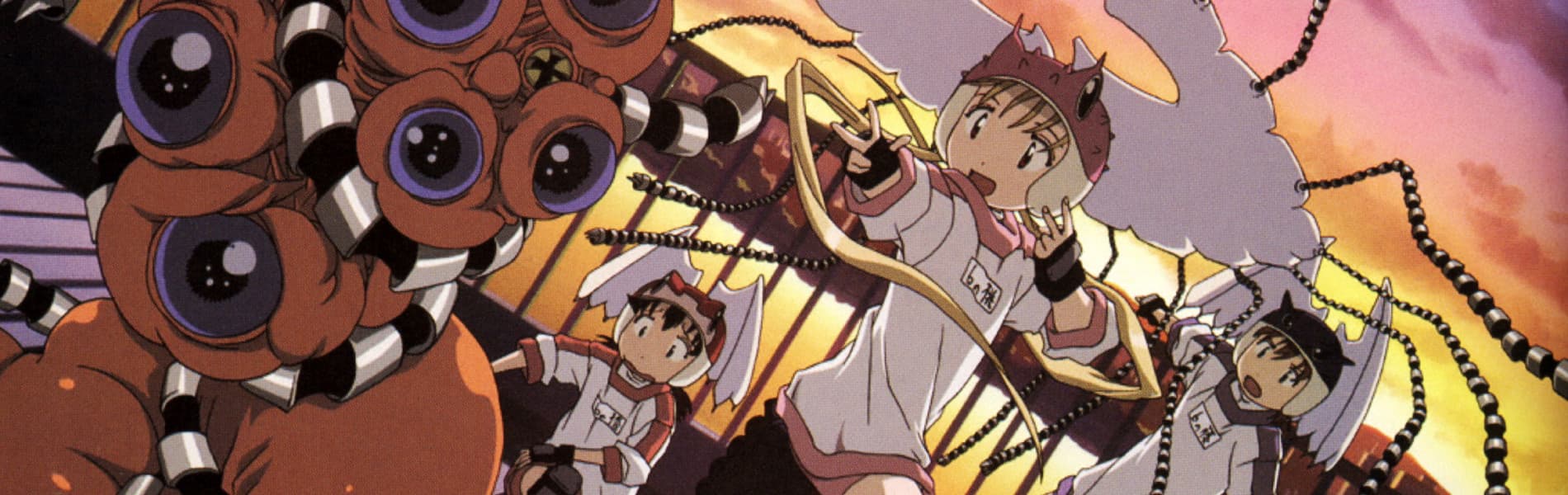
Yuri is nominated into the “Alien Countermeasures” squad, tasked to defend her school from attack by nightmarish critters that descend from Giger-esque space pods. She is made to don a helmet-shaped talking alien known as a “Borg”. The creepy, winged Borg can slice anything to ribbons with its hidden blades. Of course, for the 12-y.o. crybaby Yuri, this new and grisly set of powers and responsibilities is an absolute nightmare. It doesn’t help that her squadmates are unapproachably eccentric, and her superior plots to throw Yuri into traumatic alien encounters in service of an ulterior motive. Many battles result in Yuri cowering in terror as her Borg enters a blind killing frenzy.

Though this may sound almost exactly like Evangelion in another form (which it is), it offers a slimmer, focused experience. Evangelion presents many modes and layers over its dozens of episodes, as does the original Alien 9 manga which escalates its Cronenbergian body-horror ideas beyond the breaking point. The four-episode anime adaptation finds an emotional foundation to construct its storytelling upon, adding several lovely dream sequences that give us glimpses into Yuri’s psychological journey.
The anime is unsubtle about the Borg as a puberty metaphor. One day Yuri will fully merge with her Borg into a new being of grotesque power, and though it’s unclear what that entails, when out on patrol they are two discordant minds in one body; one clumsy and the other on point; one caving under society’s impossible demands while the other deadly when triggered. Unable to cope, Yuri finds herself left behind in a world indifferent to her struggle; such is a tween’s miserable existence.

In its portrayal of the tween condition, Alien 9 contrasts its bubbly character designs with jagged ultraviolence, finding a subversive purpose for moe beyond the fetishization of innocence. And innocence is continually set against the shadows of sunset in its dimly-colored world. Tension chords and rhythmic chaos gradually gnaw away at the childlike instrumentation of its memorable background music. The short series is one of unnerving contrasts. Entertainment doesn’t have to make a sophisticated argument when it can make a simple one viscerally. Alien 9 is a cut far above the mundane due to its many high quality elements working toward a shared emotional goal.
Unfortunately, its best episodes are in the front half. The third episode bridge is an obligatory break from the tension — a beach, kimodameshi and summer festival episode all rolled into one — and its finale tees up continuing adventures in, in my opinion, the inferior manga which quickly runs out of things to say. In a perfect world, it would serve only itself and put a period at the end of the sentence in movie-like fashion, but anime almost always plays second fiddle to extrinsic interests. With that truism aside, Alien 9 is still a special production that typifies a special era, with its earnest preemption of the trends of our post-Madoka environment. One should experience the real thing sometime.
Addendum:
77 out of 81 users liked this review
