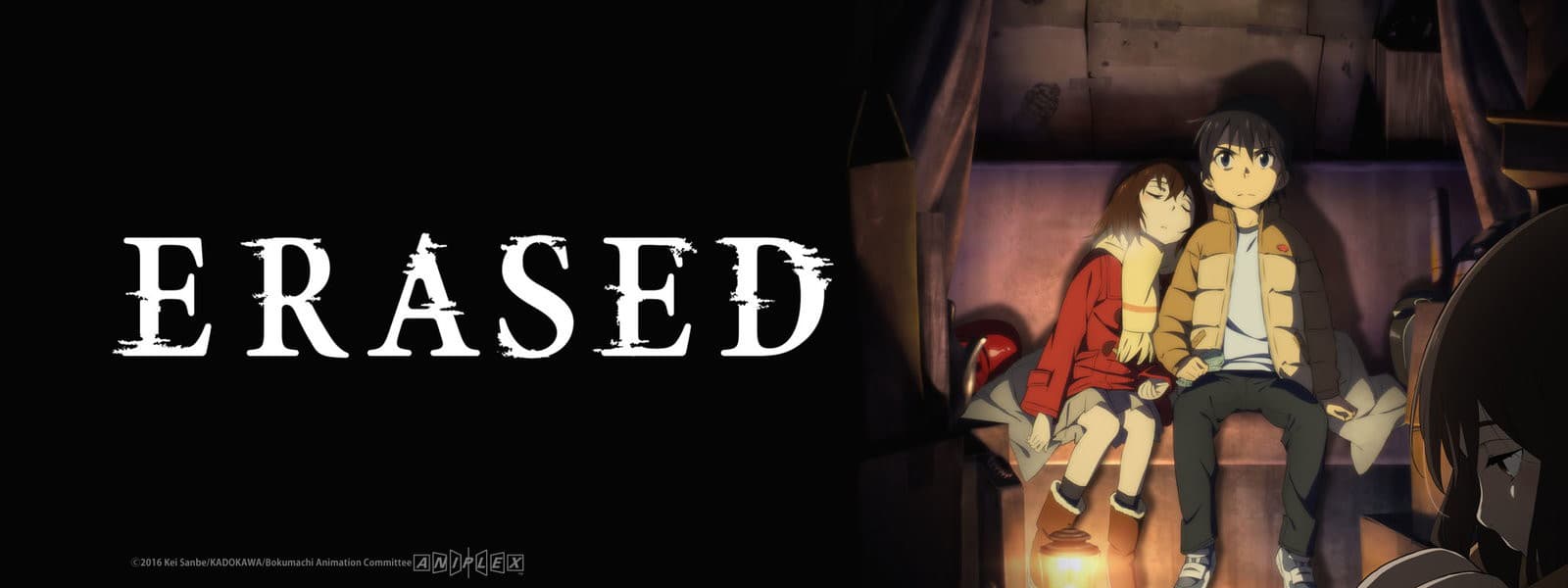
ERASED
a review by CodeBlazeFate
a review by CodeBlazeFate
Time travel is a dangerous concept. I'm not referring to how meddling with the past is an astronomically terrible idea that could invalidate the future. I'm referring to how things are never gonna fully make sense once you use it. An entire anime based on time travel is bound to require you to make concessions in order to still appreciate it. If the character writing and general narrative are strong enough, even the dodgier time travel elements can be excused. Just look at "The Disappearance of Haruhi Suzumiya", the most beloved and most gorgeous installment in the Haruhi Suzumiya franchise. Meanwhile ERASED is an example of what happens when the writing can't hold up to scrutiny, crumbling under the time travel weight. Perhaps that's not accurate enough, especially since for about 2/3 of the series, the writing is generally solid despite its child characters being practically written like teenagers and the directing being a little heavy-handed. Call this a case of a beloved series going downhill: the classic television tragedy.
One of the major problems of the series is that it tries to set itself up like a mystery when:
A. It barely follows up on that until episode 10 despite how much the show likes to remind you of this plotline, mainly focusing on time travel and relationships instead.
B. For a mystery, there really weren't enough feasible suspects, and the true culprit doesn't carry a very strong motivation for committing the crime of murder in the present day, one such murder that affected main lead Satoru enough to inadvertently jump 18 YEARS into the past.
Sure, a dramatic story about child abuse is presented, but the payoff to both that and the "mystery" set up at the beginning were so unbelievably bad that they kicked off the ruinous final third of the series. Then again, the cracks were beginning to show earlier on. After discovering that Kayo's mom beats her on a regular basis, Satoru convinces his mom and his friends to allow him to hide Kayo somewhere safe, knowing the danger of both her mom, and a kidnapper that happened around this time. He convinces his friends that this was all just role play, and given that, it is more than a little difficult to accept how they allow this to temporarily change their lives so abruptly for an extended period of time.
The time travel aspect isn't really fleshed out or explained properly, as it's apparently supposed to be this involuntary and symbolic thing, yet if it's so involuntary, why did Satoru have to manually activate it via screaming towards the heavens? What is up with that stupid, stupid time skip? What is with the whole symbolic anecdote about the spider web from heaven? Perhaps the manga makes sense of all of this, but you shouldn't have to handwave it with "oh it's symbolism" so that it can be a justified and still not properly explained core mechanic of your series and its world-building. Then again, that's the price you pay for settling for a 12 episode slot when what you're adapting requires at least one and a half times that amount if shows like Blazblue Alter Memory were any indication. The finale being a laughable Batman and Joker style encounter after a huge time skip that ends via asspulls and anticlimaxes is just the final nail in the coffin.
From what I've gathered, integral aspects of two characters (Airi and Kenya) were cut out from the adaptation. As troublesome as that is given their lack of relevance, both of them were generally likable. Satoru is a likable enough protagonist forced to grapple with all sorts of death while reeling through the failures of his manga-author life, while his mother is perhaps the purest character in the entire show. The other mom in the show, Kayo's mom, is utter garbage. For the majority of the show, she's just this singularly vile being without a hint of redeeming or tragic qualities to speak of, and then episode 9 tries to pull a sob story out of her in an attempt to make us care. Yeah, no. Fuck that. Maybe try making her an actually complex character instead of trying to make her earn cheap sympathy points at the very end. It undermines the abuse story, which was already hampered by the mother being almost cartoonishly evil. Kayo herself is a jaded child character suffering from abuse, and the target of the audience's sympathy. She's ok for what she is. The main antagonist of the show is not only obvious, but very shallow and idiotic as a villain once he's revealed. Also, yes, it is odd seeing tweens (11-year-olds to be specific) tackle such serious topics so seriously, even despite Satoru convincing them that this was role play, all except for Kenya who knows what's really going on. Maybe if these guys were around the age of 15, it would be more understandable in a lot of ways. They're basically written like teenagers anyway.
Despite how terrible A-1 Pictures' working conditions are, they're sometimes capable of releasing anime that look pretty good. This is perhaps one of their most visually distinct titles. Some of the environments look great, particularly the sky during the aurora Borealis scene. The art style is also one of the more attractive ones that this studio has done. Tomohiko Itou's directing is a bit hit and miss. There are some problems with how heavy-handed the visual communication can be, especially regarding its...shall we say, "liberal" use of the "red means dead" motif. On the flip side, there are plenty of lovely match-cuts and shots that are simply gorgeous. The letterboxing also adds a distinct style to the show's visuals. The OP, "Re:Re" by Asian Kung-Fu, Generation, is one of their best songs. Even more impressive are its visuals, always having more than enough stuff moving to not only keep your eyes plastered to the screen, but new tricks and sights to see if you merely slightly adjust where you look. The ED, "Sore wa Chiisana Hikari no Youna" by Sayuri, is one of her best songs as it's a wonderfully uplifting and grandiose song with a somber start before kicking into overdrive. The vibrant colors and minimalistic shapes are also a feast for the eyes. As for Yuki Kajiura's OST, it's surprisingly unmemorable. Nothing really stood out, which is odd for her and disappointing for me. There's really nothing else I can stay.
I remember when a few episodes in, ERASED was widely heralded as an absolute masterpiece. Things sure do change. After the show's final act, ERASED quickly went from a critical darling to one of the most common examples of a great show that couldn't stick the landing in the eyes of many. Several fans would still recommend the show despite the dodgy conclusion, and to some extent, I can see why. There aren't that many abuse stories in anime, let alone popular ones. It does have an exciting premise. Its visuals are some of the best in the studio despite some heavy-handed moments. That said, I'm not sure I can do the same. The show isn't terrible, at least until the last act. However, it's difficult to recommend something that implodes later down the line. It's even more difficult when the show was already questionable at times beforehand. It's a shame since I did enjoy this show at first, and there are great things that can be said about it. Alas, here we are at the corpse. The case behind this particular murder is closed, and the autopsy is complete.
55 out of 80 users liked this review
