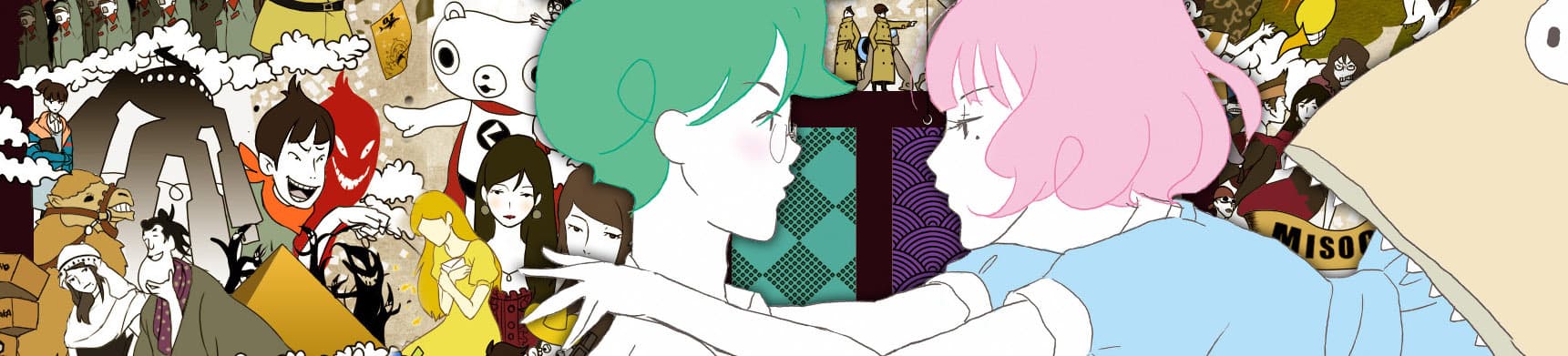
I'm sure that most people have, at some point in their lives, asked themselves "If I had made a different decision in my life, how would I be different today?" It may take a few episodes to realize it, but this question is the entire basis of Yojo-han Shinwa Taikei, AKA The Tatami Galaxy. The story focuses on an unnamed narrator, sometimes dubbed "Watashi" by viewers for the personal pronoun he uses, as he attempts to have a rose-colored school life. In the first episode, he joins the tennis circle and meets a devious young man named Ozu, who drags him down with him. In the end, after a disaster, Watashi wishes he could go back and do it all again. In the second episode, Watashi joins the film club and meets a devious young man named Ozu, who drags him down with him. In the end, after a disaster, Watashi wishes he could go back and do it all again. In the third episode...well, you get the point.
The episodic structure is rather unusual. It appears to be a Groundhog Day-style loop that the protagonist never realizes he's stuck in, and it's presented in such a way that a viewer might not even catch on for a bit. There are elements that keep popping up--a selection from a pool of characters, the fortune teller, the Mochiguma that Watashi finds--but each episode has its own plot. This, unfortunately, may be perceived by many as being formulaic and repetitive, when a closer look reveals it to be a gradual development of an overlying plot and the main themes of the story.
The plot is simple: Watashi joins a club in hope of finding a rose-colored school life and his life suddenly spirals out of control. A fortune-teller gives him vague, cryptic advice (charging 1000 yen extra for it every time) that heavily implies that he'll find happiness with Akashi, an underclassman he's taken interest in. He ignores or misinterprets the advice and makes a life-destroying decision, then reflects that he'd do things differently if he could. A clock rewinds, and the next episode Watashi joins a different club. It's only in the final episodes that the show diverges from this formula, and when it does, all the pieces begin falling into place.
There are roughly six primary characters who keep popping up throughout the stories, and though the only difference between the timeline of each episode is a decision that Watashi makes, every episode gives a new, fresh view of the characters. For example, Jogasaki is initially introduced as an arrogant and dictatorial jock, an archetype that is instantly identifiable and understandable. Watashi runs an expository film on him and portrays hidden aspect of his character in a negative light, but when Jogasaki appears in later episodes, he seems quite different, whether he's engaging in prank war or showing tender romantic devotion to his love doll. He's still undeniably Jogasaki, but the context in which he's being portrayed is different and you get a better understanding of him. The same happens to all characters, and when all the pieces begin falling into place at the end, it is this realization that there's always more to a person than you can initially see that makes Watashi reevaluate his relationship with Ozu.
The anime adaptation was directed by Masaaki Yuasa, famous for his unorthodox animation direction. The Tatami Galaxy is no exception. Much of the art is symbolic and representative. Viewers instinctively understand that when Ozu is portrayed as having fangs or the softball circle is given a bee-like color scheme, it's Watashi's own symbolic perceptions of events rather than a literal representation. Watashi sees Ozu as devious and the softball circle as an incredibly driven hivemind, so the animation reflects that. In fact, Ozu's appearance grows less monstrous as the show goes on and the narrator gains a better understanding of him. Most notably in terms of art, when the show takes a turn for the more bizarre near the end, there are more colored filters and there is occasionally live-action footage included alongside the animated footage, creating a much more deranged experience. Overall, it's quite a surreal experience, but it's very much a visually interesting one.
Finally, the soundtrack is very solid. The OP and ED are both wonderful, and the visualizations present in both manage to wonderfully summarize and encapsulate the entire series, although it's only at the end that the viewer is able to understand how.
The series does have a very few flaws, as all things do. While I found the repetition at the heart of the show enjoyable, others might not find it worth sitting through for the final payoff. In a lot of ways, The Tatami Galaxy is very didactic, and often borders on esoteric as a result. This is not easily classified as action or romance or even slice-of-life. The Tatami Galaxy can best be described as an artistic piece that's both philosophical and introspective. You watch it to think and reflect, and those who don't like those types of shows will probably hate The Tatami Galaxy. On top of that, Watashi is an incredibly wordy narrator. To my knowledge, there is no English dub available, so if you want to watch the show I hope you enjoy reading.
Overall, though, these flaws are only minor. After all, there's a reason the show has such a strong cult following. The Tatami Galaxy is an incredible experience that will leave you thinking about it long after you've finished it. If you're in any way appreciative of experimental or artistic storytelling, you'll absolutely adore it. 5 stars.
215 out of 229 users liked this review