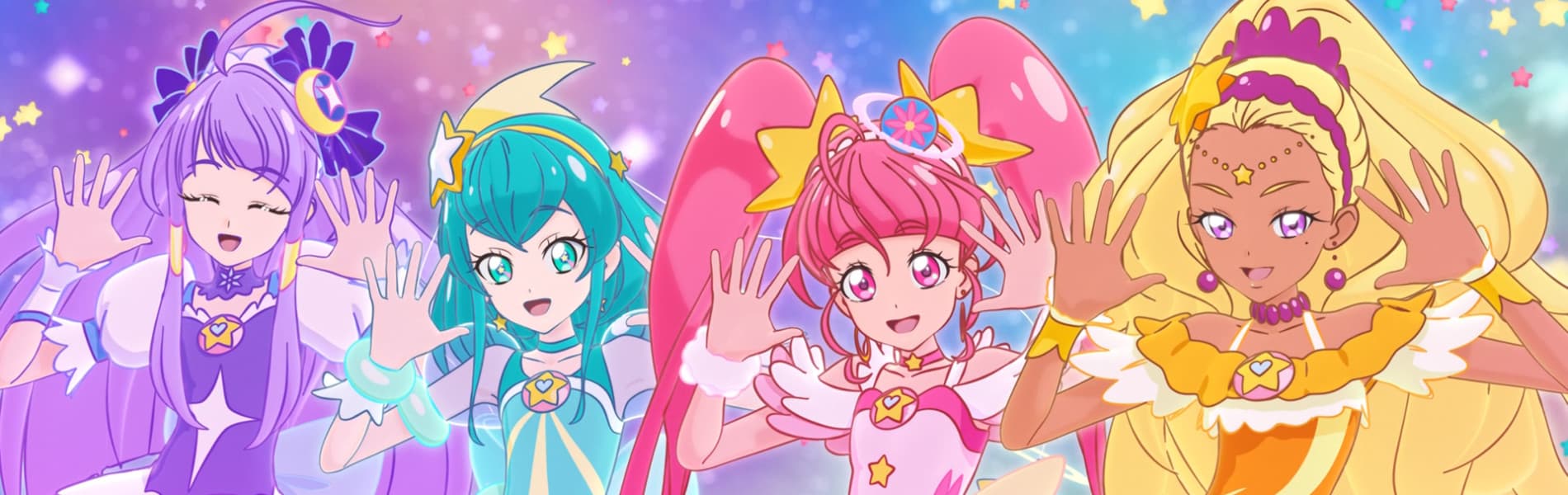

There is a sentiment that the golden days of the mahou shoujo genre are long over. It’s an idea that might even, to some extent, be true. But if it is, there’s one franchise that can be counted on to at the very least go down swinging, and that’s Pretty Cure. Precure in some ways feels like the last of its kind. Even something as great as say Symphogear or Revue Starlight is aimed squarely at adults. As far as shows to feed young imaginations via the example of a good old fashioned team of magical girls, there’s almost no one else holding this lane down anymore.
Star Twinkle Precure is perhaps not the apex of the franchise; it was always going to have big shoes to fill given the runaway acclaim heaped on 2018’s Huggto! Precure. Yet, at the same time, it’s hard not to admire the sheer determination involved simply in hanging on, given the ever-in-flux fortunes of the show’s parent genre. Idol anime aimed at kids have in recent years eaten a good chunk of Precure’s lunch (that’s probably why there’s so much singing in this entry), and through the show’s evident flaws--fluctuating animation quality and no small amount of filler being the main offenders--it’s still really hard to not root for this thing.

That’s admittedly a lot of lofty philosophizing to hang on something as humble as Star Twinkle, so what’s the show itself like? Well, it’s defined by a couple things. Stylistically, it’s humming the same tune--bright colors, limited animation with occasional moments of truly brilliant sakuga, and eye-catching poppy designs--as the rest of the franchise. That aesthetic is combined with a cheerful, sugary science-fantasy look that makes it stand out. Of particular note are its henshin sequences, with Cure Cosmo’s in particular being one of the best the genre’s seen in years.

On the writing side, it has a surprising amount of emotional maturity for something still very much for kids.
To wit; our main cast all struggle with some kind of familial or social problem. Hikaru (Cure Star), our main character, lives with her mother and grandparents. Her mom is a struggling mangaka and her father an often-absent cryptid hunter, and she herself begins to feel stagnant as her friends develop later in the series, having to come to terms with her own self-worth. Lala (Cure Milky) is a literal alien, totally lost in the intricacies of Earth culture, a fact that the series develops into a surprisingly on-point metaphor for almost any kind of marginalized existence at a young age, but most especially for neurodivergent kids. Madoka struggles with the problem of being a “gifted” child; her government-worker father pressuring her into excelling in academia, archery, and a number of other things. Elena helps take care of her large family and has problems being honest with her eternally-busy mother (who is an interpreter) and father (a Mexican immigrant who owns a flower shop, the latter also, notably, makes Elena the first POC Precure).
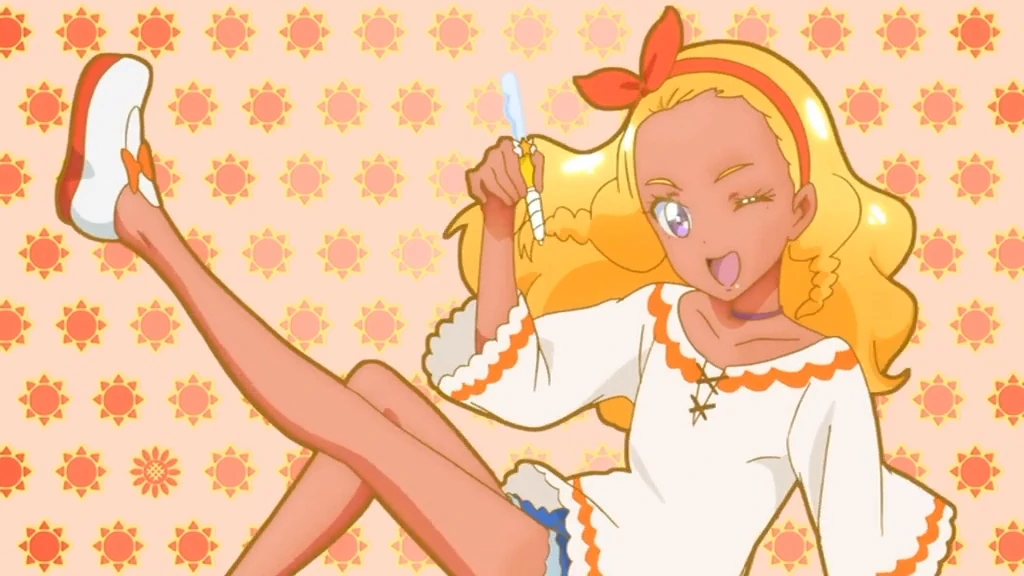
Lastly there’s mid-show addition Yuni, another alien, whose lost homeworld feels like a broad metaphor for any kind of childhood trauma that results in things, people, or places being left behind.
To be clear, all of this is very much still against the backdrop of traditional Precure cheesiness. The villains include a kappa man named Kappard and the mostly-offscreen evil overlord is named Darknest, of all things.
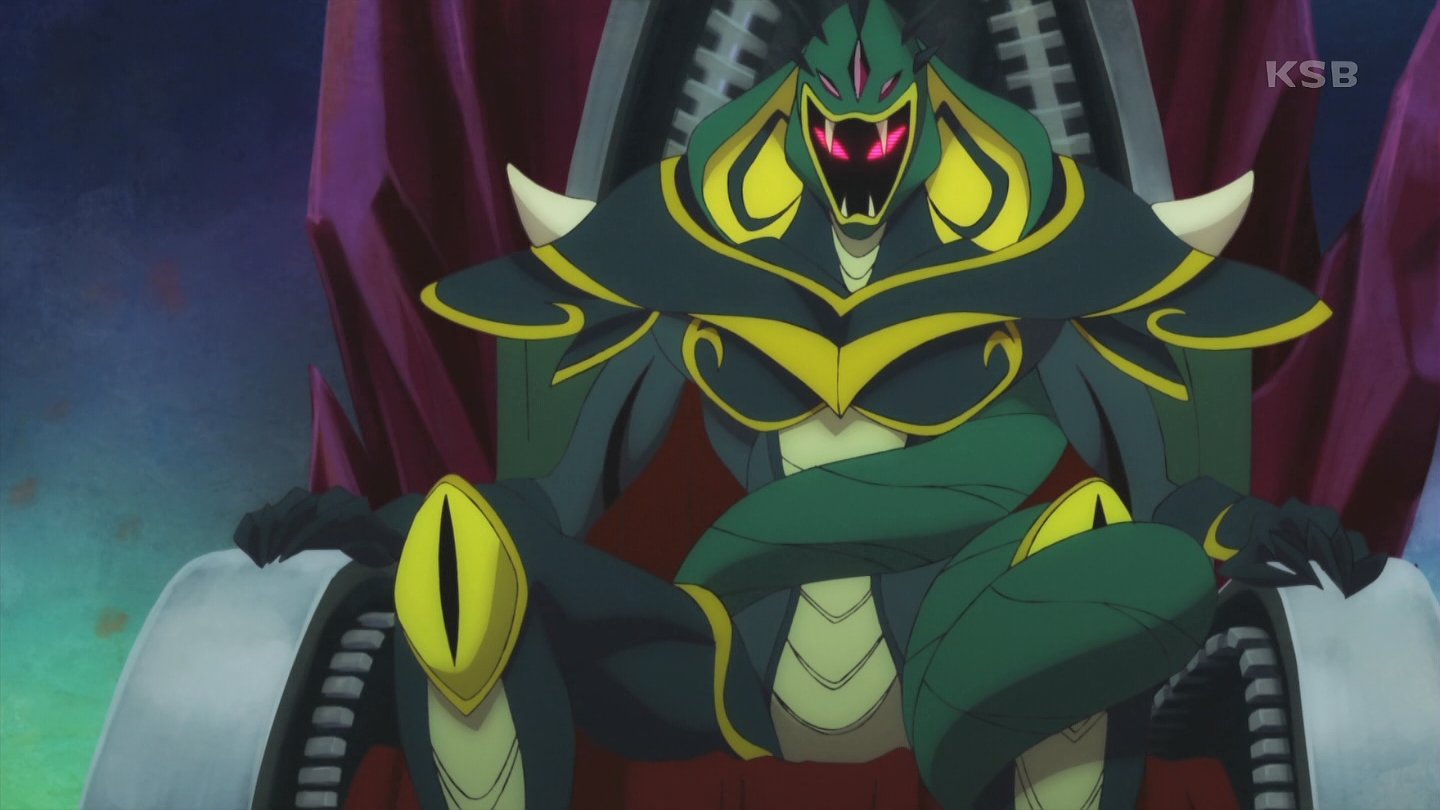 This is what villains should look like, just for the record.
But these are strengths, not weaknesses. The series’ self-assured, secure devotion to its wacky, sugary aesthetic is what makes it scan as a genuine, honest magical girl show, as opposed to something trying too hard to be “cool”. It also means that when it tries to put forward more serious character arcs, they feel sincere, not forced.
An example of the show’s writing having a lot more muscle than one might expect comes near the end of its run. There’s an ongoing arc, lasting several episodes, about the conflict between Elena and Tenjou, a tengu-like alien woman and one Darknest’s minions. Over the course of the arc, which begins with Tenjou infiltrating our heroes’ high school in an attempt to undermine them from within, Elena comes to actually genuinely like and respect Tenjou. The reveal that she’s actually the Precures’ enemy does not, as it might in a lesser series, simply cleanly sever those feelings. Tenjou gets under Elena’s skin, making her aware of her own chief flaws; a tendency to hide her emotions beneath a cheerful mask when it’s convenient, and a difficulty in conveying her real feelings to people.
The arc could end here, but it actually keeps going, reflecting back on Tenjou’s own character and digging more deeply into the roots of Elena’s issues. The writing remains kid-friendly (lots of talk of “smiles”), but something that manages to touch briefly on childhood anxiety, the difficulty of conveying how you feel when you’re young, and even (if only briefly and obliquely) colorism, which can be the root of these kinds of issues, is worth lauding. Listing more examples would get tedious, but suffice it to say that that's not the only one.
The show’s final episode is one of those famously messy several-years-in-the-future Pretty Cure finales, but it’s worth remembering who these shows are made for. Magical girls shine brightest for the young and the young at heart, and Star Twinkle Precure, no matter what flaws it may have, is a star as bright of the rest of them.

And if you liked this review, why not check out some of my others here on Anilist?