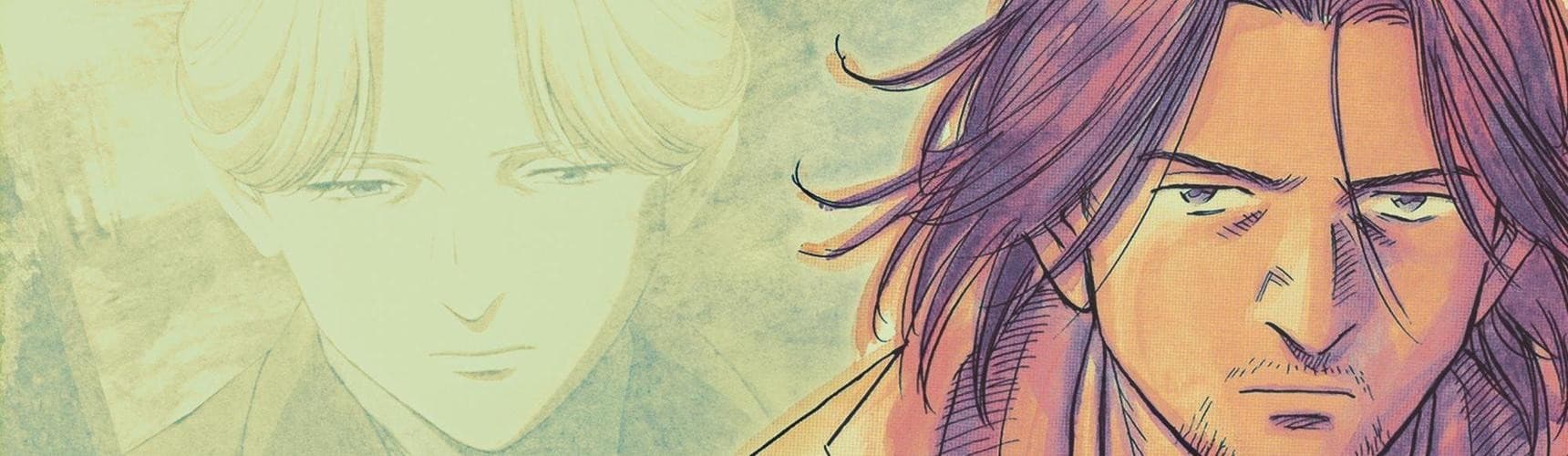
It's easy to neglect what story Monster is truly concerned with telling. At face value, it's the struggle of Tenma to prove his innocence, and yet it's driven home numerous times early on that that isn't Tenma's raison d'etre—so then what's really going on here? It's easy to detach from the central narrative and instead get swept up in its boundlessly deep characterizations. Every single recurrent character has some deeper implications, machinations, and essential strengths and weaknesses to explore, and the narrative seems hellbent on touching on each and every one. However, that still is not the central conceit of this tale; it always was and never ceased to be a story about a Monster. Pretty comical to think of, right? If you're not constantly wondering just what the hell Johan is, are you really even paying attention? Even as the series dangles an explanation, you're meant to meet such an explanation with skepticism, and yet this isn't made clear until the very end when frankly, you're quite tired of being skeptical at all and just want to have your cake and eat it. That there was my fatal falling with this series, and why I'm conflicted in propping it up as a classic as so many others do. On the one hand, I can see now the each and every character was meant to perform a specific function, and yet my cynicism and general expectations of this medium sort of demand such a construct be more easily discernible from the jump; and therein lies what must be ascertained from this musing in general. This series is a mystery. It's meant to be akin to a puzzle being constructed slowly and deliberately for that final, grand payoff at the end; sliding the final piece into place and stepping back to see what was built. Spoilers abound as we move forward.
Thus the second explanation provided for Johan's being was Franz Bonaparta's experiments which similarly sought to dissolve human emotion out of people. While the core blueprint behind 511 Kinderheim, its focus strikes me as being far more precise and targeted specifically at ~~Johan~~ or Nina, as it turns out. Here is where I find my cynicism towards the series starting to bloom proper in that I find it a bit marked by incredulity or incongruence how both experiments coalesced perfectly around Johan both in how each concerned him in particular (with Nina's involvement being the only real caveat aiding this diabolus ex machina's credibility) and in how one seamlessly covers the other. Perhaps that's a fault in my perception of the mystery genre as well, but it does leave a certain unsatisfactory taste nonetheless. Nonetheless, Franz Bonaparta becomes the central fixture of Johan's plotting and insights the burning of the library, a scene whose symbolic power and significance are far more reaching than I'd realized at first confrontation. The library contained the key to Johan's past in Bonaparta's picture books which similarly represent Bonaparta himself; moreover, the library press conference was meant to be part of the Neo-Nazis' plot to install either Johan or Christof into a seat of political power. All of these are things which Johan would wish to destroy given his revelation of his Kinderheim-locked memories, ironically unveiled by the very place he sets ablaze. The act seems to come out of nowhere, and yet in retrospect it's perfectly in line with Johan's character: he obsessively erases any hints of his past so as to preserve his trajectory of life, he wishes to strike down Franz Bonaparta as revenge for his mother's and sister's suffering at his hand, and he no longer has any need to enable the new world order for which the Nazis want to plant him as a puppet figure for. All of this coalesces beautifully as a soft reset for the central conceit of the narrative: no longer is Johan seeking wanton destruction in order to replicate his own existence with no regard for anyone; now it's a targeted mission with a clear objective, albeit this objective is not revealed to us until much later on.
And so the final layer is revealed here marrying these two aspects together, in effect. Johan still wishes to bring about some semblance of an apocalypse, but the central conceit in the end of the show is to prove whether or not he's meant to be alive at all. As we find out, the twins' mother willfully sacrificed one of her children to Bonaparta, and this perceived lack of empathy from her fractured Johan's childlike worldview, which would continue to be pressured and crushed underfoot first by Nina's mistreatment at the hands of Bonaparta imparted onto Johan upon her return, which transformed into his own state of being after 511 Kinderheim wiped away the majority of his memories, which then manifests in his later killing sprees and systematic destruction of any sense of his self. The scene of the massacre of the Red Rose Mansion echoes in both the Kinderheim and Ruhenheim massacres as well. Johan seems to want to perpetuate his suffering and spread it onto others, the ironic twist being that he wants only for people to understand his suffering—to be connected to someone. Moreover, the countless times he faces death and symbolically points to his forehead are times he's playing his rooftop game with life and death; Johan wants to confirm whether he's meant to live or not. The series ends with his confirmation being final as he slips away from his comatose hospital bed into the unknown. Despite only being a single piece of the puzzle, there is so much more to discuss on the topic of Johan that I'll leave for another time. This series certainly is fascinating to ruminate on and I'll simply have to revisit it in some way in the future. It's inevitable. Until then!
37.5 out of 41 users liked this review
