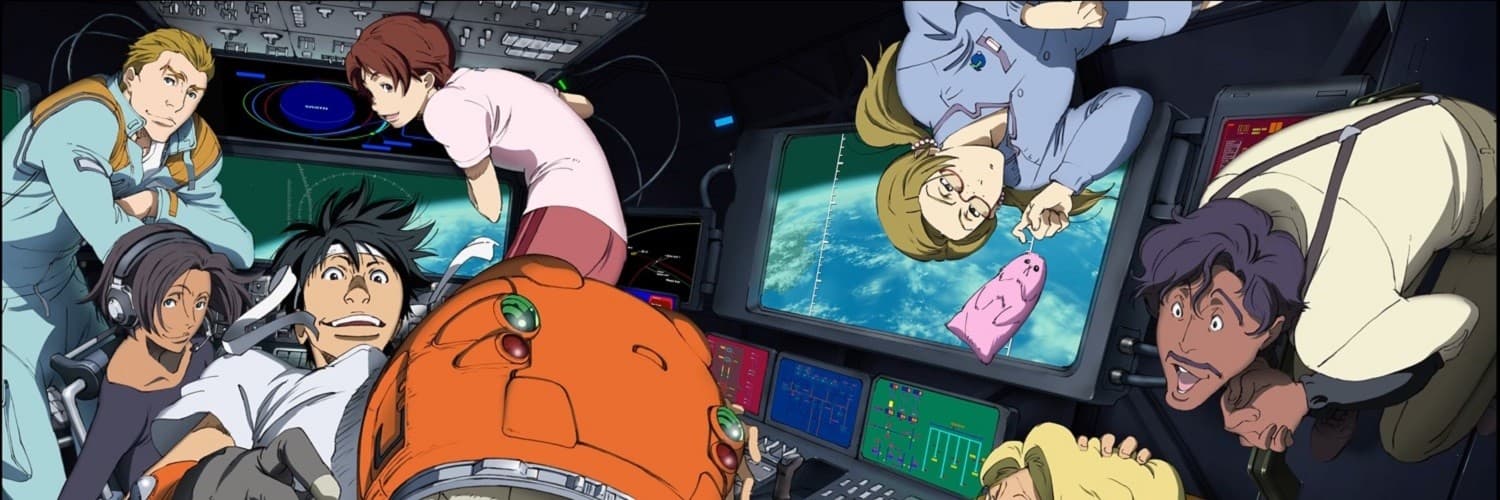
the planetes manga is one of my favorite pieces of media of all time, and i put off watching the anime for years because i was afraid that anything less than perfection would spoil the manga somehow, or at the very least waste my time. i even re-read it for the third time shortly before watching the anime to refresh my memory. so i want to preface this review by saying that i have held this anime to exceptionally high standards because of its source material. this review is, in essence, a comparison of how it measured up. as such, you can expect some significant plot spoilers. i also apologize if it is somewhat disorganized as well, as it was written in a rather stream-of-consciousness fashion.
to begin with, one of the anime’s greatest strengths was one that might be easy to overlook—the relationship between the weight of existential awareness and the fragility of the human psyche. the line between the highly romanticized idea of existential despair and the very real life consequences of the depression and anxiety it begets is so thin as to be non-existent, and acknowledging that is what makes the difference between needless, detached navel-gazing contemplation and storytelling that appeals directly to the human condition. the viewer can empathize deeply with characters’ struggles with these deeply familiar psychological demons, even though they are often triggered by (what are to us mere earth-dwellers) extraordinary circumstances.
another thing the anime nailed was its scientific accuracy. after all, the planetes manga is pretty much universally agreed to be the single most scientifically accurate sci-fi manga ever written, and the anime certainly takes that notoriety in stride. because it takes place only about half a century from now, space exploration is still in its relatively early stages, rooted in technologies recognizable from space travel today. as such, planetes isn’t the kind of story that can ass-pull some random gadget for plot reasons—everything must be rooted in the principles of real engineering and astrophysics. and although there are some things that are somewhat dumbed down from the manga, the anime never strayed toward any fantastical embellishments and stuck to the recognizable science of near-future space travel. the closest it came to anything unbelievable was the anime-only “combat mode” transformation added to some of the ships, but even this was relatively downplayed in that the majority of the conflict was fought via hacking, espionage, or good ol’ fashioned guns and bombs—nothing unbelievably far off from how wars are fought in the modern day.
as far as characterization goes, i think the anime got hachi and yuri down really well, and even expanded on their characters at a few choice opportunities (yuri’s little speech to tanabe about how it feels to lose someone you love was absolutely chilling, and a splendid anime-only addition). they captured hachi’s misanthropic, often depressive nature and the psychological circumstances for his sudden renewal of passion after the first (but not last) time he hits rock bottom midway through the series. they also do well overall with managing the complex dynamic of how this interacts with tanabe’s optimism and hope, as well as her comparative naïveté, and the conflicts and miscommunications that can arise because of their disparate—but ultimately compatible—personalities. the emphasis on how hachi really needs tanabe to balance him out, to keep the world in perspective, is well done.
something of note that might seem small but was a major issue for me was that the took out locksmith’s meeting with the sister of one of the engineer’s killed by the von braun engine explosion. this scene happened near the end of the manga, and it really drove home one of the manga’s most important themes, that no pursuit of scientific advancement, no matter how “great” in magnitude, is truly greater than the value of people’s lives. the idea of what it means to pursue space travel at the expense of one’s own humanity, and the humanity of others, is something the anime does a very good job of exploring in the general sense. but locksmith is an important figure in hachi’s character arc, the symbol of everything he aspires to be in his pursuit of jupiter—yet his purpose in the anime is not fully resolved due to the absence of that pivotal scene. only when locksmith is forced to confront with the true consequences of his actions, in the most literal sense possible, do we fully recognize how unrealistic hachi’s own misguided pursuit of übermensch-esque inhumanity really was. that even the sociopathic genius locksmith could not truly escape the consequences of his connections to other humans is an important point to keep in mind.
i also think it did both tanabe and fee a disservice in general. there is certainly a more misogynistic undercurrent to how tanabe’s story plays out in particular, which couldn’t be further from the original manga. the problem, i think, starts from the very beginning; they introduce her as a hapless OL who’s found herself a job in the space industry practically by chance, with no particular attachment to the field. she’s just a young woman looking for a job somewhere. while i can understand this choice to turn her character into a vessel for the viewer’s introduction to space travel, the “everywoman” if you will, it does a disservice to her character to remove her very particular attachment to space. while it’s worth noting that she does acquire this attachment more as the series progresses, the significance of her identity as an astronaut is never quite as clear-cut as it is in the manga. this becomes most obvious with the anime’s choice to ground tanabe—even temporarily—and relegate her to the role of earthbound homemaker at the series’ end. i understand that given the added plot with her and claire stranded on the moon (a scene which i did absolutely love, by the way—the vast cosmic horror of suffocating to death while stranded in space hit real hard), it makes sense for her to face physical consequences for her brush with death. but to disempower a woman who became such a driving force for this story and limit her role to “the astronaut’s wife” (as implied by her comparison to hachi’s mother) is insulting to her character.
on that note, tanabe’s backstory, as well as fee’s, were totally neglected. tanabe’s backstory in particular gives us some key insights into why she believes in the power of love so damn much, it gives roots to the flowers of her kindness and compassion. i also have a sneaking suspicion that fee in particular was neglected in part because her backstory is steeped explicitly in anti-black racism in the american south and the anime wanted to make her “ambiguously brown” instead. they cut a lot of great fee-centric scenes, actually, which disappointed me a lot because she’s my favorite character and the anime kind of sidelined her and didn’t do justice to her true depth. even the pivotal scene where she destroys that government mine loses a lot of depth because we never see her interactions with her son and how we re-ignites that spark of justice and bravery to rebel inside of her. also the whole thing of fee being literally declared a criminal for her rebellion against the u.s. military and how it relates to her lack of faith in the government’s sense of “justice” due to the racism in her backstory…all of that was just scrapped. which is odd, considering they gave claire a similar sort of character arc when it comes to her disillusionment with the powers that be...yet they robbed fee of that very important aspect of her character.
speaking of claire, they really wasted her potential in a lot of ways—and she was honestly the best anime-only character—by having her punished and spat on by the narrative at the very end in spite of the fact that the entire story leading up to that point had only served to vindicate her in her choices. in general, i can appreciate the character arc of building up a highly intelligent and skilled woman of color who is barred from the success she has earned due to the immense bigotry of those in power, and earnestly depicting her struggle against it. but what ultimately becomes of her, while sympathetic, spoils the great character she could have been and ultimately validates many of the racist stereotypes that the narrative spent so much time condemning previously.
relatedly, i appreciated the expanded commentary on the evils of imperialism and capitalism, which in some ways were actually highlighted even moreso than the original manga by way of greatly expanding the space defense front’s role in the story. however, the fact that they removed all the explicit reference to the u.s. government in particular and made up the exploited countries made it feel a little cowardly to me. furthermore, the consequence of the greater focus on imperialism was that it made crystal clear how the SDF was essentially entirely in the right in their beliefs and their anger, but the narrative ultimately turned them into cliché evil bad guys in the end in a manner that was really incongruous with how everything up until that point had validated their existence. basically, my issue with the handling of the SDF is the same as my issue with the handling of claire’s character, but expanded to a much larger scale.
in general, i was honestly pretty peeved at how they seemed to cut so many great parts of the manga when they had so much room, and instead bloated it with unnecessary comic relief characters, relationship drama, and a list minute action-suspense climax which was so totally incongruous with the kind of tone the manga takes. the expansion of the conflict with the space defense force into an action-packed sci-fi battle in the final few episodes was somewhat tacky and decisively the weakest point in an otherwise mostly strong presentation, even relative to other anime-only material. those final few episodes honestly lowered the score of this anime from what otherwise might have been a 9 or even a 9.5/10.
i’ll note that there were many anime additions i did like, such as the couple on the suicide vacation with their daughter, which fit neatly into the themes at atmosphere set by the source material. i also quite enjoyed the addition of hachimaki’s mentor figure and how their whole relationship played out, and especially how it fleshed out his relationship with hakim. it was a great opportunity to further explore his psychology which the anime took full advantage of. i appreciated the additional focus given to nono as well, partly in conjunction with the focus on hachi’s mentor. these were areas where the anime saw the potential for adding some extra meat to the story which made it richer without detracting from its central themes.
overall, although this review has focused heavily on my criticism of specific plot elements and characterizations, i did enjoy the anime quite a bit overall. i think ultimately most of the weakest points were anime-only plotlines, but when it comes to the source material alone the anime did an excellent job portraying the the themes with deftness and accuracy. it is unfortunate that these anime-only additions somewhat muddled the tidiness of how these themes were meant to explored, but it is also important to note that some of the anime-only content did an excellent job of bolstering and expanding upon those themes.
IN SUMMARY: this anime was well above average but had some major flaws that shine through extra clearly in light of comparison to the source material. if you like the anime, do yourself a favor and read the manga as well.
28.5 out of 32 users liked this review
