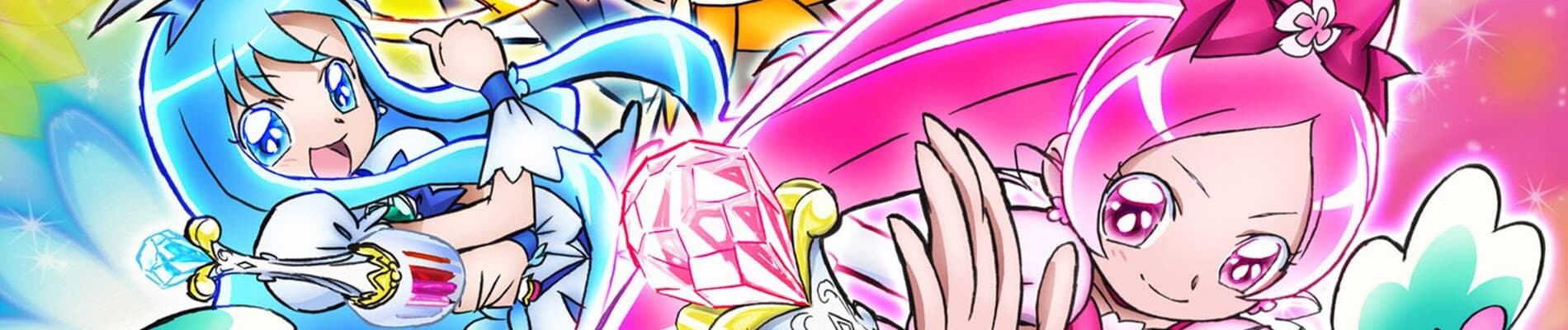


The 2010s were a weird time to be a magical girl. The decade would be marked as one where the genre’s general fortunes took a sharp downturn. Replaced in their home demographic by idol shows aimed at kids and stylistically supplanted by a number of grim-n-gritty “dark” takes on the aesthetic that had little to do with the genre itself. Indeed, HeartCatch Precure was for a few short days a seasonal contemporary of Puella Magi Madoka Magica. It’s tempting to compare and contrast the two--the idealistic children’s show that rang a final bell for the great “straight” mahou shoujo shows versus its immediate successor, the tar-black world story drama helmed by genre outsiders.
However, the truth of the matter is that the simultaneity is mostly a matter of circumstance, as nothing is ever that simple (and this oversimplified narrative would leave out the strong ‘classic’ magical girl shows that have come out since). In fact, very much unlike its era-defining chronological neighbor, HeartCatch, despite factually airing in 2010 and ‘11, often feels unstuck in time, completely agnostic to the decade it helped ring in.
There’s a couple reasons for this. For one thing, there’s the look. Yoshihiko Umakoshi’s character designs have a singular sensibility whose main peers outside of his own other work (most famously on the Doremi franchise, Saint Seya Omega, and Casshern Sins) are older shoujo art, which contributes to this feeling of timelessness.
 It also gives us The Dark Precure, who is just, like, honestly. Look at her. This design is so cool it should be illegal.
Beyond just the visuals though, HeartCatch Precure is a platonic ideal of a magical girl series. Everything generally associated with the “magical warrior” subgenre, it pulls off near-perfectly.
But while HeartCatch is certainly classic in feel, it is by no means rote. While keeping the language of things firmly understandable to its young target audience, HeartCatch often wrestles with some pretty big ideas. It’s telling that even on a cursory surface read, two of the three members of this installment’s villainous trio can be easily taken as manifestations of two of society’s greatest ills from a young, female point of view. Kobraja as the embodiment the pursuit of a cold, heartless “beauty” with no warmth or passion. Kumojacky as the toxic, might-makes-right philosophy given flesh, chasing “strength” as an end unto itself, without greater purpose. That he’s something of a caricature of a shonen protagonist on top of that is a bit telling.

HeartCatch also has a strong core theme of self-acceptance and pursuing forward emotional development, even when it’s hard or scary. Late in the series, when faced with the task of fighting embodiments of the darkness within their hearts, what our girls face is not explicit malice, but the embodiment of lingering doubts and personal flaws. The way they defeat these shades is not to conquer them in combat, but to embrace them.
Moonlight’s sadness, Sunshine’s conflicted identity, Marine’s envy, Blossom’s weakness. Flaws that are accepted, reckoned with, and ultimately embraced as part of the whole self, not cast aside or disregarded as unimportant as they might be in a lesser series. Part of HeartCatch’s core thesis is that it is not merely our best traits or our present selves who make us who we are. It is all of them, and everyone we’ve ever been. Self-acceptance is not something that HeartCatch pays mere lip service to.
The strong theming ties heavily into the character writing, which is uniformly fantastic. Almost every recurring character; from the Cures themselves, to the villains, even some minor backup characters, have strong personalities. Often surprisingly complex ones, too. Even just as far as the four Precures that make up this series’ core team. They’re layered in a way that makes them feel real.
Tsubomi--Cure Blossom--is the simplest. Insecure and cripplingly shy at the start of the series, she blossoms (haha) into a more open person over its runtime as the root causes of her insecurity (a childhood spent with parents who were often away on business, chiefly) are uncovered and addressed. She also goes from being the titled "weakest Precure ever" to one of the strongest and most confident. It's the simplest character arc of the four, but no less a pleasure to watch.

Her compatriot, Erika (Cure Marine), is arrogant and boisterous, but that belies both a genuine love for her friends and family and, on the other side of the coin, envy for people more accomplished than her, such as her older sister Momoka. She’s also surprisingly keen to the way the show works, being to date the only Precure to come up with her Cure name before she was actually chosen to be one.

Itsuki, Cure Sunshine, lives a dual existence as the heir to a dojo in lieu of her sickly brother and with a repressed desire to simply be girly. What might come across as an overdone plot point in other shows is given life here by the serious conflict it causes in her specific situation. When Itsuki actually becomes Cure Sunshine halfway through the series, she doesn’t just add a third member to the team, she’s able to live out her desire to be “cute” and feminine while still defending those she cares for. We do not, HeartCatch again puts forward, have to pick between different parts of our personality.

Lastly, the character of Yuri, the former Cure Moonlight, in particular, is written with such an elemental, bone-deep melancholy that the fact that it’s contained in what is indeed still a kids’ show just feels incredible. Over the series’ runtime, Yuri deals with the bitter sting of loss of her partner fairy and her father--even for this show, pretty heavy subject matter--and has to learn to open her heart again. When, late in the series, she finally returns to active duty as Cure Moonlight, it feels wonderfully well-earned. It helps that Moonlight, with her elegant appearance and edge in combat experience compared to the rest of the team, is one of the coolest Precure ever, no further qualifiers necessary.

These are just the four main characters, but they demonstrate nicely how HeartCatch, in a genre often stereotyped as having simplistic or even nonsensical character writing, lightly plays with expectations and, more importantly, is able to weave characters that ring true to its audience. The strength of the writing inspires empathy, which makes the girls' struggles feel like they matter instead of simply being iterations of genre convention.
In case this sounds dour, it must be noted that there's a fair bit of comedy too. Not all of it lands, but a lot of it does. It doesn't matter how old or young you are, some light slapstick with a heavy dose of funny facial expressions never gets old.


On a more basic craft level, the show looks great too. The unique visual style has already been mentioned, but the animation in HeartCatch never dips below decent and often pulls out at least a few great-looking shots per episode, really ramping up in particular in the show’s final quarter. That, combined with the strong aesthetic, makes for a show that’s a visual treat.
Now, this must be tempered with the obvious--Pretty Cure on the whole is one of the most nakedly merchandise-driven anime ever made, and as a consequence if you can’t put up with outrageously toyetic magic wands, jewelry boxes, and so on, you are going to be a touch frustrated. That, though, is less of a complaint about HeartCatch and more of a complaint about the capitalistic realities of for-profit children’s TV. Something well outside the scope of this review.

 Don't forget to bug your parents for your very own Flower Tact! So you can be just like Cure Blossom!
There’s also quite a lot of stock footage as is standard for the franchise, but it’s woven well into the episodes and allows the non-stock sequences to stand out even more. A fair amount of filler is present too. However, only about 5 or 6 of the show’s 49 episodes feel genuinely inconsequential, a batting average that most single-cour anime would envy.
There are, finally, a few places where its themes falter ever-so-slightly. HeartCatch is sadly a “straight” magical girl show in more ways than one, as Tsubomi has an early crush on Itsuki dashed by the knowledge that she’s a girl. It would’ve been a lot to ask at the turn of the last decade, but at least some token exploration of these feelings persisting would’ve been nice, as a further iteration of the self-acceptance theme. Ultimately though, these are all relatively minor qualms as opposed to major criticisms.
The long and short of it is that if you want a magical girl series of this type, you’d be hard-pressed to find a better one from the New ‘10s than HeartCatch. Ten years on, it remains one of the franchise's most popular seasons. It also hasn’t aged a day since it concluded, and if you’re the sort who finds value in classic Good Vs. Evil narratives, strong, resonant messaging that hits as hard at 33 and 23 as it does at 13, or even just pretty transformation sequences, there’s a lot to love in HeartCatch.


And if you liked this review, why not check out some of my others here on Anilist?