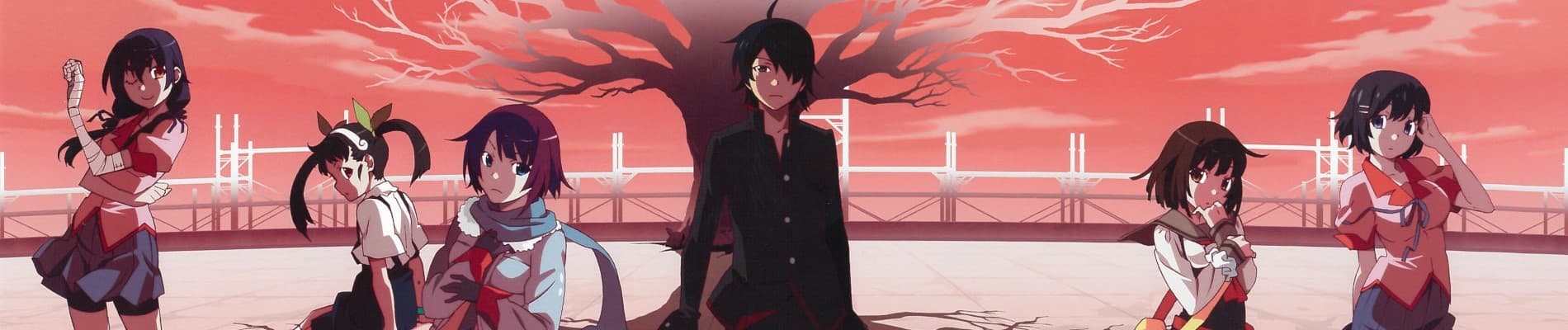
A prime example of how imaginative and unique Nisio can really be with his writing. All the concepts and characters built up within the first season come to a head, each going some different, bizarre direction that the viewer may have never expected. A shift in perspective becomes a common aspect for the rest of the season - Koyomi's viewpoint is only used for two arcs, so he's hardly the focus, yet the effects of this season shape his attitude and personality just as much as everyone else's. The variety of narrators and almost absurd quality of the writing in Second Season is incredible; so much so that each arc within this season really deserves its own review. However, this review intends to keep things brief.
Neko White starts everything off, and, although it re-treads a few things in a shorter manner, it focuses wholly on Tsubasa's perspective and thoughts. Hitagi is great in this arc as well, as the first episode focuses on the two main girls finally breaking the ice between them and befriending one another. Tsubasa’s efforts to reconcile with herself via Black Hanekawa and accept the imperfect, ugly parts of her personality bring a very satisfying, emotional end to one of the best girls in the cast. Kabuki allows more time for Shinobu to interact with Koyomi, strengthening and deepening the strange relationship between the two. The guilt Shinobu expresses for eradicating the world shows just how far she’s come from being an aloof, ancient being who couldn’t bother to learn Koyomi’s name. Not only this, but the alternate Kiss-Shot’s final scene gives us an insight into how early on Shinobu had developed an actual, emotional bond with the protagonist, giving further credence to the fact that what Kiss-Shot truly desired was a genuine human connection with someone after 400 years of isolation and regret. In conclusion, a very solid start to the season, but it suffers from the prior Tsubasa-focused arcs that have already presented us with what was essentially the entirety of Tsubasa’s character, whereas Kabuki expands on Shinobu's character dramatically.
The middle of Second Season spikes dramatically in quality – though that isn’t to say the first two arcs are poorly written. Otori just happens to be one of my favorites. It gives a unique perspective on a character that was previously presented as a simple, cute girl. Conversely, Nadeko turns out to be anything but that, yet she isn’t written in a way that simply stops at subverting that adorable appearance. Instead, she's a girl who's wholly unstable in almost every aspect, hiding and shirking around the reality of who she is to just get by and live "normally" as best she can. The progression and inversion of Nadeko’s inward hatred for her outward self is very interesting to watch. The change from an internal monologue acknowledging her own faults and discontentment to outbursts of raw feelings and emotion towards her teacher and classmates showcases the contrasting sides of Nadeko’s rapidly deteriorating psyche. The final rejection of Koyomi’s pleading almost feels satisfying to watch, considering that, in truth, Nadeko is as much a victim as she is the perpetrator. Her insanity is made even more potent for the viewer when she breaks the fourth wall and offers her fantasized version of the final confrontation in the after-credits scene. Overall, the perspective shift to such a deranged, untrustworthy narrator is a very welcome, very fascinating one, easily cementing Otorimonogatari as one of the best arcs in the entire series.
Moving on to the later arcs: Oni, although a weaker arc in comparison to everything else in SS, is more about building up some aspects of the world and the rules for apparitions and monstrosities for later stories. It falls short due to some lengthy portions of exposition dumping, which, obviously, are never pleasant for any viewer. Even more egregious is the fact that half of the information is prior knowledge. Still, the final episodes that focus more on Mayoi are very heartfelt and touching. Shinobu, although having a more minor role, lets more of her real personality spill out, although it’s nothing as significant as in Kabuki. Ultimately, it really doesn’t hold up to the rest of this season, but its brevity and finale keep it afloat among the other parts.
Finally, Koimonogatari. Like all good sequels, Koi builds off everything set up in Otori. One completes the other, making a single, coherent story about a mentally unstable girl and an underhanded, yet caring, swindler. Kaiki's perspective is the most unique yet, offering insight into the inner workings of what was previously the only antagonist of the series. His methodology, half-truths, lies, excuses, and not-so-shady history with Hitagi are explored in full alongside his efforts to save his "hated rivals" from Nadeko. Kaiki goes from a previously minor, albeit rather foreboding, antagonist in Nise to a rich, fully realized character. Six episodes of characterization and development are enough to propel him to the very top of almost every tier list I have seen, a fact owed entirely to Nisio’s phenomenal writing within this arc. In fact, it’s safe to say every episode in this arc is practically perfect. Hitagi herself has some very genuine moments as she reconciles her past with Kaiki, entrusting everything she holds dear to the man she thought she hated, thus proving her affection and loyalty towards Koyomi. An overall excellent performance from most everyone involved in this portion.
Overall, Second Season reiterates just how skilled Nisio is in writing exciting, intriguing characters and storylines. Bakemonogatari may have been slow for a first viewing, but the payoff in Second Season is so immense that it easily affects one’s opinion of the beginning. There is something within this section of Monogatari for everyone, regardless of whether you’re a fan of Tsubasa, Hitagi, Hachikuji, or otherwise. Characters that hardly seemed important are thrust forwards and given some of the best development seen yet, placing them easily among the likes of Tsubasa or Hitagi. Not only this, but these previously uninteresting individuals carry their respective arcs on their backs with their unique, unreliable take on the world and people around them. It’s safe to say that such a near-perfect season deserves all the acclaim and praise that it receives – and it definitely earns its spot among my favorites.
Of course, the events of Second Season affect more than just those contained within it. Ougi is introduced abruptly and shown to be a very strange, mysterious actor within the story, seeding the minds of viewers with that uncomfortable feeling that something is off about her self-alleged role. Even more worrying, Ougi is revealed as the one who leaked the location of Kuchinawa’s body to Nadeko during Otorimonogatari, muddying her true goal even further and deepening the mystery surrounding her. Izuko is also given more screen time within Oni, showcasing her more serious, admittedly merciless side in her handling of the Mayoi situation. Neko White specifically foreshadows and hints at some particularly exciting situations that are revealed in Kabuki and, later, in
108.5 out of 115 users liked this review