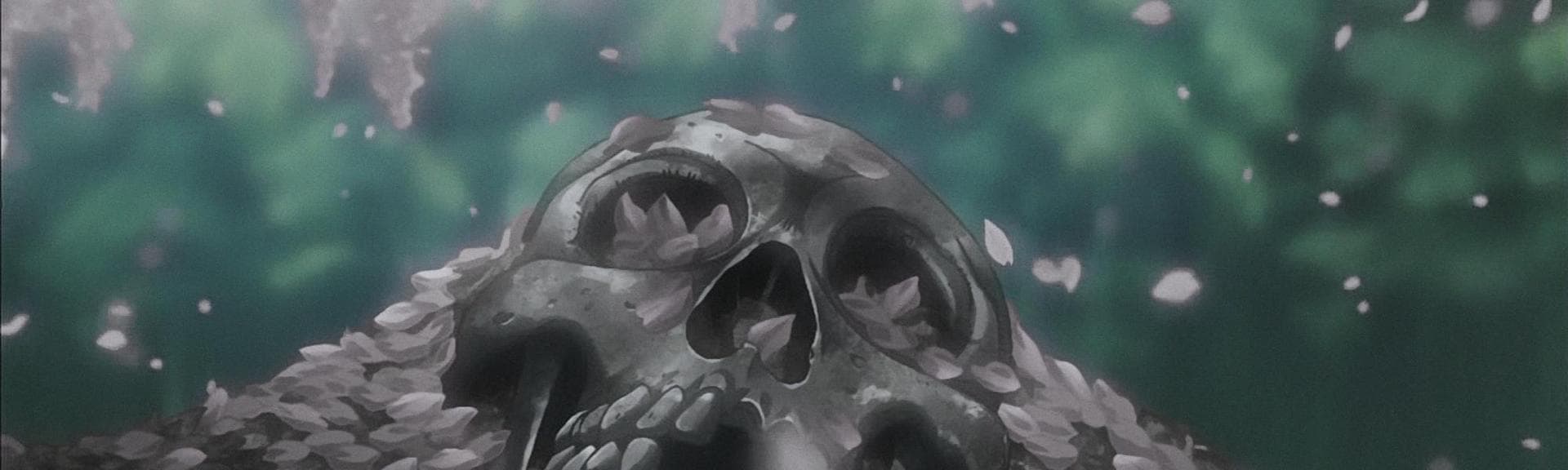

Aoi Bungaku Series is an anthology of six adaptions of classic Japanese literary works that share similarities in their sinister overtones as well as the general era in which the original works were written. The series attempts to convey a stylistic array of provocative commentary on the human condition whilst maintaining a heavy emphasis on pathos, and, to an extent, succeeds. The final result is a mix-mash of both individual stories and overall quality, dark and disturbing, yet definitely not without its flaws.


Given the structure of the series, it's best if I give my individual thoughts for each of the six arcs, as there are major discrepancies in terms of production quality and overall effect.
# No Longer Human - Osamu Dazai
The first and longest of the six arcs, No Longer Human is the flagship story of the series and focuses on the demise of teenager Yozo Oba as he enters a cycle of depression, substance abuse, sex and insanity. The arc excels at establishing a tenuous relationship between the main character and the audience, where his emotions and angst are communicated with disturbing vividness, prompting a sort of apprehensive sympathy. Similarly, it does a brilliant job at presenting the world as an ubiquitously twisted and troubled one, where the general feelings of disgust in our main character are easily understood and to an extent, even justified whilst setting the atmosphere for the rest of the series.
In the Forest, Under Cherries in Full Bloom - Ango Sakaguchi
Probably one of the most perplexing of the stories, this arc focuses on a countryside bandit who falls in love with a city woman he captures and marries. On the visual level, there is an immediate shift from the sombreness of No Longer Human to the bright and vivid style of In the Forest, with even a few quirky jokes here and there. Make no mistake, however, as the sinister and violent undertones are just as prominent here as they are in the first arc. Personally, the juxtaposition between visuals and atmosphere wasn't as much unsettling as it was distracting, but you may think differently.
It was rather interesting to observe the progress of our two main characters, ultimately culminating to a somewhat challenging conclusion that really makes you think about what this arc was trying to communicate. If anything, there is a heavy emphasis on self-awareness and self-understanding, where the consequences of not being able to grasp the truths of one's own character and nor being able to penetrate the outer-fronts of others may be incredibly dire.
Kokoro - Natsume Soseki
One of the more fleshed out stories, this arc follows two friends, a physically imposing monk and a more refined man as they compete for the affections of the same woman. What this really excels in is structure, where two episode are dedicated to the story, one from each man's perspective. As such, an immensely deep insight is gained into the two different characters, where stereotypes collapse and motivations and actions are explained, leading to interesting commentary on the jealousy, prejudice and mutual misunderstanding common to both men. It ultimately is rather tragic, and a sort of poetic beauty is established. This is easily one of the better arcs.
Run, Melos! - Osamu Dazai
My personal favorite of the series, Run, Melos! once again has a unique structural presentation where it follows a playwright writing a version of the classical Greek tragedy "Run, Melos". This leads nicely into a mise-en-abyme scenario, where we have a play within the events that are actually occurring, which is utilized to great effect. Our young playwright struggles, however, as he does not agree with the themes of the play due to a past experience where he was seemingly betrayed by his best friend. The end result in a beautifully orchestrated story which addresses the question 'is it more painful to wait or to keep someone else waiting?' Our characters are incredibly dynamic, as both childhood friends are constantly transitioning between embodying either Melos or Selinuntius respectively, which in turn raises some interesting questions regarding the fickleness of trust and conveys various emotions of guilt and despair. It gets a bit melodramatic at times, although considering its roots as a Greek tragedy, it's forgivable. The production quality was notably of a higher standard, and this arc is easily the most uplifting.
The Spider's Thread and Hell Screen - Ryunosuke Akutagawa
The Spider's Thread follows a violent outlaw and his journey into hell whilst Hell Screen addresses a painter who feels obligated to paint the atrocities of the world around him; both take place in the same setting. An intense and vivid visual style is utilized, which leads to some truly spectacular and confronting scenes. There two arcs are undoubtedly the most simplistic, each only a single episode long- and it shows. The main characters in both stories are horrendously underdeveloped and are molded to fit a single, archetype/caricature in order to convey the principal themes. Speaking of which, the principal themes aren't particular complex either, and the commentary presented is more or less a simple statement of a particular aspect of human nature (with a heavy focus on self-egotism) as opposed to an actual exploration of said aspect. The end result are two stories that, although successful in effectively emphasizing these various aspects of the human condition, (there's some interesting stuff on artistic integrity thrown into the mix as well), are lacking in any real depth of character or analysis.
Whilst the stories of Aoi Bungaku do an excellent job at conveying emotion and atmosphere, some do a far better job than others at presenting genuinely thought-provoking material. This inequality can be attributed to a number of things, whether it be actual construction or how dynamic the characters are. Ultimately, it is this discrepancy in depth that prevents the series from being truly amazing. Horror fans in particular are sure to get a kick out of this.