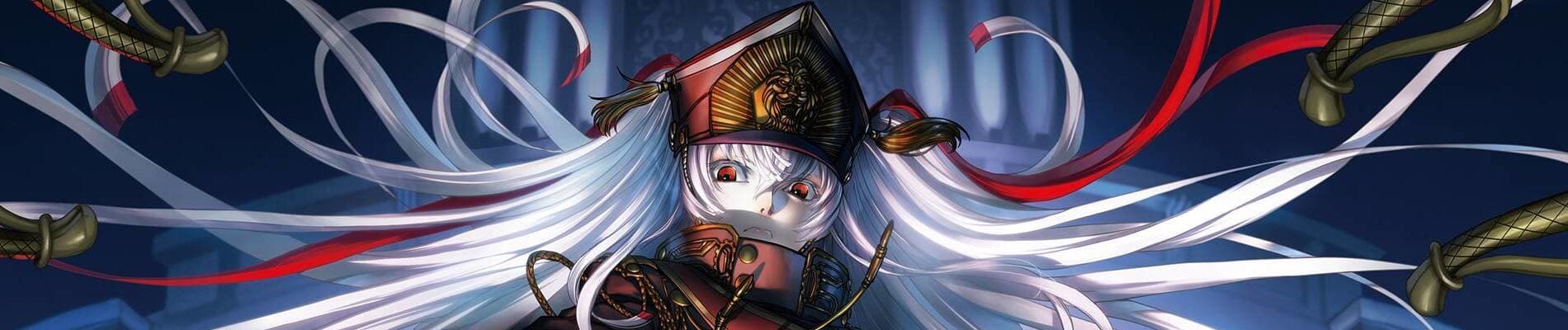
Re:CREATORS
a review by oyakume
a review by oyakume
Re:CREATORS is a strange show. The premise of fictional characters in the real world has been done countless times before, and many times to great effect, but I don’t think any have come close to approaching the subject matter from the same angle as this. I think it’s fair to say there might not even be another show like it anytime soon, if ever. It wears the novelty of having several disparate genres collide and clash almost like a disguise for what is a philosophical character study at its core. I’ve never seen Black Lagoon, but I could tell a lot about creator and producer Rei Hiroe from watching Re:CREATORS. He put a lot of care into making this world seamless in every aspect that mattered, even going as far to create eight fake stories just for the sake of this single-season show with no spinoffs, each of which has enough merit that it could feasibly exist as a story in the real world. The more I came to understand the show, the more I realized Rei Hiroe simply loved telling stories, and with this one, he wanted to demonstrate why we love doing the same.
As a warning, I’ll cover spoilers for major events without explicitly describing them, so proceed with caution.
To call the whole idea of Re:CREATORS ambitious would be an understatement. It’s not necessarily that it had never been done before; several crossovers have been made in movies and TV shows, some even containing their own in-universe fiction, but as far as I know, this is the first time it’s been done to such an extensive degree, with such believable characters and stories behind them and with such a long runtime. Even during the beginning, the characters are never excessively stereotypical and carry their stories and development with them. In that aspect is where I believe one of the show’s biggest strengths lies. As soon as the story begins, they enter a new sort of character arc in which they can no longer just be the characters they always were: they have to become people. This concept is so well-executed that it’s perhaps one of my favorite instances of characterization ever. Though confused at first, the characters eventually learn to open up, socialize, get driving licenses, and by the end, even write stories of their own. That extra little bit of seemingly unnecessary detail grounds the story in such a subtle way that makes you feel more attached to the characters than if they had just been their plain old selves from the beginning. The humanization of the characters extends to their creators, whose interactions with their characters (which I’ll be calling creations from now on for the sake of convenience) highlight the core of what Re:CREATORS is all about: The creators themselves. Souta Mizushino, the protagonist of the story, is a perfect representation of Rei Hiroe's passion for writing stories at a young age, being surrounded by inspiration and having nothing but respect for not only the creators, but the creations. Though outwardly a little quirky, the rest of the creators have their own subtlety, at times having so much experience that they have difficulty explaining why exactly they tell the stories they've been telling for years, but once again rekindling the love for their work when they see what their creations have become and the impact that they've had on everyone. It's almost like a parent-child relationship in that sense. They feel genuinely proud of their creations despite putting them through hell in their own stories, because they know they will ultimately triumph, and seeing those triumphs happen before their eyes is staggeringly beautiful, even to the viewer.
It’s kind of a disservice to call Re:CREATORS an action show, because apart from there not being too many fights, the real battles happen between the creators and their creations, and they’re what drive the narrative at every step of the way. This is one of the very few instances where I really enjoy, and sometimes prefer the moments where characters just sit around and talk, because the content of their dialogue hits pretty deep into the philosophy behind making stories and the people who make them. That’s not to say the action is bad, however. In fact, it’s very meaningful. Every physical encounter between the characters is a violent clash of ideals and morals, and the more you get to know them, the more their previous actions make sense. At first glance, a character like Alicetaria is simply hard-headed to the point of stupidity, always preferring to fight first and never talk things out, but when you take into consideration that she comes from a story of death, torture, and loss, where she has all the power she needs but everything she holds dear is always dangled just out of her reach, it’s difficult to blame her. It's her exchanges with both her creator and Souta that make her realize just how important she is to the readers of her story, and that she doesn't simply suffer for the sake of entertainment. It's this melding together of genres into one whole that shapes the characters into perceiving the world through a different lens than the one they've always had, and that's great.
It was certainly courageous to make eight completely unique characters and stories solely to put them in one show and never again, but it's that level of commitment that really sells the show. There are no stupid low-effort parodies like "Two Piece" or "Dragon Cube X"; there are no cheap memes or references; it's all original and believable. Elemental Symphony of Vogelchevalier; AVALKEN of Reminisce, Alicetaria of the Scarlet, Code: Babylon, Lockdown Ward Underground -dark knight-; Magicalslayer Mamika. Just looking at those titles might make an unassuming passer-by think they're real shows, comics or games that they can experience by themselves. A couple of times while rewatching the show I had to stop and remind myself that they weren't independent stories and I couldn't buy and play a copy of AVALKEN, or watch the latest episode of Vogelchevalier. It might seem strange, but the show has such an effective way of subtly disintegrating the barrier between the fiction made for it and the fiction that exists in the real world that it feels way more personal than it should.
Visually, it's just slightly above average, but audibly, it's excellent. Composer Hiroyuki Sawano never fails to make an amazing soundtrack for anything, and this might be my favorite work of his to date because of just how diverse it is. His sheer skill lets him make an edgy, hardcore theme as well as a cutesy magical girl theme without it feeling out of place. All throughout the soundtrack, there's a tone that's equally somber, yet hopeful, that seems to transcend divinity and touch right into the core of raw emotion. I wouldn't call it a coincidence; the music embodies perfectly the power of stories.
God, I am biased. As a final attempt at a balancing act, here’s some things I don’t like: After the second act low point, things slow down to a crawl. A new character is introduced that brings nothing and only serves as a vain attempt to replace an old one. As the show continues, the mechanics it set up in the beginning become increasingly convoluted and stretch pretty damn thin the boundaries of its own logic just so it can make things work in the end. The protagonist is heavily underused in the final battle, and almost nothing comes from him being directly and personally related to the antagonist, which wasted huge amounts of potential. One character with a giant mecha gets thrown to the wayside in nearly every one of his fights and he rarely gets to use the damn thing. Some loose threads are left unresolved by the end of it, and some arcs don’t have a satisfying ending. You get my point, it’s by no means a perfect show, but y’know? As a writer and creator, myself, the rest of it is so influential that I can’t help but recommend it. Even as just a proof of concept, it’s stunning. Re:CREATORS encapsulates the essence of storytelling in a beautifully crafted package that even three years later its reach never fails to escape me. If there’s one thing I can say now, is that I’m sure there was a miracle, and that there was a story that surpassed all stories.
35.5 out of 42 users liked this review
