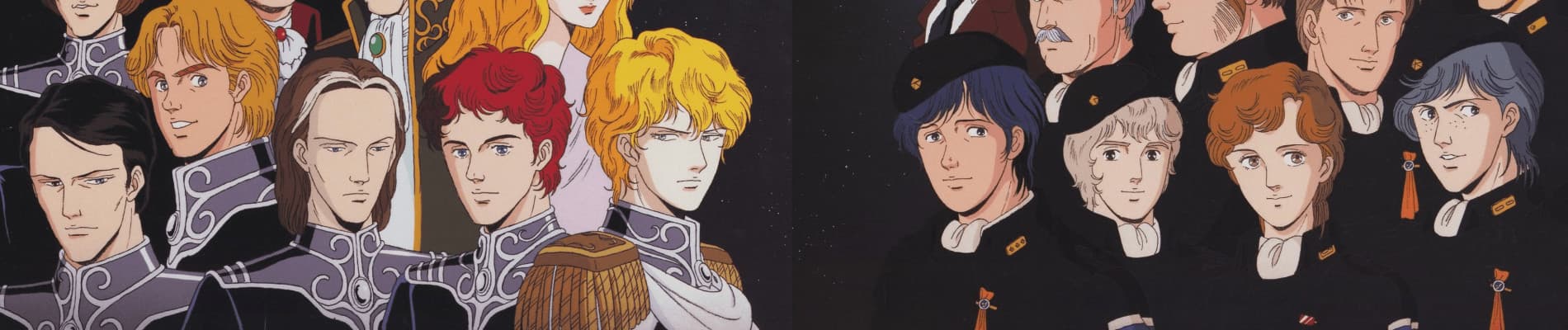
Rewatch. An interesting word. Especially in the event of getting the opportunity to reexperience a work which changed your perception of the medium. A chance to see how it measures up with the passage of time and evolution and development of your own beliefs. A work like that for me was Ginga Eiyuu Densetsu or Legend of the Galactic Heroes (LOGH) in English. My first time watching this masterpiece was between Aug-Oct 2014. What I saw, transformed my perception of anime from something to kill time to a medium which could potentially rival my admiration for novels. LOGH was to serve as a template of not only what an anime could achieve if given the care and attention, but also what I was to expect from my future 10s henceforth. Sounded like a great plan. But people change and what we first considered inviolable might not remain so on a second look. I was however sure that LOGH would still be unchallenged with this passage of time. Heck, Count of Monte Cristo went through the same ordeal, only to emerge unscathed. I was expecting the same from LOGH as well.
But before starting my part reaction and part review, it’s important to give some context as to why I thought of rewatching the show. The strongest reason was my read of the Romance of the Three Kingdoms, written by Luo Guanzhong. The novel is credited to have influenced LOGH. And having read the book, I can attest definitely see the similarities between the two. LOGH definitely has a strong Chinese influence in terms of how both the MCs approach their respective philosophies. The 2nd factor was my personal growth itself. My experiences post my bachelors was some of the best years of my life in terms of personal growth, where I emerged a far more rational individual. Keeping these two in mind, I believe I was justified in giving the show another ride. I restarted my journey in December 2018, finishing it on 23rd March 2019. And boy what a journey it was.
To people not acquainted with the work, LOGH is set somewhere in the 35th century AD, with the galaxy divided between the democratic Free Planets Alliance and the autocratic Galactic Empire. Both the sides have been at war for over 150 years, without any significant change in the status quo. However, both the sides have seen the rise of individuals who will change the face of the galaxy forever through their actions.
“The deeds of men remain the same”, the narrator declares, thus presenting to us the themes of the work from the start. Humans remain the same, no matter the age. The conflict between democracy and autocracy in the series is the latest form of this theme. We admire the resolve of fighters for the respective sides who have their own sense of good and evil and clash against the other side to defend their beliefs. And yet, at the same time, we are exposed to the apathy of the existing powerholders and society in general. It is these people whose ‘deeds’ has led to the current circumstances. Apathy, while a shield from the world, also hinders one’s ability to respond and fight for their ideals, when such a situation arises. This creates conditions for unscrupulous individuals to take over power and subject their fellow human beings to atrocities. This is of interest, given the political climate we find ourselves in today. The anime also provides a platform to discuss various political ideologies and philosophies. It however does this without boring the viewer and not going in depth. This enables the viewer to also think for themselves, making them an active participator in the watch. The battles themselves are inspired from Chinese tactics, in the way they are conceived and executed, again paying homage to ROTK. The melee battles however are absurd, with men going at each other with axes and all that fun medieval stuff, which does make it comical at times, despite not intending to. Another major point of criticism is the portrayal of religion in the series in general. It is unfortunate, given the sheer scope of the work and their overall importance to the plot of the series, that they ended up drawing the short end. Some more background into their motives and ideology would have enabled this area to be truly flawless, at least in my eyes.
Moving on to characters, LOGH has one of the largest cast characters in any story. At the same time, it makes them so real, as if I were watching actual historical series. Most of them are military men. And despite being at war for over 150 years, they are not blinded into hating the other side, but rather give respect where its due. These characters can identify with each other far better than their own political masters. One might argue that the anime promotes militarism through the honourable soldier trope to an unbearable extent. But upon closer study, one can find that these men have their fair share of flaws. It’s just that they do not allow these flaws to hinder them in their aims and dreams. Another aspect which I greatly appreciated was the balanced depiction of characters from both the sides. There is no ultimate good or evil (one could say that the religious group is the big bad). The anime achieves this through allowing us to see the story and characters from multiple perspectives, thus deepening our knowledge and respect of motives of these characters. And though the lack of a villain might make it unconventional to many, it doesn’t take away from the amazing character development and dynamics. In this rewatch especially, I was able to appreciate characters who I ignored or didn’t care about the first time. Individuals like Bucock, Trunhit and Julian were definitely the biggest beneficiaries of this rewatch, with their motives striking the right chords with me. Reinhard and Yang Wenli were a pleasure to watch as always, with their charisma and ideals offering rallying points for their respective groups. Reinhard was and still remains my favourite character in the anime medium, until I find someone else.
The animation, though dated is bearable and only continues to improve as the series progresses. The character designs are great, without looking similar and captures their personalities and expressions with aplomb. The soundtrack is made of Classical Music, boasting names like Mahler, Dvorak, Mozart, Wagner to name a few. A really good way to get started listening to these great composers.
To finish off, the rewatch was definitely worth the time. It was a show meant for me, combining historical, political and philosophical themes harmoniously. And I would highly recommend it to people who are fond of the same genres.
66 out of 70 users liked this review