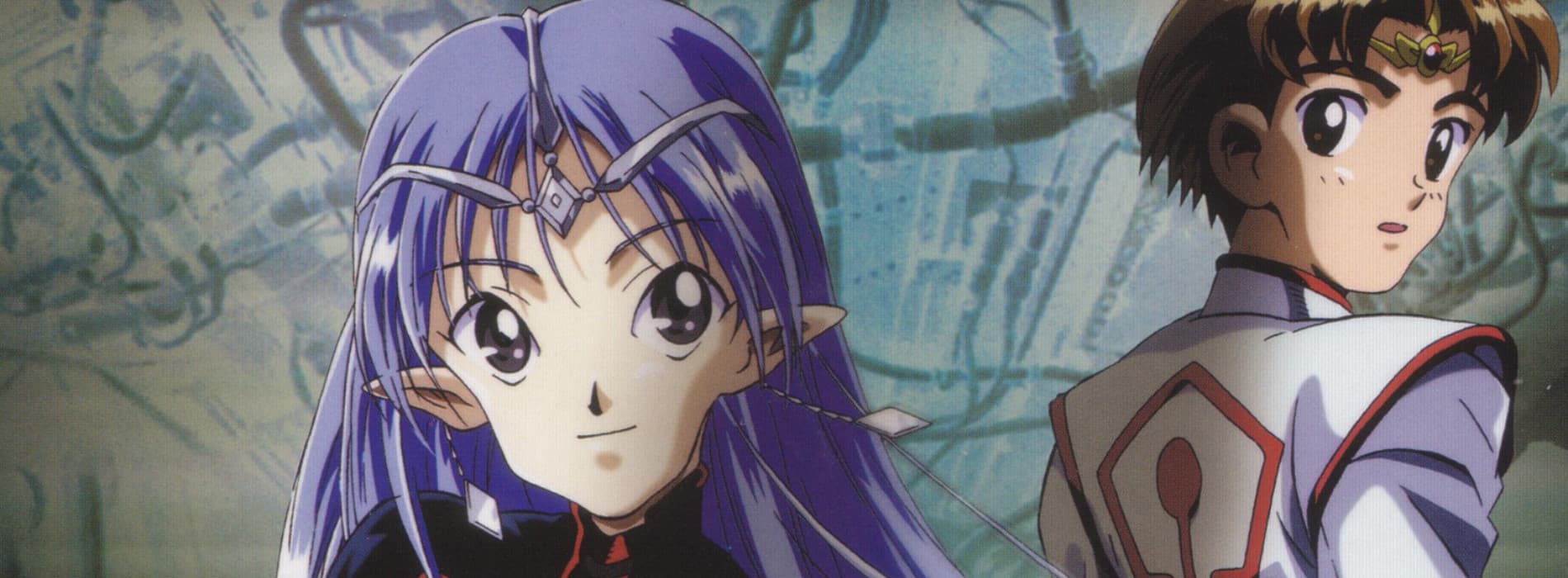
Crest of the Stars (CotS) (and its followup, Banner of the Stars (BotS)) is the series I return to to make myself feel something again at the least once per year. This is an adaptation of sci-fi novels by Hiroyuki Morioka, which I, too, hold very dear to my heart. The books and the series are very similar in many aspects, and actually complement each other very well. there are some things done in the adaptation, that actually surpass the source material, while in some cases the books beat the anime, and this I consider to be extremely rare, as usually the book surpasses its adaptation in every aspect. I will not focus on the books too much, but several differences I will point out.
The story of CotS takes place in a universe of roughly 4000AD. Humanity has spread across the galaxy in chaotic fashion during a heated diaspora age, when Earth got too overpopulated, and humanity developed the tech to safely travel between the stars, and to effectively terraform certain planets.
Early ships used nuclear propulsion to reach interstellar speeds, until later the yuannon particles were discovered, allowing to get some yo sick propulsion with free power supply, dude ... ahem, sorry. Anyway, yuannon propelled ships were travelling faster, further, were bigger and more effective, and thus overshadowed and pushed aside the classic nuke-powered ships.
What humans did not know is that yuannons were a bit more than just particles - they were gates to local hyperspace, that is... planar. Each yuannon is connected to a fixed point in 2d-space, which means that hyperspace and realspace are not connected in any comprehensive way. Two portals - called sords - can be in one system in 3d space, but separated by months of passage in hyperspace, - or can be nearby in 2d space, but lie on two opposite sides of the galaxy in 3d. Add in that passage through the sord is not as simple, too. Hyperspace is literally flat, ergo, 3d object cannot just get in. So, the ships have to hide inside a "space-time bubble", an area of pseudo-3d space, in which the laws of normalspace still work. There are many more rules on which the planar space works, but I've kinda digressed. This stuff is important, though.
So, there is the evil empire of the race called Abh. Brutal conquerors, they attack and enslave every world inhabited by humans they find, and force it upon the unholy rule - or this is what you'd hear as a citizen of four other interstellar states in the galaxy. Abh do indeed conquest all they can, though - in particular, the free worlds, inhabitants of which do not belong to the states with hypercapable ships.
One of the two CotS protagonists, Jinto Linn, lives on one of the worlds like this - Martine, a planet in Hyde system, was discovered and conquested by the Empire roughly 300 years after its colonisation by the "Leif Erikson" yuannon-powered ship. He is the only son of Rock Linn, who happened to be the president of this colony at the time of invasion. Unlike many martinians, president Linn understood quickly that a fleet of a couple of thousands ships orbiting your planet is not something you can beat with six barely working laser turrets, built mostly to prevent asteroids falling down. So, the president makes the decision to not try anything funny, and surrenders the planet, under condition that the ruler of the planet (which, by imperial law, is a feudal nobleman) will be elected from its populace.
Imperial commander, crown prince Dusanyu, who is a troll of galactic proportions, agrees -- and assigns Rock as the new planetary ruler. From president of Hyde system Rock Linn becomes the Count of Hyde, and the planet Martine - now Martinyu - becomes a part of his "own territory". Jinto, who, I remind you, is the protagonist, was 10 at the time, and for his safety he was transmitted to neighbouring Vorash Countdom, where, on the planet Delktau, he finishes his schooling. But to become an actual nobleman with the right of inheritance he has to partake in at least ten years long military service in the Imperial Star Forces, and thus has to enlist into the military academy.
The structure of Star Forces is another very interesting topic, which is connected to the way the race of Abh functions. The Abh are humans, who were genetically engineered to thrive in space. They can withstand low gravity without muscular and skeletal degradation, they can survive extended periods of several-g acceleration without internal organs turning into soup, they are able to calculate complex trajectories intuitively, and they have a special organ, allowing them to visualize space around them, called frosh (though, to use it at full potential they need special devices). All Abh technology is built around these abilities - for example, they control starships by projecting ship sensory data through frosh, making pilots to feel as if they were the ships. Genetic Abh have naturally blue-ish hair as a marker of their heritage, and each genetic Abh of noble rank from baron and up has to genetically modify their children in order to comply with Imperial Genetic Standard, which remains unchanged since the origin of the Empire (I know, I know, too much "genetic"). Without it the Empire would not be able to function for obvious reasons. Abh themselves (as well as Imperial law) consider an Abh anyone who belongs to any kind of Imperial nobility - from a squire, to the Emperor himself (it's relatively easy to become Abh - squirehood is automatically provided to acting officers or medium-level officials). For regular humans in most of the galaxy, though, the Abh usually are considered to be a separate race, or worse, as rebellious subhumans, and this is the root of tension.
Look, I haven't even started discussing the plot. You see how deep this setting goes? This is one of the best parts of CotS - the depth of and integration between the setting and the narrative. The setting dictates how the story will progress, as it should in a good sci-fi.
Now, as a nobleman's son, Jinto has the right to be delivered to the academy via a ship of the Star Forces. He uses this right, and a patrol cruiser "Gosroth", which passes by the system of Vorash during its test run, picks Jinto up on the way to the Imperial Capital of Lakfakalle.
The shuttle dispatched to pick Jinto up is piloted by a cadet - "a trainee pilot" - called Lafiel. She is just a regular blue-haired pointy-eared Abh girl. Jinto, as oblivious as he is, asks her for her name - for which she replies with oddly phrased "You can call me Lafiel!"; Jinto was an outsider, and he did not know that pointy ears are another genetic marker -- of belonging to the Abriel family, i.e., the family of the Emperor, and that this girl is granddaughter of Her Majesty Empress Ramaj, and the daughter to Debeus, King of the Royal House Kryb. Fed up with inability to come closer with someone - anyone - due to her high place in the Imperial social hierarchy, she gets the first true friend in Jinto thanks to his ignorance, and this kickstarts their long friendship.
The two successfully return to "Gosroth" and... The war starts right there, with an invading fleet of Four Nations Alliance moving in to seize control of key worlds in the area. Further development of the plot I'll avoid to spoil - this is totally worth watching. There are no "unnecessary" parts in this narrative. Some reviewers point out that part of the story in the middle (the one involving certain barony) is unnecessary - I disagree. It is very important in order to understand both the characters and the setting. You see, in CotS and its followups, the story is built around the setting, and said barony is the flawed microcosm of said setting. If you understand what and why happened in the barony - you understand the Empire and the Abh as a whole.
This is probably one of the - or the main dish in the platter. The cast is rather wide and varied, and while most characters lack screentime for obvious reasons, even the background roles are rather memorable and well-characterised despite lack of time. Each character has clear motivations, character quirks, and some even get proper character arcs - often absolutely unexpected.
But the main main dish is clearly the protagonist duo. Thanks to them, CotS is often compared to Wold and Spice - not too accurate, but understandable comparison. Relations between Horo and Lawrence are absolutely different than those between Jinto and Lafiel, yet the feeling is similar. The two interact a lot, trying to find common ground with their diametrically different perspectives. Lafiel is literally peak Abh - she comes from the Imperial Family, and these guys do not mess around; they are expected to be, and raised as the best of the best - confident, skilled, smart, proud and often arrogant, Lafiel is the literal powerhouse of the duo. She's the one to kick ass and chew bubblegum here. But she has flaws, many not quite obvious, that could be her downfall (as Jinto has pointed out - "You are like a hardened blade; if one would bend you too hard, you'd break but not give up" (or something like that)) - if not for Jinto, who, too, is far from being a fool or useless. Unlike Lafiel he is neither powerful, not confident. He feels lost and lonely in the "alien" society, and he does not feel whether he deserves the title or can he carry the responsibility associated with it. He needs Lafiel, becuase in the world of Abh he is lost and helpless - but, oddly, Lafiel needs him even more. Their dynamic is written brilliantly, and the way their friendship builds up is shown the way I've never seen done that good neither before, nor since.
There are flaws, though, some - big, some - small. My main, and the largest gripe with this anime is Jinto's seiyuu. Yuka Imai just does not fit the role. Jinto sounds like he's either dying, or ready to wet everything around with tears half the time, and his narrations are pure cringe and hard to listen. I know some people like this approach - I don't. Jinto is not someone to constantly stream his self-pitying. He does pity himself sometimes, but almost never allows others to see it. He builds a sarcastic facade, behind which he hides his fears and insecurities, and even in the most dangerous situations he will mostly stream self-deprecating jokes or #sarcasm at any threat he'd face.
On the technical side - animations sways from AWESOMEGLORIOUS to pure shite depending on scene, time of day and temperature on Martian poles. Characters can go off-model so hard you'd think they're different people. Surprisingly, the most off-modelling one is Lafiel, whose face drawing swings from absolutely hypertrophied chibi-esque weirdness to Evangelion-style. Some scenes show certain QUALITY, which is acceptable for short frames, but the stuff sometimes stays on screen for far too long. At times animation is not present at all - this all is clearly budgetary restraints showing, but the stuff is there. In the ending five minutes of teh last episode the authors even have to use recuts of scenes from before to fill the parts of final dialogue.
Score is very good, but it is often mismatching to the scenes it supports - or going into total mood overkill, when something slightly sad thanks to the music turns into, again, cringe-inducing tearjerking attempt. But when it works - it works.
Finally, the first four episodes of CotS are chronologically jumpy - to the point of becoming complete mess. Story jumps between Jinto's arrival to Delktau space port, annexation of Martine and Jinto's departure from Martine, with added flashbacks about Jinto's life on Delktau. I am usually not against the technique, but in this case, especially in first viewing, it is hard to follow, and does not improve the pace in any real way. Plus it's the most Jinto-narrated part. D'oh.
I'll throw in some minor nitpicks on the series overall, too, for the sake of completeness:
1) In BotS we see female Abh wearing dresses. While I would be the last man to say that I'm not happy to see Lafiel in a cocktail dress - this is a serious mistake: both male and female Abh when wearing civilian clothes in-canon would wear skin-tight garment called sorf and a decorated robe on top of it. In CotS this is pointed out quite well. I understand the desire to show off dem legs - and support it in full - but a nice sorf can help with this task equally well.
2) In the book Lafiel is described as having dark-blue hair and piercing black eyes (or, at least, in a translation I was able to put my hands on - a Russian bootleg one :D). I think this look would actually suit her better. What's funny, in the anime someone mentions that Lafiel has black eyes, while her character design clearly does not.
3) In the book there is a rather large and very important scene of the Imperial Elders Council meeting near the end of the story. It had to be in the anime, as it is extremely important. Not only it is funny as hell, it'd clear up a bunch of misconceptions about the Abh, the Empire and the overall plot.
4) Through almost the whole CotS Jinto is wearing Imperial Star Forces junior officer-administrator's uniform instead of a civilian sorf, while constantly insisting he does not wear a military uniform.
There are a couple of other issues I have - even more nitpicky, and spoilery, so those I'll omit presenting.
It's good. it's very, very good. CotS, both seasons of BotS, and even the BotSIII OVA, which is far too fast-paced and disjointed for its own good, - but it's stripped down to two episodes, what'd ye expect. Of course I understand that many would think it's boring; it's not boring though. It's methodical, accurate, and very respectful to the source material. It is the way it should be. Absolutely recommended to anyone who values fine sci-fi and ready to turn their brain on.
PS Updated the review with certain phrasing fixes, clarifications and typos cleanup.
34 out of 36 users liked this review