
(Note: I tried to keep things spoiler free until the spoiler warning below)
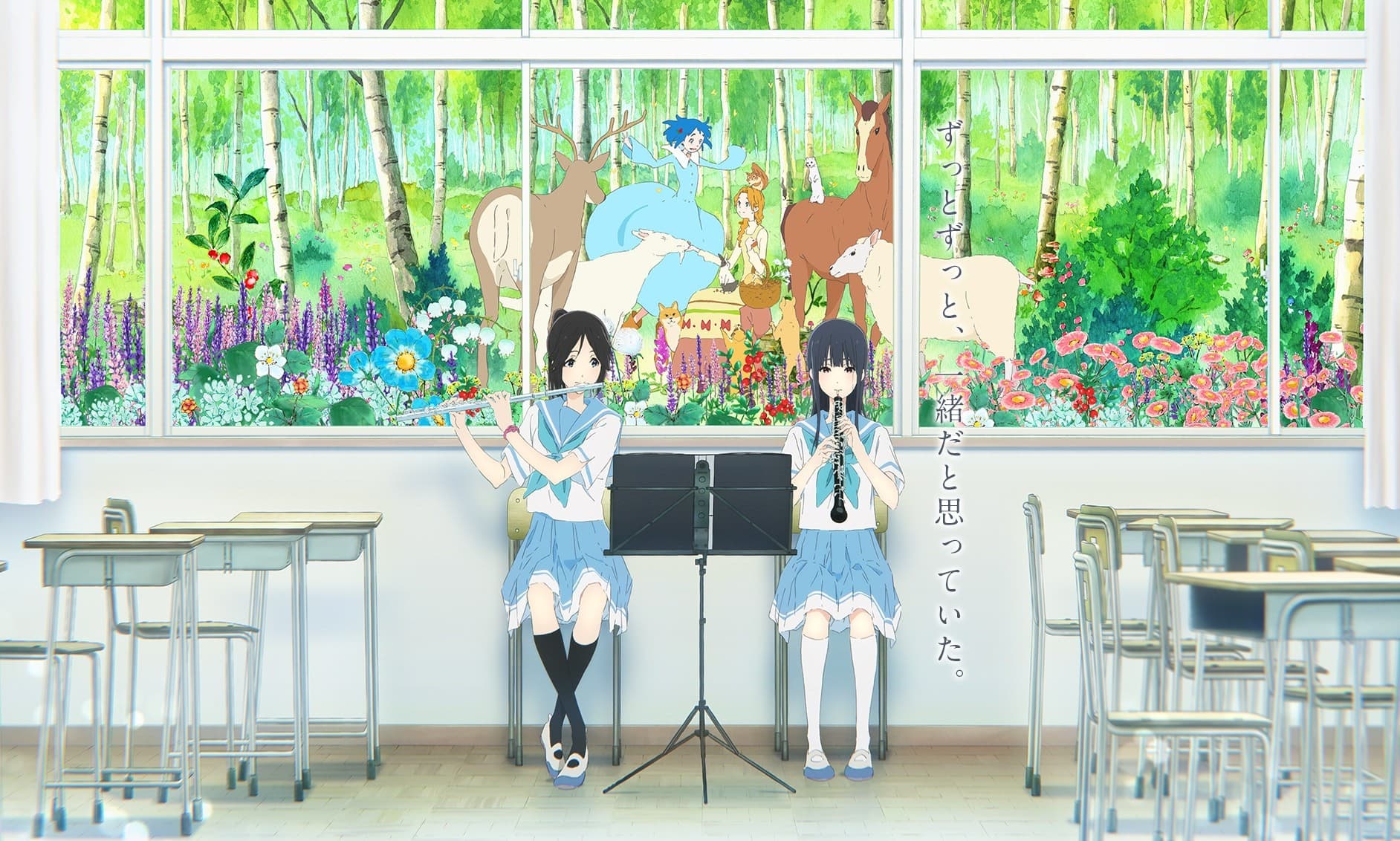
Liz to Aoi Tori (Liz and the Blue Bird) is a movie by Kyoto Animation, part of the Euphonium series. The story centers around Mizore and Nozomi, two best friend and members of the school’s brass band club.

The movie takes place after the events in the second season of Hibike! Euphonium.
Mizore Yoroizuka is a shy, introspective, and extremely talented oboe player, who has in Nozomi her best (if not only) friend.

Nozomi Kasaki on the other hand is an extroverted and easy-going flute player, with lots of friends, the kind who is easily the center of attention and a target of admiration for her juniors and classmates.

The plot itself centers around the fairy tale of Liz and the Blue Bird. The tale is used as a backdrop and framing device for the story of the girls and their friendship, being presented in glimpses as the main story progresses.

# Let’s get the basic stuff out of the way first…
This movie is beautiful. The story alternates between the “real world”, and scenes from the fairy tale story. The fairy tale scenes use pastel tones and a drawing style reminiscent of a children’s book, while normal scenes use Euphonium’s (basically Kyoto’s) signature style. In both styles we have the highest caliber of Kyoto animation excellence.

The story follows a slow and deliberate pace, where each scene is full of meaning and detail. Characters convey their emotions with each movement, expression, gesture. Background, scenes and objects are used to the fullest to enrich the story telling. In many moments, the perfect synchronized background music elevates a scene, being a core part of setting its mood and tone.

Talking about music, the soundtrack is exquisite. Lot of the background music comes from incidental sources, further improving immersion. And then we have the Liz and the Blue Bird theme, which is something of beauty, being prominent in the movie emotional climax.

Character-wise we have a lot of the characters from the main series making a mostly background appearance, as most of the attention is given to the protagonists.

The level of character development is excellent, something already expected of the Euphonium series, as we relate to the characters’ feelings and motivations on a deep personal level. The direction here must be praised as a lot is conveyed from the subtle cues in the animation, backgrounds, and music working in tandem.

…
Be warned, spoilers ahead!
…
# The meaning behind…
Now for the main reason for me to write this review.
Liz and the Blue bird (the movie) is above all a story about love and interdependence. Let me expand and come back to that…
In the fairy tale, Liz befriends a girl that appears collapsed in her yard after one stormy night. The two develop a deep friendship until, after being revealed that the girl is in fact a blue bird, a brokenhearted Liz makes her fly away to her freedom.
The gesture, although painful to both, is a loving one: Liz would not be happy keeping her friend caged, and the bird girl realized that giving away her freedom, even willingly, would only bring pain to Liz who, above all, desires for her friend’s happiness.

The tale is a very close analogy to the relationship between the protagonists. The shy, indecisive, and lonely Mizore can be though as Liz while the extroverted and happy Nozomi as the bird. That analogy is reflected both on their characters traits and their relationship, e.g. Mizore dependence and total devotion to Nozomi, and Nozomi high spirits and confidence.
In a crucial point for the above argument, Mizore decides to attend a music college based solely on Nozomi’s whims of going to said college. Her own desires notwithstanding.

Mizore also has no real friends besides Nozomi. She repeatedly turns away invitations and approaches from her sectional mates, particularly Ririka Kenzaki, acting coldly and keeping distant from anyone else that is not Nozomi.

And this is where things take a turn, because the above-mentioned analogy hides a lot more than what’s on the surface:
The fact is that Nozomi whims of taking a music college were derived entirely from a desire to force herself to the same standing as the much more talented Mizore, an oboe player recognized even by her teachers as having a bright professional future, and also to not be left behind.
Further evidence comes when Ririka slowly chinks away at Mizore armor and the two become closer: Nozomi hints of jealousy and possessiveness flash through the cracks and she starts to lose confidence, eventually going as far as ostracizing Mizore.

In the end, it is Mizore who is the actual “caged bird” and Nozomi the one who does not want to let go. In fact, they both don’t want to let go. It is that realization that allows the duo to come to terms with themselves and move forward at the end of the movie.

But, in contrast to the fairy tale, there was no need for the metaphorical flight of the bird. After coming to terms with their reality, the two girls leave with a stronger bond, and a deeper sense of being. Finding themselves, they come back and vow to each other and to their friendship, while still tracking their own path.

And now I come back to what I said about interdependence and a most important take from the movie:
Being happy with oneself is what allows one to be truly happy with another. In a relationship where there is only dependence, where one side surrenders its freedom and becomes caged, there’s a lot of pain to be had. Independence is a necessary step before becoming interdependent. Interdependence is a decision and it is where a relationship finds its utmost happiness.
As the Liz story tells, sometimes letting go is the only, albeit sad, choice, and part of loving is being able to. But regardless, figuring that out and making that decision for oneself is the true path, as the alternative is a lie.

# Conclusion and parting thoughts
Liz to Aoi Tori is an absolute masterpiece in all aspects: animation, soundtrack, characters, storytelling. It is Kyoto Animation pulling out all the stops to masterfully craft a beautiful, deep, and emotional movie, with lots of important insights.
As a fan of the Euphonium series, this was more of an awesome series that I love deeply and a precious look into two characters that were explored far too briefly in the anime. But even for those who don’t know the main series, this is a beautiful story that can easily stand on its own.