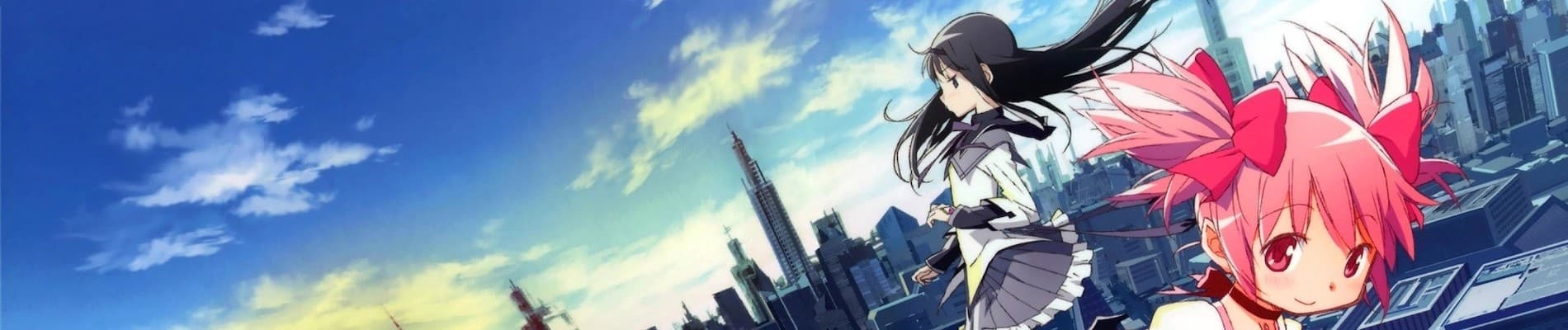


When I was kid, I was really easy to please. When it came to entertainment, all you’d have to do was show me something from a genre I liked and I’d pretty much be guaranteed to like it. Race cars? Hell yeah. Superpowers? You got it. Magical girls? Kill yourself. But here I am, trying to convince you that a magical girl show is one of mankind’s greatest creations. I first watched Madoka Magica in a time where my tastes were still rapidly developing, and despite the high rating and rave reviews, my expectations were set pretty low. Of course after starting it, I was quickly proven…right. It only took me three episodes to tell myself that there was nothing about this that interested me. And so I dropped it. God, if only I could go back in time and punch myself for that. But at least it didn’t last for long. I kept hearing people call the show “a psychological masterpiece” and always saw it at the top of hardcore elitists’ favorites list, so I eventually decided to grit my teeth and give it another go. And while I’m not completely sure what exactly changed this time around, I actually found the same episodes I had disliked just a couple months ago pretty fascinating. I like to think it’s because this time I was actively considering why I hadn’t liked it the first time. I started to think things like “how had I not seen how insane the art here was?”, a sure sign that I had been taking several things that I really did value for granted. Fast forward almost two years later after finishing the show, and I’ve now found countless aspects throughout that I practically worship, ranging from broad universal ideas to the tiniest hidden details. So without further ado, here’s a few of those aspects that I was able to put into words.
STORY - 9.8/10

How does the universe work? What makes us human? Can we be happy by simply fulfilling our desires? Are our desires even what we think they are? Gen Urobuchi has built up quite the reputation for crafting complex and captivating stories, and despite being a magical girl show, Madoka Magica is no exception. In his usual pattern of writing, the Urobutcher thoroughly explores the difference between logic and human emotion to shed light into how the world really works. He does this through war in Fate/Zero, through society in Psycho-Pass, and with Madoka, he does this through the entire universe itself. Questions about the fundamental aspects of reality and how it affects us are analyzed in depth, making this Urobuchi’s most existential and thought provoking work I’ve seen to date. And given the guy’s prowess as a writer, that’s basically saying it’s one of the most thought provoking works I’ve ever come across. The show’s world building and magic system are built completely around these themes, with well-defined rules and few to no plot holes despite dealing with complex supernatural elements. Another aspect worth noting is the sheer density of storytelling in the show. Every single moment in its entire 12 episode runtime has its purpose, whether it’s directly advancing the plot, humanizing the characters, exploring its world and ideas, or often all of the above at the same time. One criticism I’d make is that the first few episodes may seem quite slow on the first watch, but on a rewatch you’d find them packed with some of the most brilliant foreshadowing in the medium for all of the story’s crazy shocks and surprises that come later. All of these tightly packed elements build towards a surreal, beautiful ending that effortlessly ties up all of its ideas while leaving room for its insane sequel movie.
CHARACTERS - 9.4/10

While I’d say its characters are the show’s “weakest” aspect, this is not at all a show with weak aspects. As expected from its short runtime, almost all of the focus is placed on the five main girls and their adorable little pet, Kyubey. Oh, and a villain who I won’t name. In fact, for the sake of being spoiler-free I won’t name anyone while describing them. If you’ve seen the show you should be able to fill in the blanks. And if you haven’t, you now know exactly what you’re gonna do after reading this. Of the five girls, two in particular really stand out as stellar characters: ____ and . Both have several layers to their personalities, and their growth throughout the show is fascinating to watch unfold. While not quite as complex, is also very multifaceted and human as a result of her dark past. As for , she is quite a bit simpler since her character is largely used as a symbol, but she portrays that symbol very effectively. is admittedly a step down from the others, but she still deconstructs what it really means to be a role model quite well. And of course, how could I forget _, that adorable little rascal. On the other hand, the main villain, ____, is an incredible foil to the main cast, representing the ultimate incarnation of logic. As a result, this villain’s actions are supported by some of the most justifiable motives I’ve ever seen, to the point where the show starts to question why the villain is the antagonist, what his antagonism shows about humanity, and why we were even made to want to antagonize him in the first place. Lastly for characters are the many witches presented in the show. While their characters are not explicitly told to us, hints of personality are shown through some crazy visual storytelling, which leads me to what I most admire about the entire show: the art.
ART - 9.9/10


They say a picture is worth a thousand words. I say it’s worth infinite. Even a simple picture of…say, a cotton ball with a mustache, could probably be talked about and dissected for somewhere around a thousand words before forming some sort of meaning that makes sense, and even then all those words wouldn’t do the picture justice. So imagine just how many words it would take to come even close to interpreting a witch labyrinth in this show, with its hundreds of different seemingly nonsensical animations and images all swirling around in a sea of chaos. If such words even exist, they’d have to capture how these chaotic masses of abstraction can radiate such nightmarish feelings of awe, terror, depression, and insanity. The attention to detail is just unreal, with every movement timed precisely and every single image conveying some symbolic meaning that altogether creates a seemingly living, breathing environment that morphs into representations of certain characters’ deepest feelings. I’m talking the type of stuff that’ll make your English teacher pass out. Hell, the art directors even made an entire unique alphabet to hide several hidden messages, literary references, and poems within each labyrinth. To decode these, you have to first match each letter with up to three different symbols per letter depending on the situation, and then translate it from German to an actual readable language (sorry Germans). If that isn’t attention to detail, god knows what is. Studio Shaft may be famous for their abstract visual style, filled with vibrant colors, symbolism, and overabundant head tilts. But what they’ve done here with these witch labyrinths might as well be on another dimension from anything I’ve ever seen before, including the rest of their work.
Even outside the witch labyrinths the art is incredible. Gorgeous futuristic cityscapes are depicted throughout, which look crisp and clean in a stark contrast to the chaos of the labyrinths. The extreme minimalism often gives off an empty, desolate vibe, almost as if it’s putting up a facade for something deeper within, like a person hiding their emotions behind an expressionless mask. Sunsets are especially beautiful, and wash the entire city in a fiery orange glow. The character designs themselves are pretty unique and cutesy. I didn’t really like them at first, but they warmed up to me over the course of the show and now I find them quite adorable. And like everything else in this show, their clothes, accessories, and mannerisms all carry plenty of symbolic meaning.
SOUND - 9.6/10

We all know soundtracks can convey a really wide range of feelings. They can warm your heart, inspire hope, drain away all your happiness till you’re left soulless and crying yourself to sleep…oh wait, I don’t need a soundtrack to do that. But anyways, where Madoka’s music excels the most is in creating those cold chills that make your arm hairs erect; a feeling you might get from watching something like the apocalypse unfold. The greatest example of this is Magia, which also doubles as the ED for most of the episodes in addition to being used as a normal track, and my goosebumps get goosebumps from those heavy electric guitar strokes and ghostly vocals whenever it plays. There are also tracks that are amazing at conveying bittersweetness, like Decretum and Sis Puella Magica, by combining somber violin strokes with delicate chimes that pluck at the heartstrings. No matter what kind of tone the show is trying to convey, there’s always a track that fits and amplifies it naturally. Something that makes this soundtrack stand out in particular is the way it’s able to convey meaning, and I’m not talking about through just lyrics. For almost every major character in the show, there’s a theme for them that captures their personalities and development through tone, progression, and even chord structure in Homura’s case.
Apart from the main soundtrack, there are some super trippy sound effects to accompany those trippy visuals. I don’t even know how to describe them, but that should be proof enough of how trippy they are. The OP is sweet enough, with heartwarming melodies, visuals, and lyrics that are thematically relevant, but I don’t think it’s one of the greatest OPs ever or anything. The main ED though, which I talked about before, is by far the best I’ve ever heard. And voice acting is on point throughout the entire show, particularly at its emotional highs when those words feel like they pierce right through you.
OVERALL ENJOYMENT - 9.8/10

I could spend all day talking about the unreal emotions this anime has made me feel. I could talk about how it made me tear up 3 times within the span of two minutes just from awe. Or how it made me go numb from pure shock on a rewatch when I knew exactly what was going to happen. But I think the best way to convey how I truly feel about this series lies in a question I find myself thinking on a daily basis:
How is it even possible for something so brilliant to exist?
Yeah I bet that caught your attention, skimmers. Of course, this isn’t something I immediately thought while watching the first few episodes. It wasn’t even really something I thought after finishing the series, despite loving the hell out of it at that point. It was only after at least a year of thinking, reading, and rewatching in hopes of truly getting a detailed understanding of it where I started to see just how insane of a creation Madoka Magica really is. Not only does it master all the individual aspects above, it seamlessly blends their boundaries so that all these aspects are constantly working together throughout the show. The story isn’t just enhanced by the visuals and music, a large part of it is told by them. The characters don’t just exist for plot convenience or to look cool, they all represent key ideas that drive the story’s themes. And every single thing you see, hear, or taste in the show, whether it’s an entire witch labyrinth, a weird camera angle, a conversation about how girls can’t love girls, or even just an overabundance of windows in a school building, all of it builds toward a massive overarching message about existence itself that can be applied to every single aspect of our reality. I know that sounds like an exaggeration, but that really is what I’ve come to believe after all the time I’ve spent digging into it. And all the enjoyment I got from doing so made all that effort so much more than worth it.
I like to think of a piece of media as a cake. At least right now for the sake of this review I do. In Madoka Magica’s case, it would be a cake with simple frosting covering countless different layers that all contribute to the flavor. For each extra layer you eat per bite, the bite tastes exponentially better since each layer helps complement and balance the others out. I often see people on the internet or in real life say they thought Madoka Magica was “pretty good” or just “decent” without being able to come up with a single justifiable reason for thinking that way. Of course, there’s nothing wrong with having a different opinion. But to them I ask, if you can’t justify your opinion on something, are you sure you aren’t just eating the frosting by itself, just like I did both literally and metaphorically as a kid? And if that’s the case, what’s stopping you from digging deeper into that cake if you know it’ll taste better that way?
Stories are powerful things. For every person in the world, there’s at least one story out there that can significantly change them for the better. After all, stories are able to convey ideas by showing them to us, which can be infinitely more powerful than simple words of advice. Unfortunately, over the years, people seem to have become less and less willing to acknowledge this power, sometimes even going as far as ridiculing the possibility of a mature adult having their worldview changed by a movie, TV show, or god forbid, one of those Japanese cartoons. I’d bet a good chunk of people have already consumed a story that could’ve changed them, but weren’t willing to look deep enough to view it as something far more than just a way to pass the time. It all starts with simple ideas or expressions that resonate. After that comes finding out why these ideas resonate, and seeing how they can make you a happier person. With Madoka Magica, its ideas were enough for me to devote a deep and personal interest towards, and before I knew it they had become influences on my life that even today affect the way I imagine things, the way I cope with despair, and the way I see myself in relation to the vast unknown. And Madoka Magica is the type of story that’ll have me exploring these ideas for the rest of my life.