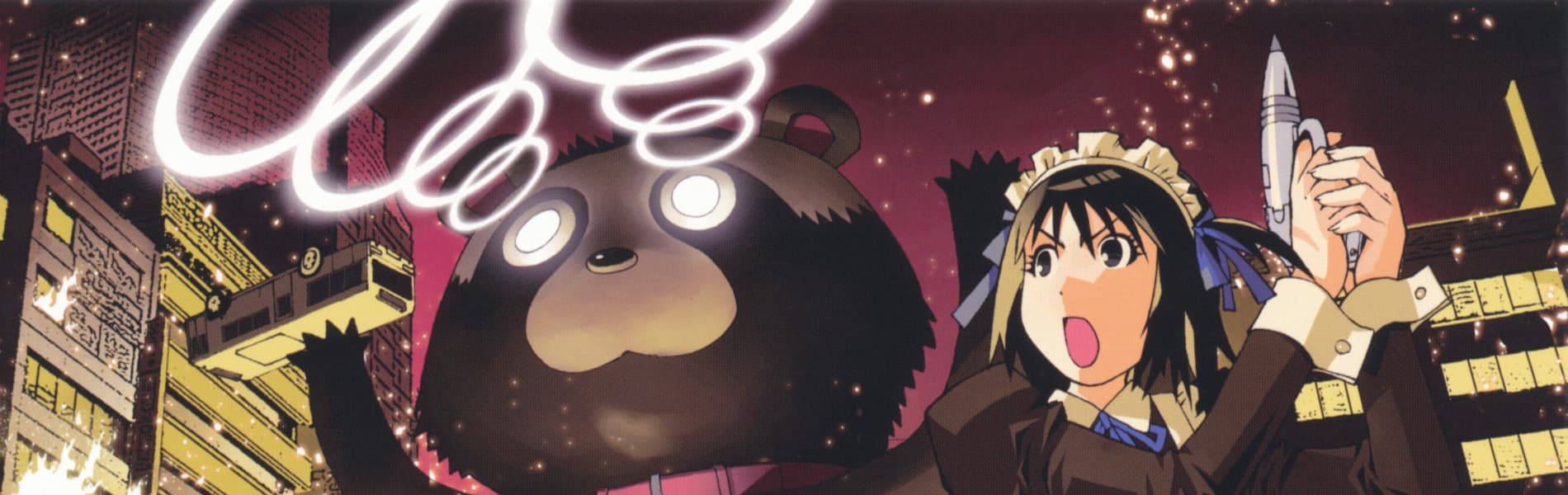

If SHAFT are a weird studio who, consequently, make shows that are a bit hard to review, and comedy, by its very nature, is hard to review, And Yet The Town Moves may set some kind of land-speed record as far as TV anime that seem purpose-built to throw a monkey wrench into critical analysis. There's just not much that's like And Yet The Town Moves. Yet, here we are. Series Director Akiyuki Shinbo has a reputation as the man who made SHAFT what it is. We can sit here and ping-pong back and forth all day about whether or not that’s true, but what is inarguable is that he’s a very idiosyncratic director. One with a style you can spot a mile away, yes, but the clockwork that makes that style tick is a bit hard to lay out in plain English (or, one imagines, plain Japanese).

The simplest way to put it in this specific case is that And Yet The Town Moves, which sits closer to the more obscure end of Shinbo’s mainstream works, is a school life comedy that’s constructed like Bakemonogatari. This ignores several obvious wrinkles (point the first: it takes place at a school only about half the time) and makes some admittedly over-simple comparisons (point the second: Bakemonogatari is Like That because Shinbo directed it, not the other way around), but it’s the simplest way to get your head around the series. Not to imply that Town is particularly complicated--not many anime that take place in a maid cafe` are.
In truth, Town’s core source of humor is first and foremost its characters, chiefly its protagonist, the dolty Hotori, a high schooler with a whiny voice and a love of detective novels, and her friends. The direction uses visual cues like extreme closeups, pointedly-deployed and well-done character animation, meaningful match cuts, and oddball asides to sell her antics, and those of the rest of the cast. The point of those antics, in turn, is to highlight the absurdity of the mundane (and sometimes its surprising beauty as well). One episode sees Hotori’s math teacher driven to the brink of madness by her sheer lack of affinity for the subject. Another sees her younger brother subjected to the confusing and arbitrary rules of dating in middle school. Others see Town temporarily transform into a sports shonen or condense an entire school festival arc into 12 minutes. The directorial approach threads the needle here, lending a delightful air of zany loopiness to what are, when you strip all this away, fairly simple stories.
Sometimes, the show dares to get a bit more ambitious, and it’s here that Town really shines. Episode 7 is a great example for our purposes. It features not one but two classic staples of the “mundane made fantastic” ethos. The first half of the episode revolves around Hotori and Sanada (a boy who has a crush on her) nodding off on the bus on the way to school and ending up in a far-afield town.

The second half sees Hotori take her younger brother out on his first-ever late night stroll. In both cases, these simple, fairly grounded changes of scenery shift the entire mood of the show. The former is played as a fantastic, romantic adventure. The latter conjures an aura of dusky, wide-eyed wonder. Both, and really, many of the show’s best segments, have a real sense of liminality to them. Yet at no point does Town sacrifice its sense of humor. The jokes remain on-point throughout, and the main focus.


These are Town’s strengths in miniature. From the simple; the absurd and the sublime. Either by turns or at once.
Occasionally, it flips this formula on its head. Milking this absurdity not from the mundane, but from the genuinely paranormal. For another example, the “rainbow snacks” subplot in episode 9, one of the few to barely feature Hotori at all, is one of these. In it, pawn shop proprietress Shizuka gets her hands on a baked treat from her grandfather, who in turn got it from a man wandering the streets of Tokyo. She becomes obsessed with finding more, only to find that the mysterious ‘Mori Confectionary’ listed on the back of the package doesn’t seem to exist. A half episode of dead ends, clues that lead nowhere, and some of the show’s best visuals follow.


The answer? The man wandering Tokyo and giving them out was a time traveler. In a similar vein to Ground Control To Psychoelectric Girl (another Shinbo-directed series, coincidentally enough), the series has just enough of actual "weird stuff" crackling underneath its surface to add the slightest edge of intrigue to things, even as its focus largely remains on comedy. As the series winds down, the final few episodes unscrew the cap completely, decoupling Town’s world from our own and diving into full lighthearted urban fantasy and sometimes delving into more serious territory. Not many anime of this sort ever make that kind of jump, and it’s fascinating to see here. This is to say nothing of its absolutely breathtaking finale, which I cannot in good conscience let myself spoil. It’d be criminal.
If there’s anything Town “lacks”, it’s perhaps the truly thunderous insanity of something like Nichijou! or the (also Shinbo-directed!) PaniPoni Dash!, but these things are relative, and Town’s marginally more “subdued” (frankly the word feels a little inappropriate here) comedy is just as worthwhile as that of those anime. For all of its silliness, Town is a surprisingly sincere show. There is probably no critical cliche older than “you’ll laugh, you’ll cry”, but, as it just so happens, And Yet The Town Move is good enough to warrant unearthing old cliches. Ultimately, and perhaps surprisingly, this is a series that reminds us, as we live our lives, the world spins beneath our feet. We can try and stay in place all we like. The town still turns.