There are few things quite like Baccano. Or rather, Baccano is like many things combined together in a ridiculous gory romp.
Baccano is perhaps best described as Highlander meets The Godfather plus a battle royal on a train as directed by Quentin Tarantino. The basic plot is such: there is a newspaper in New York compiling the events surrounding a group of immortals. After a brief meta discussion on stories and protagonists, the show simultaneously launches into three separate but connected stories in 1930, 1931, and 1932, starting near the end of each of the stories and then jumping around between them until the end.
The 1930 story deals with Szilard Quates and his Old Men Club recreating the elixir of immortality, and said elixir consequently accidentally falling into the hands of seemingly every mafia member in New York. The 1931 story covers the debacle on the transcontinental express, the Flying Pussyfoot (go ahead, get your jokes out of the way), in which a cult, a mafia family, a gang of bootleggers, and a mysterious being known only as the Rail Tracer all collide on the same train. Also, there are immortals in the mix. The 1932 story follows Eve Genoard as she searches for her missing brother Dallas. This is generally considered the least interesting of the three stories, though admittedly the other two set the bar pretty high.
Baccano's non-linear storytelling is a bit hard to wrap your mind around at first. Keeping track of three separate storylines, especially when those stories themselves are told in nonlinear fashion, is slightly taxing, and a rewatch almost becomes necessary if you want to understand everything that's going on. However, the story is still able to stay engaging and fun, and due to the nature of the series, the added chaos potentially even adds to the fun. Baccano is absolutely ridiculous and embraces its zaniness fully. It takes an almost childlike glee in excessive violence, and loves throwing multiple unallied factions into the fray to make everything just a little more complicated and unpredictable. The show spoils many things from the get-go, such as which characters survive and/or become immortal, but the ride to reaching that point is so hectic that it's like the show has handed you a puzzle that has an image of a bunch of men sitting around playing cards, but when you actually start working on the puzzle it turns out that you're actually trying to reassemble Dogs Playing Poker.
This wildness ends up working to Baccano's advantage, as it keeps any character or story from being in the spotlight for too long and gives the sense of the stories being connected despite covering different events--which ties wonderfully into the metanarrative that the newspaper staff provides. There are no starting points to stories, there are no ending points, and there are no main characters. Everyone is the hero of their own stories, which are affected by events that happened before their births and can affect events after their deaths.
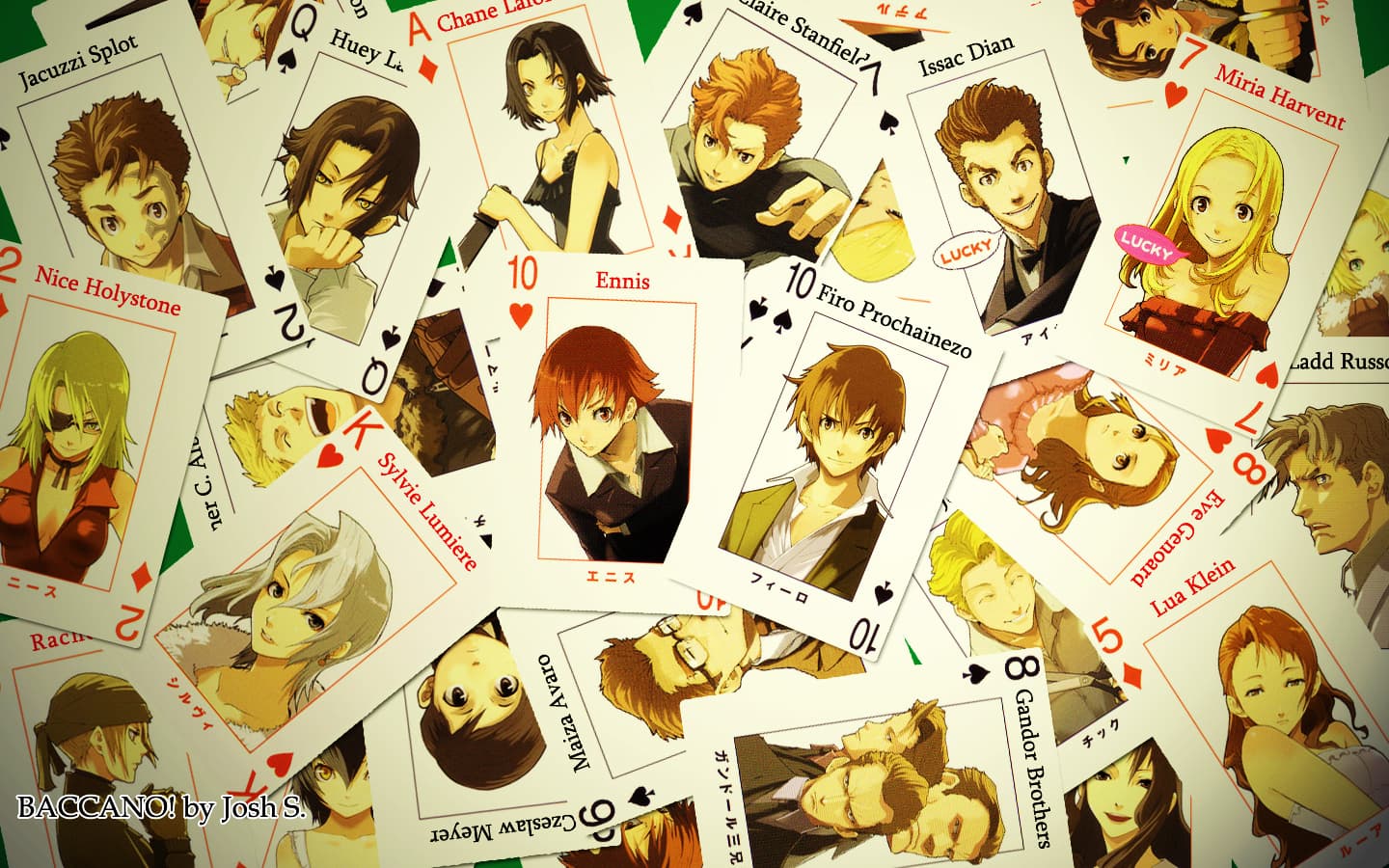
On that note, perhaps the biggest appeal of Baccano is the characters. Almost every character is fun and entertaining. There's the book dumb, hotheaded young Firo Prochainezo, who becomes a rising star in the mafia. There's the psychopathic manchild Ladd Russo. There's Jacuzzi Splott, who is named Jacuzzi Splott. And, of course, the airheaded thieves Isaac and Miria, who manage to tie all the stories together but seem to be largely unaware of the greater plot going on around them. The result is that Baccano has the greatest ensemble cast I've ever seen. No one is truly a main character (Isaac and Miria probably get the most screentime but are certainly not the protagonists), and few characters really slip through the cracks. In fact, the episodes are divided more by character than they are by event, each episode announcing who it's choosing to focus on with titles like "Ladd Russo Enjoys Talking A Lot and Slaughtering A Lot" and "Isaac and Miria Unintentionally Spread Happiness Around Them."
In addition, the English dub is worth mentioning. This is one of the more lauded dubs in the industry. So many of the actors are able to capture the energy of Baccano wonderfully (Jerry Jewell as Claire Stanfield is about the only performance of his I've seen that isn't completely dialed in), and the actual New York accents help add to the setting. I have not actually heard the original Japanese performance so I'm not sure how it compares, but it is certainly a dub worth your time.
Overall, Baccano is just plain old stupid fun, and it knows exactly how to be plain old stupid fun on a fundamental level. The characters and situation lend themselves to its particular type of style perfectly, so it never feels like it's trying too hard to be entertaining. In addition, the metanarrative provides some nice commentary on the nature of storytelling and, with the inclusion of the OVAs, ultimately brings the story full circle.
I would recommend Baccano for just about everyone, even those who wouldn't normally give a series in this genre a try. It's admittedly a bit confusing, but not to the point of being a turnoff. If you're against violent series or can't stand action in general, you might want to skip this one, but if you like action, non-linear narratives, battle royals, fun characters, 1930's American settings, or anything else I mentioned, this is one you won't want to miss. And if you're considering watching its cousin series Durarara, please, consider watching Baccano first. Five stars.
42 out of 45 users liked this review
