Since their inception, vampires have been one of the most popular supernatural creatures in horror. Their imposing status is backed by their array of powers, from their ability to fly to turning others into vampiric servants of their own. I remember back in the mid-to-late 2000’s when series like Twilight and True Blood were around. They wanted to seek out drama and romance in the world of the undead. Hey, if you got the right actors, even vampires could be sexy! I never bothered with either, but I remember seeing a lot of backlash against this move, criticizing the stories for poor writing or overdramatization. Maybe it was a call from the purists or enthusiasts against the newfound trappings associated with their beloved undead. However, another series was also introduced in the mid-2000’s (or earlier for the manga readers) that would give the extreme qualities back to the bloodsuckers – Hellsing Ultimate. Granted, a 13-episode series by Gonzo was produced in the early 2000’s, but it branched off from the original story due to lack of material. Hellsing Ultimate, a 10-episode OVA by beloved studio Madhouse, stays truer to the manga. Each episode is roughly 50 minutes in length, giving a volume’s length worth of material per episode. Though it may be the “ultimate” adaptation, is it a worthwhile watch?
The story is fairly straightforward. Alucard, our vampiric protagonist, is the underworld mercenary to the Hellsing organization. He deals with all things related to the undead, mostly vampiric. An abnormal number of vampires in the town of Cheddar have started to spring up, alerting the Hellsing organization of someone planning something behind the scenes. This story unfolds to a battle of epic proportions, involving old foes from Hellsing’s past in a brutal bloodbath. This is a series that wants to be known for its action and violence, so naturally the story aims for whatever can provide the most extreme outcome. Almost every twist and turn in the story is meant to drum up emotion or shock. This can be a good and bad thing, as will be explained later. The first few episodes are a good way to introduce the story and some of the key characters of the tale. It’s a necessity, as the primary focus of the series is an all-night battle royale in London. Blood is shed to an absurd degree and, with each episode acting like 2 or 3 episodes of a normal viewing, it may become a bit tiring to watch. That said, the show is not nearly as gory or extreme in its display as one would think. It smartly “self-censors” some of the more brutal aspects of the show to keep its more curious viewers hooked while not letting down the blood enthusiasts. This isn’t an 80’s style OVA, but it sure will provide more barbarous moments than your average action show.
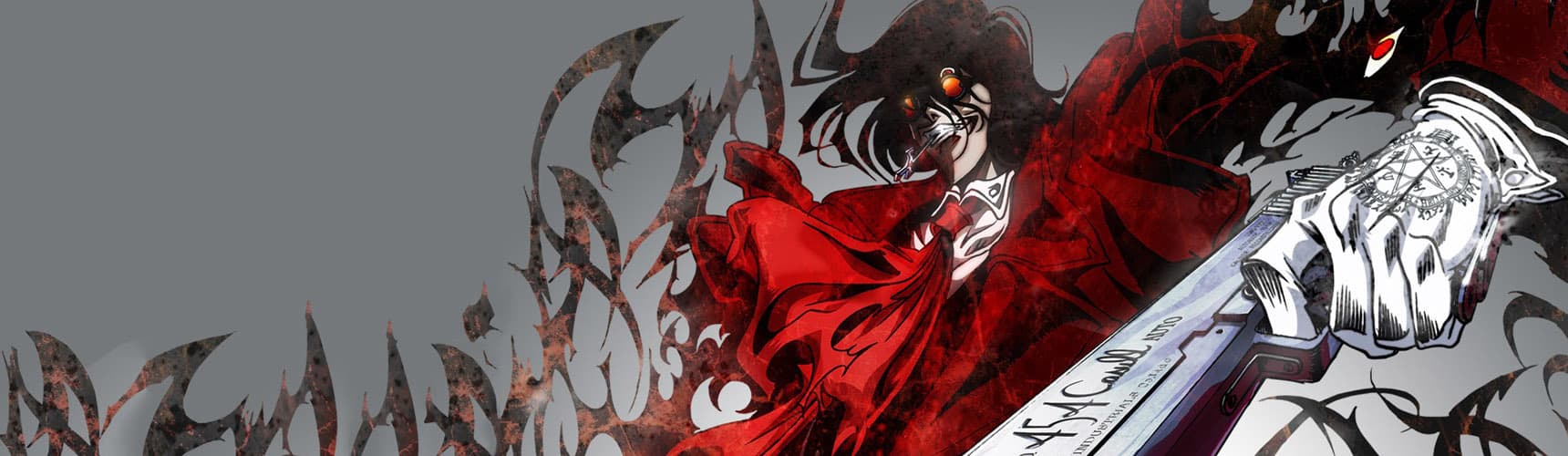
Of course, what separates good action from the bad is found in its characters and Hellsing has quite a few. The protagonist Alucard is what you’d want out of a lead. Cool, cocky and charismatic, this vampire has a knack for getting in his opponent’s head as much as he gets his bullets in their body. You read that right – in addition to being a vampire, he also brands 2 guns that soften up the enemy before he has his way with them. Contrasting him is the stoic Integra Hellsing, the daughter of the late Arthur Hellsing. As the head of the organization, she orders Alucard and others to learn about and destroy all the vampiric foes attacking the local areas. She is fearless in all manners, not breaking away from her sternness in even the direst situations. Their butler, Walter Dornez, is an older gentleman who once bore the nickname “Angel of Death”. Though he does not possess any vampiric powers, his use of razor-sharp, near-invisible strings catch enemies by surprise and lead them to their demise. The last of the main troop is Seras Victoria, a former policewoman saved by Alucard. She has a friendly personality and provides more of the humorous or sweet moments on the show. Don’t be fooled, though: when she gets going in battle, her more vampiric personality traits start to show and she becomes far more aggressive. She provides a decent reference point for viewers as the newly formed vampire on the team to introduce us to the world of Hellsing.
What’s probably the best part of the show is found in the character interactions and personality traits of each character. A hierarchy is found in the Hellsing crew, with Integra on top, followed by Alucard and Walter, and then Seras. It’s rather strange to let the member with the least battle-ready skills be on top, yet this paves way to some deeper meaning the show aims to scratch at. Alucard won’t attack unless given permission by Integra and these conversations reveal the true power dynamic at play. Alucard gets a strange sort of pleasure poking at Integra’s cold demeanor, aiming to make her as much a monster as he is. With such a deadly force at her disposal, one has to wonder if an enemy could be saved or if someone innocent could get caught in the crossfire. This is more lightly touched upon and, if given more time, would be an interesting look behind necessary sacrifice or war crimes. Other themes of humanity are explored, such as what qualifies as human in a show filled with supernatural creatures and body modifications. Even topics such as religion and their duties are explored in a strangely mature way. Yes, there is endless amounts of violence and irrational hatred driving some points, but some characters question their methodologies and what is right even if it’s what they’ve been told to believe. Father Anderson, the rival to Alucard, is a great example of this. Though an impassioned man hellbent on sending vampires to Hell (as well as an extreme dislike of Protestants), he grows more mature as he realizes the extremes his cohorts will go to. Coupled with his holy blades, he provides a great clash against Alucard and is always a joy to see on screen.
Though the show is over-the-top and as bold as one could want, the show suffers from a few big problems. The pacing of the show is one of the first I could think of. The first few episodes are good to introduce what the show is about and its characters, but the meat and potatoes of the show is an all-night battle in London. So many opponents come into the mix, with millions of lives lost, that it becomes quite ridiculous to take in. The point is made clear by the villains that their efforts have been leading to this one-night blitz, but it often feels like more characters and fights are introduced for the sole sake of continuing the series. If this was a war anime with strategies and larger time spans between fights, it’d be more understandable but here it often comes off as mindless. As if it wasn’t enough, between these moments of action are rather long monologues, often repeating what’s already been said or known. It’s a sort of paradox – when you want action, they’re monologuing, but when you want a break, they’re adding more bodies into the mix. It comes down to a sense of timing more than anything else and other viewers may not see this as a problem.
The biggest problem of the show I can see is in its development. The show has so many cool ideas, themes to explore, characters to introduce and yet does little with them. This is a show that’s begging for a prequel to explain character origins more clearly (which it technically did but was cut short for reasons that escape me). As a result, a lot of depth is lacking from the show and adds to that mindless feeling I described earlier. Some villains are a footnote in the show’s story despite being labeled as big threats – one villain treated as a major threat doesn’t even speak! This is honestly one of the few cases where a manga/anime is justified into needing more episodes. Maybe creator Kouta Hirano wanted to focus more on the action or felt he’d add on to certain details later but didn’t get around to it. Whatever the case, it really hurts what is otherwise a cool show brimming with ideas.
Almost as a fallback to expanding out on these ideas is the final problem with the series: Alucard’s overpowered status. Now, it’s to be expected that the members of Hellsing need to be naturally tough to combat their enemies – after all, there’s only 4 main members of the group compared to the squadrons of the enemy. That said, it often makes me question how he was taken down in the first place. He has so many abilities and attributes that you often need a nation’s men to even think about tackling him. Even just having a regeneration ability can be busted as it makes any battle against him (or any opponent with a similar ability) the equivalent of fighting a wall. While that may be the point to this endeavor, it often makes each situation he’s in predictable and loses out on potential edge the show could have. It’s almost humorous trying to see what other busted powers the opponents have. What is usually a dominant force in any other show is treated as the bare minimum to keep up with the protagonist. This is the case for many unmoderated supernatural works. To give credit where it’s due, it often is displayed as “rule of cool” and those who enjoy the imagery or quips of Alucard will probably not mind this point as much.
Hirano’s art style is accurately portrayed here, with its sharp outlines and big ringed eyes. Everyone seems to carry a cocky grin to boot, giving each character some form of assurance of their victory no matter the odds. Things can get bloody, but they never get too graphic as to turn your eyes away from the screen. Often, it’s a whole man in one frame followed by their limbs everywhere in the next. Despite being backed from Madhouse and given the OVA treatment, the animation isn’t always of the best quality. It can sometimes appear a bit choppy or make characters look a bit off in mid-shots (though this latter part can also be found in the manga as well). Most controversial will be the show’s use of CG for weaponry and large crowds. It’s not the worst but, like most CG, it sticks out like a sore thumb. The music department will be a real gem for most. Hellsing Ultimate has a varied soundtrack, ranging from rock to choral pieces and everything in between. Some songs will get you pumped, while others reminisce of stereotypical war songs. Sometimes the songs can be mashed-up, such as in ED 8. It starts off with a choir before plunging straight into a distorted boogie blues piece. I was recommended the English dub for this anime, a move that’s a bit out of my element as I usually watch subs. Crispin Freeman is the star of the show, with a deep menacing voice that shines as Alucard. It was a bit strange to hear at first and some lines felt a bit too “straightly spoken”, but by the end I could imagine no other voice. Other voice actors tried to match the setting by having varied English accents. Though there is some danger as to being “phoned in”, they all felt believable. Katharine Gray is as bubbly as you’d want for Seras while Victoria Harwood gives the voice to Integra’s commands. Sometimes the anger or tenderness is a bit misplaced, but they did a great job overall. It could be a bit of bias: after all, it’s easier to recognize atonal voice acting when it’s your native language.
Overall, I give Hellsing Ultimate a 5.0/10. With enough time, this could’ve been the definitive vampire, horror and possibly action series. As it stands, it’s a treat for the fans of the manga and perhaps adolescent audiences, but not for me. Despite my rating, I still would recommend it to those who are looking for an action series that delves into the supernatural. My only condition would be that the viewer is looking for over-the-top action/powers but not anything more than that.
Do you like or dislike this anime? If you haven't watched it, are you encouraged to watch it or not? Leave a comment on my profile telling me what you think of the anime and/or my review.
Thanks for reading and have a blessed day!
69.5 out of 112 users liked this review