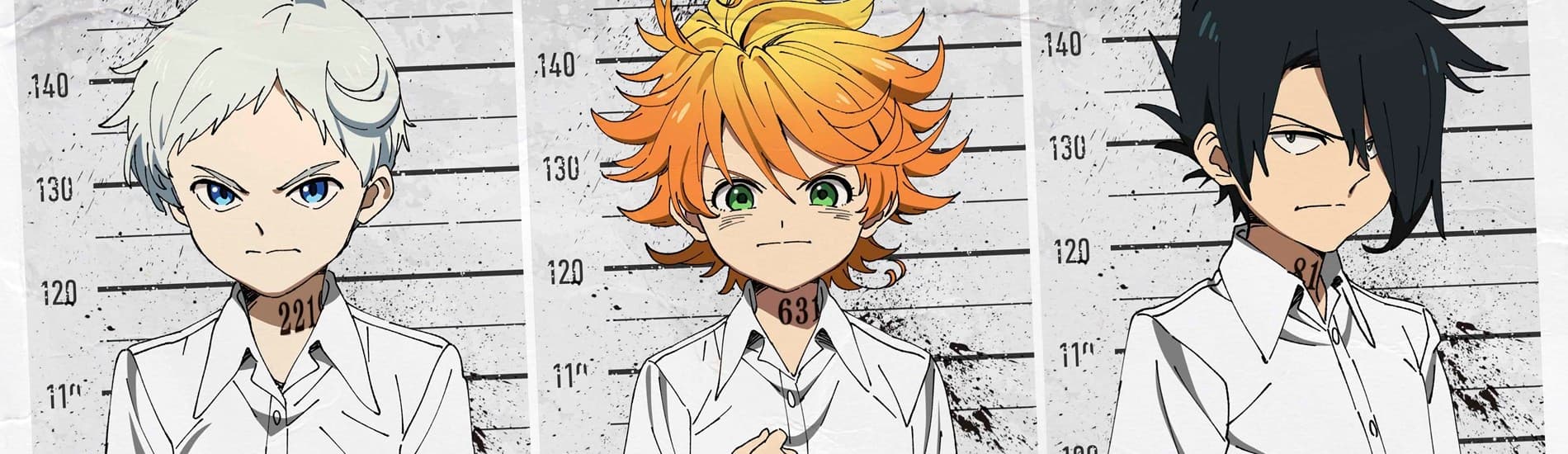
The Promised Neverland is part horror, part thriller. It centers on a group of orphans whose idyllic, wonderful lives are about to be shattered by a chilling revelation about the true nature of their world and their purpose. What ensues is a battle of wits that pits the children against the person they trusted the most.
My favorite part about the anime and what is most compelling about it is its themes. They’re set up in such a way as to mirror the structure of the physical world.
The orphanage aligns with the theme of cages and what they entail. There are those who rage against living inside it, and those who find themselves surrendering to it. One of the questions this anime poses is can you live a happy life inside a cage, bound and controlled? Furthermore, is it okay to be happy but only to a point and at the behest of others? Can we be satisfied with that? Should we be satisfied with that? In direct opposition to this, both thematically and physically, is the other side of the wall, the outside of the orphanage, freedom—a concept that poses its own set of problems. Is freedom worth it if it comes with the possibility of danger? Of pain and uncertainty? Is it worth it if it means fighting to survive and struggling to carve out a place in the world? By placing these two side by side, the anime creates a sense of tug of war and powerfully illustrates both the struggle and the divide between them.
Beyond the orphanage and the other side of the wall is the world that encompasses both of them, the world of humans and their overlords. This perfectly represents a system that lives off the backs of the subjugated, and functions and survives because of a combination of oppression and complicity. The two previously discussed themes also fit right into this world view, dividing the world into those resigned to this system and those fighting against it. And the struggle of the children in the anime presents the question of whether it is possible to overcome, to break free. And if it is, how? The answers, I think, are effectively communicated in the ending.
By giving these themes both literal and metaphorical shapes, the anime creates a tight, atmospheric world filled with contrasting motives, choices, and ideals. Compounding the physical obstructions with metaphorical dilemmas also ensures that there is a constant sense of multilayered tension. It’s not just a matter of whether they get caught or not, of being able to climb the wall or not; there’s also the problem of surviving the uncertainty of the outside world, of choosing to stay willfully ignorant and comfortable or braving the perils that freedom comes with.
Another thing I love about this anime is its protagonists, the children. I know that a lot bemoan the fact that they seem too mature for their age, but while this complaint does have some merit, I was able to suspend my disbelief just enough to go along with the story. Though they are not the most well-written, with the three main leads never growing beyond their archetypes and the rest just serving as an adorable background, I like how their youth is showcased and used in the anime. Because of their age, it’s fascinating to watch what strategies they come up with and what they make of the tools available to them. The use of play as training is an especially genius idea and distinct to them, since play in the real world is indeed used as a training ground for children to learn real-life truths and techniques. I also like how much respect the show has for the little ones. Too often people come to the mistaken conclusion that things have to be dumbed down for children to understand them, but this anime believes in their intelligence and capacity for understanding (some argue a little too much) and never underestimates them. It also shows and banks on a child’s ability to be constantly surprising. By using children, the anime also doesn’t have to try as hard to get us on the side of the protagonists because kids have a sense of innocence that makes most immediately root for them.
Unlike the protagonists, the central antagonists are particularly well-constructed, with Isabella and Krone as both representatives and victims of the system. Though they can be seen as the main villains, they are also cautionary tales. This makes us fear and pity them at the same time. They also serve as two points of tension. The first point comes from their role in the orphanage. The second point has to do with what their existence implies about the larger unknown world. Again, we have that sense of multilayered dread. Here, we don’t have the usual kids vs. adults trope, instead we get oppressed vs. oppressor and all the nuance that comes with this.
As for how the mystery unravels, this might be one of the weaker points of the show, as there are far too many “reveals” in my opinion that seem hastily put together. It’s not horrible, but it’s definitely not as well done as the thematic play in the show.
All in all, though it stumbles a few times, there’s much to love about this anime.
44.5 out of 47 users liked this review