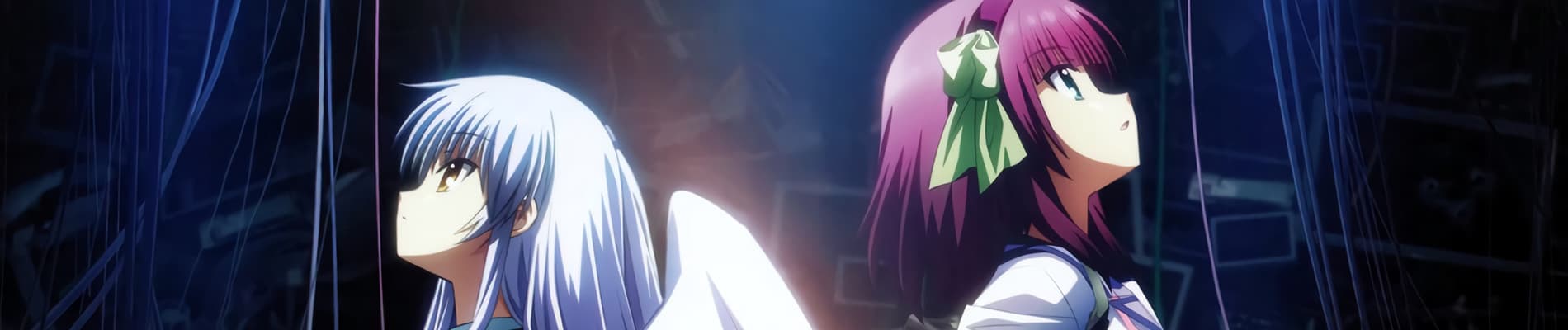
Angel Beats!
a review by Heinzes
a review by Heinzes
Also: this is the first part of a less formal ongoing project of mine to watch every show primarily produced by—perhaps my favourite studio—P.A. Works.

Angel Beats! is a strange beast to me. Perhaps, as someone who was old enough to have watched it as it came out, yet checked out of the culture and medium at the time, I can never fully appreciate this particular series or its ilk. I was never immersed in—nor did I personally experience—the particular brand of anime subculture that existed at the time in which this show aired. As others before me have pointed out, Angel Beats! came at the tail-end of an era in anime culture birthed by Kyoto Animation's The Melancholy of Haruhi Suzumiya, that was ultimately snuffed out by Shaft's Puella Magi Madoka Magica. Among the artifacts of this particular moment, some of which still exist in the culture today, are the classic power-creep of supernaturally powered characters and a reliance on humour with pronounced elements of zany "randomness," both of which are evident within the text of Angel Beats! Underneath, the flashy exterior of this cultural exhibitionism, though, is the core of a decently compelling story about a search for meaning and satisfaction in what appears to be an indifferent or outright cruel universe.
In many ways, Angel Beats! is a model example and running exhibit of practically everything that was in vogue throughout this particular period, the clear desire of its creators to outdo any popular work that had come before—at doing whatever it was that popular work did—makes for a show that feels to be pulling in essentially all directions at once. I might more snappily describe this as a tonal schizophrenia, and even building off the broad definition of that term utilized by Deleuze and Guattari, that is "the counter-acted tendency," I feel this is an apt description of what this particular series does with its narrative tone, pace, and structure throughout that kept me at a distance, it is a body that frequently seems to have misplaced its organs. [1] This is to say that individual moments of emotion or comedy (certainly the former more than the latter in my eyes) are observably effective on their own terms, but then are often swiftly undercut by the need to jump straight into a scenario doused in whatever feeling is the specific opposite of whatever was just experienced. The series fumbles when it comes to tying moments and disparate tones together into what should feel like pieces of the same narrative, but individually many moments hold up in and of themselves.
The pageantry of suffering shown in the various protracted flashback sequences and episodes can come off as overwrought, even dare I say "edgy," and I can't say much to defend them from those criticisms because they would all ring extremely true. The most emblematic element I could point to of the humour within the show falling flat is the presence of the character known only as TK, his entire shtick is a one-note where he says some poorly conceived phrase of nonsense English, we acknowledge it's nonsense, and then we move on; the joke never escalates, and we never learn enough about the character to understand why he does this. It's a thin premise for a joke with no pay-off that overstays it's welcome within one episode, let alone the full series. Although the series has a number of jokes and recurrent gags which frequently fall flat, some of its gags are so brazenly metatextual and referential in their grabbing of style points from the Haruhi wave that they proved to raise a chuckle, despite my best efforts to do not naught but balk at them. Audacity is often a vice of a production that goes for broke the way Angel Beats! does, though it will always to some extent also be admirable. It isn't a series that always sticks its landings gracefully, but it remains enjoyable enough and grabs at what feel often like the right moments that I couldn't simply toss it aside out of frustration.
Final Grade: C+
Notes
You can find the full text of Gilles Deleuze and Felix Guattari's Anti-Oedipus here.
47 out of 65 users liked this review
