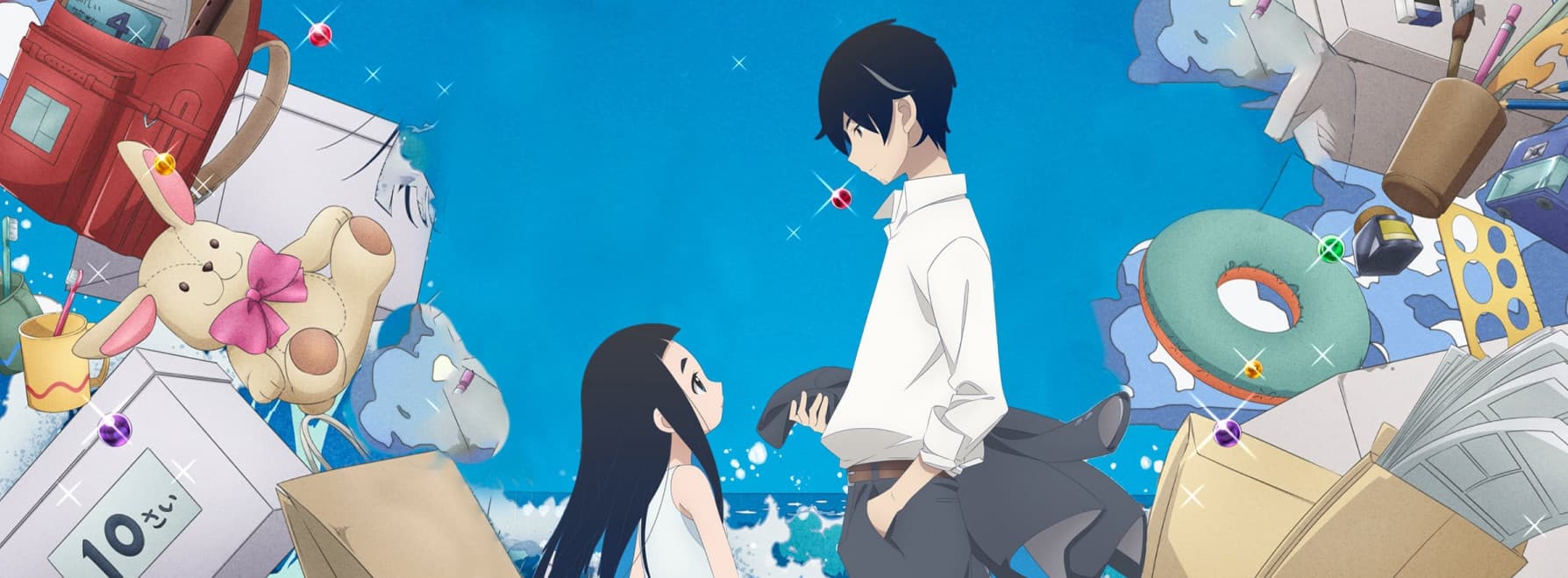
Kakushigoto
a review by planetJane
a review by planetJane
Billing itself as a “father-daughter tale of love and laughter”, Kakushigoto is the anime iteration of the latest from Kouji Kumeta, best known for Sayonara, Zetsubou-sensei. Kumeta’s best-known series was often drenched in a sardonic, black humor. SZS, those who have seen or read it may remember, made a running gag out of the main character’s desire to off himself.
If the bulk of your knowledge of Kumeta--like mine--comes from SZS, you can feel free to chuck out much of your preconceived notions about the man and his work. Kakushigoto stands as a work that reckons with the frayed edges of the slice of life genre. It is sometimes melancholy, and at times strikingly sincere. This places it within a broad continuum of recent anime that seek to develop simple situational comedies into fully-realized, three-dimensional portraits of their characters' lives. The good and bad, the tragic and the funny.

And Kakushigoto’s core is still comedic--and we’ll get to that in a bit--but it’s impossible to talk about the series without mentioning the frame story that bookends most episodes and finally concludes in its last. In the main body of the series, Hime Goto is an 11-year old space case who lives with Kakushi Goto, her father, a comedy manga artist and widower.

That contrast informs the entirety of Kakushigoto, and is arguably its entire raison d'être. Anyone who’s familiar with critical work focusing on anime as an artistic space in recent years has heard this line before. It is the endless everyday coming to an end, and a surprisingly thoughtful consideration of what comes after. It’s also quite transparently grounded in Kumeta’s own experiences (or if it’s not, the man is such a remarkable fabulist that it might as well be).
However, before it’s a personal reflection of Kumeta’s inner thoughts, or a comment on the state of the artform or the world, or anything that heady, Kakushigoto is a fairly simple situational comedy. It must be emphasized that for all its applicability, Kakushigoto does spend the bulk of its time trying to make you laugh. The trying to make you cry comes only intermittently, and only works as well as it does because much of the comedy is so good. In particular, Kakushigoto likes to derive humor from basic miscommunications. Everything from Starbucks orders being misinterpreted as magic spells by Hime and some of her friends in the first episode, to Kakushi mistakenly thinking his manga is being axed in the penultimate episode, this is where a lot of Kakushigoto’s juice comes from. It’s good stuff, and this kind of Thought You Meant X But You Really Meant Y affair is so common to human relationships that it’s also instantly relatable.
If there’s a misstep in this part of the show it’s that for something that’s otherwise by turns clever and familiar, it does spend a good chunk of time, especially early on, lobbing airballs in the form of lazy, unfunny stereotype humor. This is Kakushigoto at its weakest, and it’s to the show’s credit that it drops away almost entirely in the second half of the series.
Elsewhere, and on a more positive note, it drives down strange plot and characterization detours. For example: through no effort or desire of his own, Kakushi develops what is essentially a harem by the halfway point of the series. Several young women (all of whom are minor supporting characters in their own right) pop up from time to time to vye for Kakushi’s affections. It’s never particularly relevant, and Kakushi never even catches on, but it is funny, just by dint of being ambiently puzzling. What do Hime’s teacher and her rivals see in a 30-something widower mangaka? Who knows, that’s (part of) why it’s funny.

There’s also a fair amount of manga industry inside baseball leveraged as humor. In particular the character of Kakushi’s editor, Tomaruin, is a riot, just by dint of being a massively unhelpful jerk without even slightly meaning to.
Of course, all this in context. Kakushigoto’s other half--that frame story--is where it really, truly shines. Kakushigoto’s premise of a man who writes comedy manga for a living trying to hide it from his daughter may seem fairly silly, at first. However, it becomes clear as the show nears its conclusion that this is grounded in a very real anxiety. Artists, especially those who do not work in the “serious” arts, struggle with this all the time. During the time skip between the main body of the show and its finale, Kakushi is forced to quit his job as a mangaka, concluding his manga-within-a-manga Tights In The Wind after a several-years-long successful run. He ends up doing manual, hard jobs as his household money runs dry. All this for his little girl.
We learn that what happened to Kakushi is an act of cosmic black humor. While working as a forklift operator, a massive pallet stacked the ceiling with Jump magazines tumbles down on top of him. The ex-mangaka literally crushed by his chosen medium. On the nose? Slightly, but we can forgive that.

When he awakes in the second half of the finale, he’s amnesiac, believing himself to still be a working mangaka. What ends up restoring his memories is his manuscripts, brought to him by his daughter. The two things that are truly important to him, you see.
It’s perhaps oversimplifying to say that Kakushigoto’s core thesis is that you shouldn’t be ashamed of your art. If only because that’s an easy thing to say and a very different thing to put in practice. It may be more accurate to say that the series is a best-case scenario for always pushing forward to the future and keeping what you love close to you. In this context, the finale makes perfect, wonderful sense.
Kakushi loves his daughter, and he loves being a mangaka. Thus; the show closes on him pitching a new comedy series to his editor both so he can pay off his debts and so he can resume his real passion in work. Kakushigoto is here kind enough to foreground its subtext: Tomaruin suggests writing a series about an artist who draws dirty manga and goes out of his way to hide it from his young daughter. “Who would read that?” is Kakushi’s bemused response. A question I think we all, by now, know the answer to.

It’s hard to say--and ultimately irrelevant--if some distant cousin of this conversation occurred in reality. Kakushigoto is clearly the fruits of a very long career in an often punishing and ill-respected medium. It is, one could argue, a surprisingly eloquent defense of that very career. When it crushes you, you weather the storm and stand again. And, if you're lucky, your passion may one day inspire theirs. The series' second to last scene is Hime, sketching out a shoujo manga that she plans to hide from her dad. For "a while", at least.


And if you liked this review, why not check out some of my others here on Anilist?
85.5 out of 90 users liked this review
