Tower of God
a review by planetJane
a review by planetJane
Tower of God is a fascinating series, and that would be true even if we looked solely at where it comes from. Tower of God is an anime adaptation of a South Korean webcomic. The first of many, I would venture to guess. (Indeed, if you’re reading this as it goes up, the similarly-titled but unrelated God of High School premieres in only a week or two.) But while Tower of God’s multinational pedigree is certainly fascinating, and does inform some of its sensibilities, it would be a mistake to preoccupy ourselves with solely this aspect. So let’s take a step back.

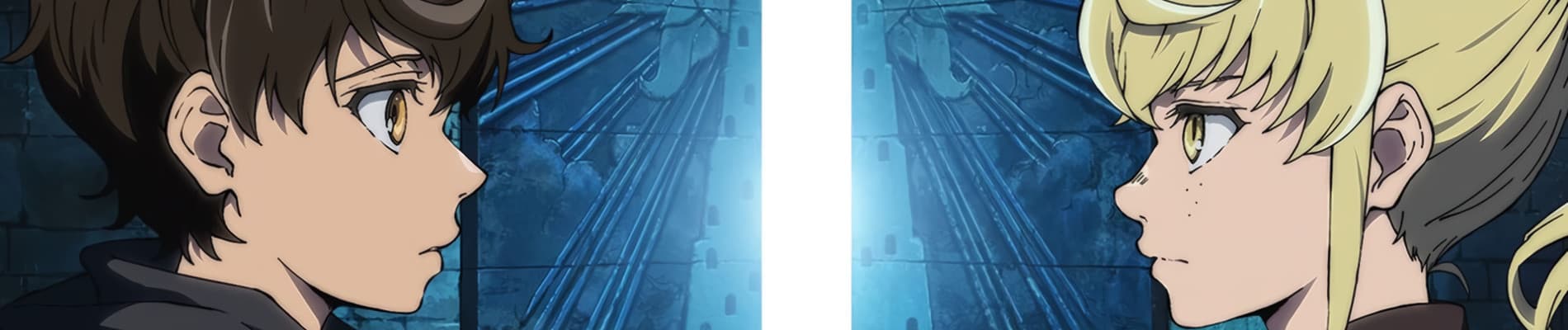
Tower of God is the story of Bam, in many ways the very image of an archetypal shonen hero. Friendly, naturally gifted, determined, honest. Ah, and singularly devoted to a girl, who he begins his quest to scale the Tower in search of.
Tower of God is also the story of Rachel, who is that girl. Rachel is Bam’s opposite and his shadow, though that does not become clear until the series’ closing episodes.
There are a few ways to analyze Tower of God. Purely as an action series, what’s presented here is well above the merely competent. ToG has an interesting, clean visual style that sets it apart from most of its peers. Its plot is a pleasing mix of adrenaline-pumping fights and twisty political intrigue. The cast is colorful, both in personality and often literally, as the series’ origins as a webcomic really shine through in many of the “fuck it, it looks cool” designs of certain characters, such as the inexplicable number of ribbons that Yuri Jahad uses to tie her hair, a one-off character who is a living pink punch dummy, Anaak, a charming green lizard girl with a bobcut, and Rak, one of Bam’s main companions, who is a spear-wielding alligator-man. Even more “sensible” designs, such as those of Khun and Endorsi, make eye-catching, pleasing color choices.

In terms of actual characterization, they’re great. This is true when they’re working in surprisingly subtle, nuanced shades, say with Aguero Khun or Yu Han Sung, who operate as the series’ obligatory plan-spinners, or the intertwining histories of Anaak and Endorsi, or, indeed, Rachel. It’s equally so when dealing with broader, archetypal characters, such as Rak or for that matter, Bam himself. Nearly to a one, every character is a joy to watch work, even if it’s in a “love to hate” sense as with some of the villains.
The other point though is that Tower of God’s titular structure is a metaphor the size of a million skyscrapers. What for? Well, any system you care to name that pits its competitors against each other in a zero-sum game, and there are many of those. It maps most closely, in my estimation, to capitalism. Both with the foregrounding of the “haves vs. have-nots” dichotomy when Hoh betrays his team during the “tag game” arc, and the subsequent inequality and cycle of suffering that dichotomy perpetuates. Some of our characters are empowered by it: indeed, this is Bam’s role, someone deposited by fate and circumstance into a system which rewards his skill set and natural talents (making allies and shinsu manipulation, respectively). Others are much less lucky. Hoh, a blonde, horned character, is the clearest example. We never get the gory details of what, exactly, happened to his homeland, but the scattered nightmare flashbacks we get speak to the trauma on its own. In this light his betrayal makes perfect sense. Who wouldn’t do anything they could to come out on top of a system this vicious?

This appears to be what drives Rachel, too, whose arc is a more subtle, larger-scale reflection of Hoh’s (perhaps that’s why they’re both blonde). We never learn why she’s so obsessed with “becoming a star” and “being special” (as Headon, the rabbit-like ‘guardian of the Tower’, puts it), but her deep-seated envy drives the final episode of the season. It would be easy to write her off as simply a bad person (and hell, maybe she is), but Tower of God seems to resist such simple readings.

There’s also, to return to the “Tag” arc, Selena, who literally exits the series at its 2/3rds marker, plainly in the Tower because she is the only survivor of a band of criminals. It’s only when the system grinds her will to fight down that she willingly leaves. She isn’t dead, and in that sense her fate is better than Hoh’s, but both have given up the fight.
But Tower of God also touches on other forms of inequality. Khun’s apparent exile from his family seems to have been caused by either a violation of some sort of social taboo (it’s broadly implied his relationship with his sister may have been incestuous) or a frame-up to resemble one. This is certainly a very different sort of inequality than the systematic oppression wrought by having or not having shinsu affinity, but it feels an interesting stab at applicability nonetheless. Our own world is certainly no stranger to ostracization on these grounds. It’s not nearly as fully-realized a metaphor as the show’s primary storytelling mechanism, but it’s interesting food for thought nonetheless.

There is even incremental touching on of misogyny. We learn very little concrete about the King of Jahad, but his policy that his “princesses” cannot have sex or reproduce certainly feels like commentary. Again, it’s not followed through-upon with the same strength as the story’s central metaphor, but it's meaningful that the show even deigns to go there.
Of course, no anime is perfect. Tower of God’s thoughtfulness in some areas only makes it more obvious when it’s deficient in these same regards. No dark-skinned characters play a major role, which would perhaps be less egregious if the only one who comes close, Hoh, wasn’t the only named character to die on-screen. Elsewhere, Rachel being disabled and one of the show’s more outright villainous characters feeds into the ancient “evil cripple” stereotype that fiction in general, really, should be well past by now. Some scenes in the finale also imply that she’s faking it, which is not any better.
On the narrative side, the simple realities of cutting even a given length of a sprawling webcomic into thirteen 22-minute episodes means things are occasionally a bit confusing. The Tower’s mechanisms being obscure and obtuse usually works in the show’s favor--it really only adds to the central metaphor--but it sometimes gets in the way of the show’s literal plot. The “Tag” arc is the big offender here, while the emotional beats are great, the actual logic that the tag game works on is rather confusing.
Tower of God thus can certainly feel like the long prologue to a story we’re only going to get in full from the second season (which, one seems likely) onward. I would hasten to ask, though, is that a bad thing? All of the above is tied together with an excellently-executed action shonen setup that is rarely less than a good time. Its flaws may mark room for improvement, but on both a pure craft level and intellectually, the series excels overall.
In general, Tower of God stands as one of the strongest entries in the already-strong Spring 2020 anime season. That’s to be respected, and celebrated. Tower of God ends on an ambiguous note, Bam washed down, seemingly back to the bottom of the Tower. A still, mysterious shot of a lone figure closes the series. The cliffhangers feel pointed, a promise that Tower of God is nowhere near finished telling its story. For that, we can be hopeful.

And if you liked this review, why not check out some of my others here on Anilist?
174.5 out of 205 users liked this review
