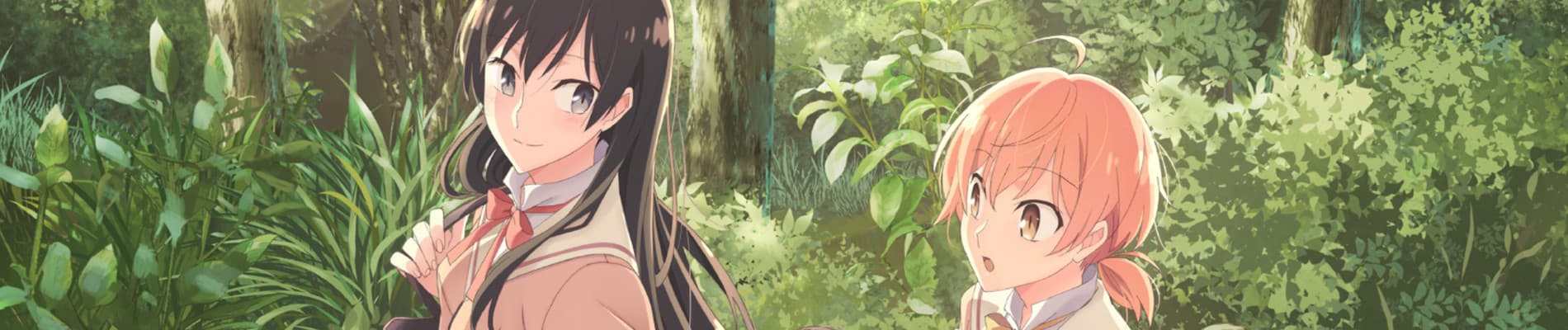
Bloom Into You
a review by AltoRoark
a review by AltoRoark
Bloom Into You is an embodiment of pleasantness, constructing a wholesome narrative about finding oneself and what lies ahead. This series is best described as a slice-of-life with romance as a primary narrative. While the setting is somewhat like Citrus in terms of character archetypes, Bloom Into You approaches storytelling much differently than most romance stories. The show is far less about dramatic tension between the characters, and instead focuses on evaluating their relationships with one another, whether it’s affection, ambivalence, admiration, or animosity. The story takes form as a series of conventional moments and activities in which characters interact with one another in a practical, level-headed manner. Bloom Into You has a notorious aptitude for presenting these characters in such a way in which they are acting upon their own accord, rather than bending to the will of the narrative. The daily life of Yuu Koito is followed by us as we witness the changes in her everyday routine as well as her own views, watching everything blossom and mature as nature takes its course.
The melancholic tone that pervades much of Bloom Into You comes from conflicts within the characters’ own selves, but rarely between characters. Yuu struggles to feel love and ponders about her future, Touko is lonesome and fixated on her duties, and Sayaka is jealous and keeps her feelings bottled within her. These are character arcs that rarely end up in dramatic confrontations, and rather are pursued by their own accord. The cast maintains a positive rapport throughout much of the story, largely shielded from dramatic complications that would negatively affect their relationships. Hostility between characters either occurs very rarely or is short-lived. Viewers who want to steer clear of serious drama will feel right at home with Bloom Into You. But those looking for drama will be somewhat dissatisfied by this aspect.
Even as someone who has a strong bias for dramatic, emotionally driven narratives such as Octave, Citrus, and Aoi Hana, all of which are about lesbian romance as well, I can certainly say Bloom Into You has plenty going for it either way. The characters have just enough personality to give life to these situations. They emote, interject, pout, and elicit various other responses true to their character. Even the most mundane of character interactions feel very alive, and due to how likeable everyone is, this really emulates the pleasure of genuine socialization between good friends. The plot itself is largely unaffected by anyone other than Touko, and the cast succumbs to this as they wind up in various moments of recreation, discourse, and determination. In a way, the plot is the cast itself.
Yuu is an endearing character to follow in how her internal feelings slowly mature and develop as she interacts more with Touko and ponders over her feelings about her. Her attitude ranges from curious, to longing, to content, to frustrated. Her development, as with everything else in Bloom Into You, is taken slowly, but is done with nuance and purpose.
Touko is unfortunately a less engaging character, and dare I say Bloom Into You’s biggest missed opportunity. Her conflict is very sensical, but her background isn’t expounded enough to really make her dilemma feel genuine. Conceptually, she is a sympathetic character. Making decisions that only affect how people see you with no benefit to the self is unhealthy, and Yuu is both wise and respectable in trying to draw somebody away from this line of thinking. So this works well on paper, but Bloom Into You doesn’t fully commit to this. Touko doesn’t appear to be suffering nearly as much as the story wants us to believe. A person with low self-esteem shows symptoms, such as social withdrawal, hostility, and sensitivity to criticism,, hardly any of which is apparent with Touko.
Her one quality that's consistent with self-hatred is putting up a facade to impress others and consequently, her attraction to Yuu, who holds nothing against the true self which Touko hides from everyone else. But even then, the difference between these two versions of Touko is almost negligible. Being timid and somewhat pushy are really the only traits of her that we see that aren’t of the ‘perfect’ self she puts on around others. Additionally, we hardly ever see her truly distressed about her whole charade, or just how negatively it affects her. Any sort of behavior she displays around Yuu, apart from her romantic attraction, isn’t symptomatic of being under pressure or constant stress, which are logical effects on someone in her situation.
Funnily enough, this is actually commonly declared to be where Bloom Into You succeeds Citrus, which is odd to me since Citrus was far more successful in depicting a mentally broken love interest, by which I mean Mei Aihara. Mei is a truly broken individual, and the story accentuated this by having her act unfavorably in many situations. These scenes were off-putting to many viewers, but you should expect nothing less with this kind of character. Rather than telling us constantly about how broken and misguided she is, Citrus instead showed us what years of neglect and abuse have on someone, to where Mei can truly be believed as the character she was written to be. We’re shown how she doesn’t value her own body and has a horribly distorted perception of relationships.
The characterization of Touko is extremely tame in comparison. When I hear a specific quote from Yuu along the lines of “Touko has so many flaws I don’t even know where to begin,” all I can think is “What flaws?” At most, she’s pushy around Yuu and tends to lean on her during emotional hangups. These traits alone aren’t characteristic of a broken person. Bloom Into You teases you constantly about what Touko is really like without her perfect persona, and the most it can offer is having Touko telling the audience about her conflict and history. This isn’t enough because human beings aren’t that simple. If Touko really is suffering so much, why not show how this affects her general behavior and interactions, rather than the constant “I hate myself” or “I love you because you expect nothing of me”?
There’s a pretty obvious answer to the question above: it’s because Touko needs to be likeable. Likeable she is, however, it’s hard to get invested in her plight because her character is so artificial. If Touko’s character was explored better, I’d have a reason to believe that she truly is damaging herself or Yuu with her mentality or by trying to become her sister. Her personality would be more than just lip service to the audience and comedic blushes around Yuu.
As much as I praise the character of Mei Aihara, I can admit that this sort of approach isn’t for everyone, and there’s certainly a mindset encouraged to take in this story. Mei’s terrible communication skills can be onerous and frustrating to viewers, which is a sentiment I can understand. Theoretically, a heavily flawed love interest with such a troubled background can offer an appeal of her own if not taken to the same extreme as that of Mei; someone like Mei but more morally grounded and accountable to make a love story that is wholesome yet emphasizes the dysfunction and grit we love to see in our messy romance tales.
Touko Nanami as a character has the potential of striking that perfect balance, a reconciliation of Mei’s toxicity with the dramatic overlay that Touko offers in her own dialogue. Bloom Into You was Nakatani Nio’s first attempt at writing a story outside of a Touhou doujin, so you can’t expect everything to go perfectly. But apparently, she was so passionate in writing Touko’s character to where she was originally the main character of Bloom Into You until that role was taken by Yuu.
If the character of Touko falls short, then the romantic pairing is less captivating as a result. That said, Yuu and Touko have interactions that are comedic and charming, with Touko being pushy at times while timid at others, and Yuu being cheeky and somewhat playful, as well as being occasionally snide in response to Touko’s mannerisms.
Even if Touko isn’t as emotionally captivating as I’d like her to be, the nature of the relationship between her and Yuu is what sells the experience. The time they spent with each other is sublime, The dynamic between them makes for what I consider the best character moments in the entire series. Their interactions can be comedic, heartfelt, or introspective, and deliver in all these. Furthermore, that one exchange between them in episode 6 might as well be a series highlight, and those who have watched the show will know exactly what I’m talking about.
This pairing also has a depressing nature to it, thanks to Touko’s pessimistic view of love. Touko has essentially shackled Yuu into remaining in a state where if she were to develop romantic feelings for Touko, then Touko would no longer want to be in this relationship. It’s especially disheartening to see a character you really like confined in such a way out of her own volition, with the feeling that she may never live the dream she wanted for so long.
As worthwhile as all these characters generally are to watch, Bloom Into You really doesn’t have all that much going for it in the way of depth. The character exploration is there, and the themes about love are quite engaging, but with the exception of Yuu, the personalities aren’t exactly complex, as they’re quite limited in traits. I honestly struggle to describe any character of Bloom Into You with more than a paragraph. The fact the Bloom Into You will outright explain things that are already implied, draining the narrative of its subtlety, certainly doesn't help matters either.
Yuu’s inner thoughts are strongly comprised of fanciful metaphors which, while they may effectively portray her immature, derivative line of thinking, it makes her conflict feel less involving. With that said, these sort of scene-by-scene diary entries effectively sells the mood as we vicariously experience these events flow one after another and the significance they hold.
These monologues are the main drive in which Bloom Into You sells the experience, as the dialogue in Bloom Into You is unfortunately lacking in the way of a character drama. Much of the value comes from the meaning and implication of the dialogue, not so much the dialogue itself. For example, Yuu and Touko’s first couple of days as a pairing demonstrate the lack of emotional correspondence between the two, signifying the fruitlessness in Yuu’s acceptance to go out with Touko hoping to acquire that feeling of love she’s longed for. While this is all fine and good, and is well in line with Yuu’s character arc, I have little desire to ever revisit those several scenes because the emotional connection is so meager.
Sayaka herself encapsulates this priority in making a statement rather than making the most out of character investment. On one hand, it’s commendable how Sayaka’s character arc emulates the hurdles of an LGBT making their way through a conservative society, with her own subtle homophobia and dilemma in whether to believe her sexuality as something genuine or the adolescent phase it’s sadly viewed to be. However, when taking out the context of this liberation, Sayaka’s overall character leaves much to be desired. Apart from her dialogue with Miyako, and the liberating feeling one is bound to have with this long-awaited progressive attitude towards LGBT, this arc sadly doesn’t offer much in the way of character investment. Take away this true-to-life struggle, and what’s left is an unfortunately bland character.
After watching Citrus, which had lively interactions between characters with great emotional dynamics, Bloom Into You feels like a huge step down. Even Yuu, who I consider the most engaging character in Bloom Into You, shockingly pales when compared to Citrus’ protagonist Yuzu who has far more personality, often acting reckless yet possessing a sharp mind when feeling the need to, as well as having layers as a character. Arguably, Citrus’ biggest weakness was its overall plot, relying too much on contrivances coupled with a breakneck pace which makes plot points less impactful than they should be. But what Citrus has in place of its somewhat messy plot is highly endearing characters and interactions that don't rely on incessant monologues and soliloquies to be engaging. Bloom Into You is the exact opposite case, with a solid narrative and a more authentic series of events. Yet the characters and their interactions are what’s lacking in comparison. With both series having different strengths and weaknesses, I suppose it’s up to debate as to which is better. However when it comes to a character drama, I’m sure as hell more in favor with better characters.
What makes the experience so worthwhile is watching these personalities cross roads with one another. The characters of Bloom Into You are not what I would call complex or even deep, but their development and general traits are woven into the narrative with such nuance and at a steady pace to where it feels authentic and wholesome. Each personality is a piece of a larger whole, working like organisms in an ecosystem giving function to a wholly pleasant and mesmerizing experience. Coupling this with the serene presentation and sensitive, nuanced animation sells the splendor all the more.
This adaptation of Bloom Into You has effectively displayed what TROYCA is capable of, with lovingly rendered backgrounds and moving color direction to effectively frame the events that transpire. Lush flora and vegetation is detailed in its texturing and accentuated with the shot composition, emphasizing the theme of nature by enveloping scenes in a breathing, changing wilderness. TROYCA has crafted a product in which art and technology work in harmony bringing the presentation to a commendable level in every regard.
...Or so they would have, if not for many of the hamfisted and borderline infantile choices in directing.
For some reason, in episode 4, it’s essential that a black, blotchy effect with a raucous splatting sound is put within a showing of Yuu’s apprehension of what would happen to Touko’s reputation. The first episode also decides to disrupt the soft and somewhat mellow tone in the classroom by evoking Yuu’s feeling of indifference with a visual of water gushing into the room and submerging her, then displaying her to be located far away from her deskmates.
Let’s also consider the scene right after Touko apologizes for her...mishap, let’s say. Transition is made with a well-composed shot of Touko and Yuu walking in opposite directions with a pillar in between them, in an environment of subdued greens, yellows, teals, and dark greys effectively contrasting with the previous scene. Yuu then makes her way outside, thinking about why she felt nothing when she was kissed by Touko. In order to emphasize her feeling disappointed and forlorn, there’s plenty of ways the environment could have been used to pull it off. Maybe she stands in a shaded area. Maybe a cloud passes over the sun and obstructs the light everywhere around her. Maybe she stands in front of a grey stone wall with nature out of sight in the shot. So what does Bloom Into You end up doing?
It instead puts her in a shot with color removed completely, over an abstract background with no resemblance to the tangible location she was in previously. This amateurish technique is used once again in that same episode during a group photo, where Yuu holds Touko’s hand hoping to finally get “that feeling,” as the color inexplicably fades out. This is then followed by flashbacks with an obnoxious film scratch overlay and the end of each to convey the point even further.
Bloom Into You’s presentation is at its best when it isn’t so artificial, with episode 6 being a standout example. Shots are framed naturally to convey distance and relation with scenery, with no abstract, artificial filters or effects to disrupt the harmony. Water is again used as a motif, but in a manner that is much more subtle and respects the attention of the viewer. All of this combined with gratifying music and strong voice acting makes for an exceptionally memorable scene.
Utilizing natural assets from the scene to create a more authentic mood is not only a great fit for the theme of nature, it’s also good practice in general. The use of warm light which glares through the window to evoke intensity between our main leads is also well in line with this practice, even if its contrivance makes it less than ideal. Dare I make yet another comparison to Citrus, which almost never enters the same directing pitfalls Bloom Into You does on occasion. Takeo Takashi made sure to always ground situations, how theatrical they may be on their own, in authentic, non-abstract environments where natural symbolism and character acting take precedence, with camerawork and editing on par with even some of Bloom Into You's most impressive scenes. Let's also not forget about the trip to Kyoto which, even at its more intense moments, retains the sort of natural atmosphere Bloom Into You is notorious of.
A prominent virtue of reading fiction is the idea that someone else's mind is being delved into; peering into an author's own philosophies and worldview depicted as a narrative. Nakatani's Nio's Bloom Into You is an elaborate culmination of ideas that are awe-inspiring and take form in captivating ways, yet is seemingly shy of taking more daring approaches with its narrative. Nio seems more keen on expressing her own ideas and self than anchoring them to a more austere, grounded, double-sided reality that said ideas would realistically come with. This mentality was shared with and carried by the production team in the making of this adaptation, for better or worse.
Our world is certainly not a completely grim, harrowing, cesspool as reflected by some self-indulgent writers out there, but it's not quite as amiable as Bloom Into You seems to imply. People like Touko generally have more layers to their personality that are more unpleasant than we see here. People like Sayaka usually aren't as easygoing or quick to forgive. And don't count on your luck to have someone learning your secrets to be as good-natured as Maki. Now, a more pleasant version of life is always welcome in the realm of fiction. However, Nakatani Nio's choice to implement more cerebral themes into a high school drama, and a lack of commitment to this direction, leaves the end product feeling dishonest and overly safe.
Bland characters and gauche directing aside, Bloom Into You displays illustrious writing skill accompanied with equally eye-catching presentation. Everything falls into place creating an experience unlikely to be forgotten by me or anyone else in search of a very solid and wholesome romance story between girls and a tale of self-realization. It’s sure to offer something special to those who have been in a place similar to that of Yuu, and its ideas are sure to enthrall those itching for out-of-body experiences through a solemn, angst-driven romance.
19.5 out of 25 users liked this review
