Chess remains one of the oldest and still most popular games of all time. There’s a good reason for this: it’s simplistic layout and rulings with a variety of pieces give it an ocean of depth. The art of trying to put your opponent’s king in a state of inescapable capture while simultaneously keeping yours safe can be as complex as the players want it to be, giving the game a fresh feeling even after all its years of play. Besides the chess most are familiar with, variants of the classic board game are popular in different regions of the world. Shogi, the Japanese variant, has some unique properties that give the game its own intrigue. It has a bigger board (9x9 vs. the standard 8x8 checkerboard), new or different pieces to chess (gold/silver generals, lance, no queen, etc.) and even has a “revival” system where captured pieces can be used against your opponent. Though both shogi and chess have a near infinite number of options, the way its played is ultimately decided between it’s players. As March Comes in Like a Lion shows, it’s often the players, not the pieces, that are the most complex.
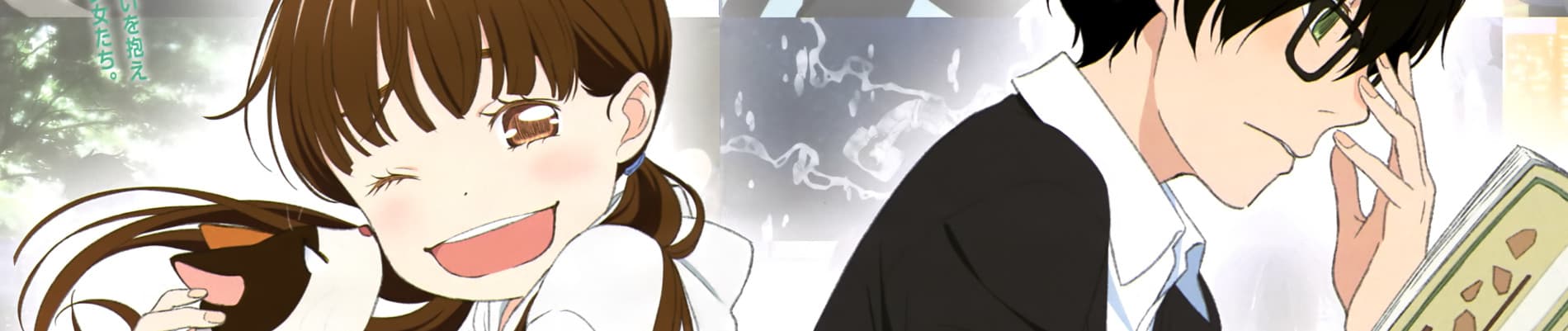
The premise for March Comes in Like a Lion is simple. It follows the life of Rei Kiriyama, a 17-year-old shogi player who has become quite notable for his skill at the game despite his age. When not playing or practicing shogi, Rei can be seen eating dinner with the Kawamoto sisters in June City or attempting to be a high school student with the support of his homeroom teacher, Mr. Hayashida. If this premise was seen in a bubble, only going as in-depth as the basics to kickstart a shogi-centric plot, it’d be an otherwise average-to-good sports/game series. What sets March Comes in Like a Lion apart from its competitors is its meaningful look at its ensemble of characters. Though the show has shogi as a holdfast, it is instead a means to an end to examine the lives of its players and their peers. Like the metaphorical river Rei seems to sink in, March shows that there is a lot to each character below the surface.
The lead, Rei Kiriyama, is the quintessential example of this. From an outsider’s perspective, he’s an introverted loner type who is prone to awkwardness and stubbornness in making decisions. It’s during the conversations and moments in his life, both past and present, that we see the events that has shaped the way he’s become. A victim of tragedy, Rei is often caught in the crossfires of other’s misfortunes, developing a hedgehog’s dilemma similar to that of Evangelion’s Shinji Ikari. The events he encounters in his life, from his time spent with another family to becoming aware of the current lives of the opponent’s he faces, brings multi-layered psychology to his character and gives believable backing to his hesitant nature. Examples of this can even be seen on the Rei’s external actions. Rei’s most observable quality, his “independence”, is true more so than in name than in action, living in a near empty room, eating rice and cup ramen while only focusing on his next shogi match. Though Rei might not be a charismatic lead like many sports/game genre protagonists, he still remains a strong representation of a dejected individual.
Rei, however, is not the only character who has experienced personal misfortune. A majority of the show’s cast, whether minor or major, have also gone through painful experiences. The most interesting part of this is how it has shaped their character. Rei’s “sister”, Kyouko, is often seen angry and mean towards Rei. However, a closer look at her own upbringing and relation to Rei opens up the reasons for her attitudes and her actions (such as pursuing after players like Gotou). The Kawamoto sisters, Akari, Hina and Momo, have an external attitude of being motherly and almost doting towards Rei. Behind it lies personal scars that seek Rei out beyond a level of friendship into a way of healing those wounds. Nikaidou is a boisterous individual who seeks to be Rei’s rival in shogi but carries struggle due to health problems. Shimada is an experienced shogi player whose reserved and frail demeanor hide a deep motivation of the game from his upbringing in the town of Yamagata. While not every character is explored as well as Rei (with the occasional feeling of “drama for drama’s sake” bubbling under), it never reaches a level of hindrance in the story and gives the cast more layers to evoke more realism within the show’s cast.
Though as solid as the characterization is, the biggest problem with March Comes in Like a Lion is actually found in its execution/style. Studio Shaft was behind this work and, with director Akiyuki Shinbou on board, you can expect the show to be more colorful and visual than other titles. Though this may work for other series he’s directed (such as the Monogatari series), it often feels as if it’s a major detractor to March’s message and delivery. The show will sharply go from serious to comedy as a way to break the negativity, but it does so in such a silly way that I felt that the tone or impact of a scene was hindered. The infamous “head tilts” found in Shinbou’s work are in full force here. They’re good for emphasizing a point or belief of a character, but when used in excess, it feels unnecessary and detract away from what a character is saying or doing. Because of these decisions, it can feel like Shaft are pouring their resources in heavy artistic flair in a show that doesn’t really need them. There are also a few animation goofs, seeing characters jog in place as if they’re trying to run away or the head tilts leading to a shot that doesn’t match the direction or place a character was. This is partially caused by the animation oversights/limits and partially because of the focus of making this appear more artsy.
Ultimately, though, a lot of what the show is at this point will strike people differently. Though the show is indeed a drama, you wouldn’t be remiss to say that it also has quite a few slice-of-life elements. While seeing them can be a nice breather and way to counterpoint the work from becoming too dramatic, I didn’t find as much enjoyment in these more relaxed environments. Though many of them in theory open up Rei to the surrounding world, I don’t always see the immediate or long-term impact from these decisions. I’m more moved by Shimada’s game against Kiriyama than I am seeing Rei eat with the sisters or Nikkaidou’s commentary speech towards Rei. As said before, every moment in the show technically makes an impact in a slice-of-life sense, but it’s more dependent on the viewer as to how much they take away from each scene.
Regarding the sound of the show, the seiyuus all did an admirable job portraying their characters. Kengo Kawanishi, Rei’s seiyuu, does a good job portraying Rei’s sensitivity and even his expressions of pain. Nobuhiko Okamato showcases the loud, extraverted passion of Nikaidou, while Misaki Kuno gives Momo a cuteness that would make anyone say “Aww!”. The music itself, outside of the OP’s and ED’s, wasn’t as memorable as I’d like, though there was a pleasant piano piece utilized in the last episode. BUMP OF CHICKEN does a great job capturing that wistful melancholy in OP “Answer” and ED “Fighter”. OP 2, “Sayonara Bystander” by YUKI, doesn’t capture that same feeling. Despite a more raw, “honest” vocal delivery, it has a buildup that doesn’t hit its mark, coming off as flat by the time the OP ends. “orion” by Kenshi Yonezu is a modern smooth pop track, with catchy tenor harmonies and finger snaps. It’s not really for me but I can see the appeal the track has. The only real problematic element I had was found in the sound effects. As an extension of the comedy, the sound effects of the show were said out loud by an overdubbed female seiyuu. While it wasn’t anything very detrimental, it was a contributor that broke my immersion of the show, making the character’s lives feel more silly than serious. Like many of my detriments with the show, though, this will be all dependent on who’s watching and they might appreciate this comedy more than I would.
Overall, I give March Comes in Like a Lion a 6/10. At face value, the score looks rather low for my praises, but don’t be fooled. I still think of the show has having great characters and an otherwise good story, but I’m just not sold on Shaft’s interpretation of these events. I feel I would enjoy the manga’s version of what I’ve seen vs. the adaptation. Perhaps I still need to get used to it. Regardless, fans of shows such as Rakugo or other character dramas should definitely watch this show. If you also like Studio Shaft or Shinbou’s style, this will also be another favorite as his fingerprints are all over this show. At its core, though, March Comes in Like a Lion has a lot of good elements and I can easily see users listing this as an essential watch.
Do you like or dislike this anime? If you haven't watched it, are you encouraged to watch it or not? Leave a comment on my profile telling me what you think of the anime and/or my review.
Thanks for reading and have a blessed day!
61 out of 105 users liked this review